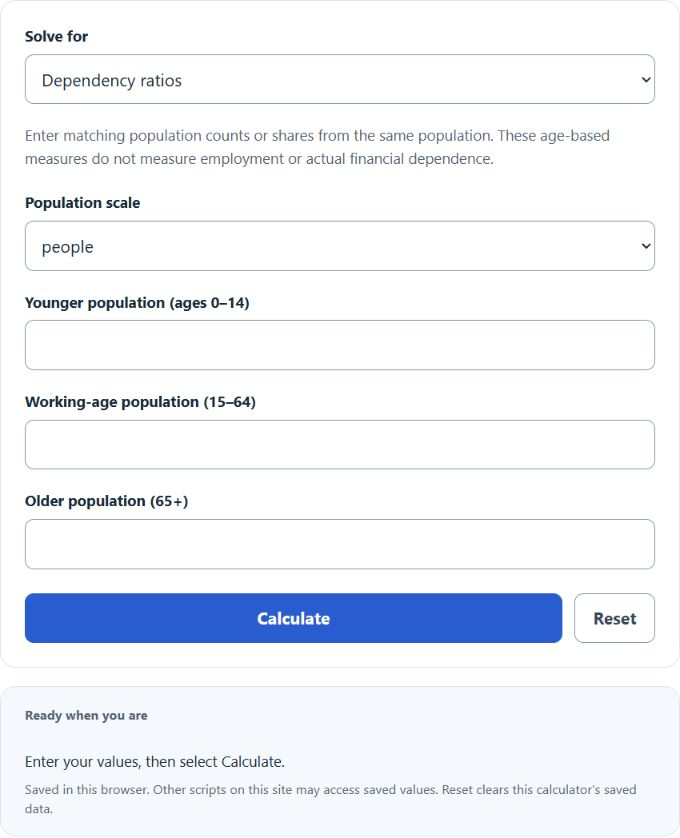
Calculate total, youth, and old-age dependency ratios, potential support and aging indexes, or reverse a population count from a target ratio. The potential support ratio uses working-age people per person aged 65+; a separate measure uses all dependents.
- All Statistics Calculators
- HDI Calculator
- Population Density Calculator
- Population Growth Calculator
- Crude Birth Rate Calculator
- Per 100,000 Population Calculator
Dependency Ratio Formula
The dependency ratio compares the dependent population to the working-age population. It is usually reported as the number of dependents per 100 working-age people.
- Dependency Ratio is the number of dependents per 100 people ages 15 to 64.
- Dependents are people ages 0 to 14 plus people ages 65 and older.
- Working Age Population is the number of people ages 15 to 64.
The calculator takes the number of dependents and divides it by the working-age population. It then multiplies the result by 100 so the answer is expressed per 100 working-age people. You can enter population counts or matching percentages, as long as both inputs use the same basis.
Dependency Ratio Interpretation
The ranges below are illustrative comparisons, not official thresholds or a measure of actual financial burden. Interpretation depends on labor force participation, institutions and the age bands used.
| Dependency ratio | Meaning | Example interpretation |
|---|---|---|
| Below 40 | Lower dependency burden | Fewer than 40 dependents for every 100 working-age people. |
| 40 to 60 | Moderate dependency burden | Between 40 and 60 dependents per 100 working-age people. |
| Above 60 | Higher dependency burden | More than 60 dependents for every 100 working-age people. |
Age Groups Used in the Dependency Ratio
| Age group | Category | Used as |
|---|---|---|
| 0 to 14 | Youth dependent population | Included in dependents |
| 15 to 64 | Working-age population | Used as the denominator |
| 65 and older | Older dependent population | Included in dependents |
Example Dependency Ratio Calculations
Example 1: A population has 30,000 dependents and 60,000 working-age people.
The dependency ratio is 50. This means there are 50 dependents for every 100 working-age people.
Example 2: A population has 18,500 dependents and 50,000 working-age people.
The dependency ratio is 37. This means there are 37 dependents for every 100 working-age people.
Dependency Ratio Calculator FAQ
What does a dependency ratio of 70 mean?
A dependency ratio of 70 means there are 70 dependents for every 100 working-age people. Dependents include people ages 0 to 14 and people ages 65 and older.
Can I use percentages instead of population counts?
Yes. You can use percentages if both inputs are based on the same total population. For example, if dependents are 35% of the population and working-age people are 65%, enter 35 and 65. The result is 53.85 dependents per 100 working-age people.
Is the dependency ratio the same as unemployment?
No. The dependency ratio is based only on age groups. It does not show how many working-age people are actually employed or unemployed. Some people ages 15 to 64 may not be working, and some people 65 or older may still be working.