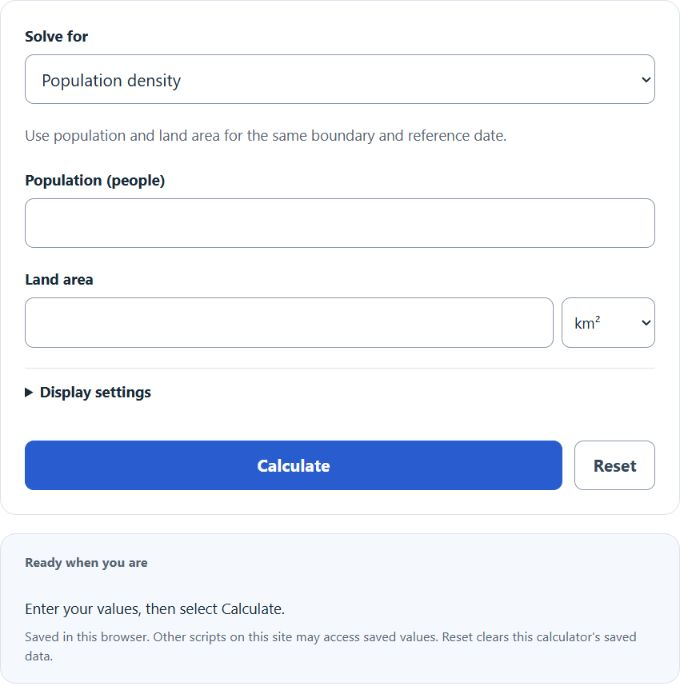
Calculate population density by dividing population by land area in people per km² or square mile, or solve for population or land area from density.
- All Statistics Calculators
- Population Growth Calculator
- Population Proportion Calculator
- Residential Density Calculator
- Housing Density Calculator
- Per 100,000 Population Calculator
Calculator Functions
| Function | What it does | What it requires |
|---|---|---|
| Population density | Finds the average number of people per unit of land area | Requires the population and the land area of the same boundary |
| Population from density and area | Estimates the population of an area from its average density | Requires the population density and the land area |
| Land area from population and density | Finds the land area that a population occupies at a given density | Requires the population and the population density |
Land area can be entered in square kilometers, square miles, hectares, acres, square meters, square feet or square yards, and density in people per any of those units. Every result includes a table of the same area and density in all seven units. Optional display settings change the number of decimal places and switch thousands separators off.
Population Density Formula
| D | Population density (people per unit area) |
| P | Population (people) |
| A | Land area of the same boundary |
The U.S. Census Bureau calculates population density by dividing the total population by the land area, and in the United States states it in people per square mile [1]. Most other countries use people per square kilometer. One square mile is 2.589988 square kilometers, so a density per square mile is 2.59 times the same density per square kilometer.
Population density
The formula applies directly. A city of 8,419,000 people on 302.6 square miles of land has 8,419,000 ÷ 302.6 = 27,822.21 people per square mile, close to the figure of almost 28,000 the Census Bureau gives for New York City [1]. A town of 40,000 people on 92 km² has 434.78 people per km², which is 1,126.08 people per square mile.
Arithmetic density and physiological density
Arithmetic density is another name for population density: all the people divided by all the land [2]. Physiological density divides the same population by the arable land only, and agricultural density divides the number of farmers by the arable land [2]. The calculator works for all three, because only the inputs change. A country of 10,000,000 people with 250,000 km² of land, of which 50,000 km² is arable, has an arithmetic density of 40 people per km² and a physiological density of 10,000,000 ÷ 50,000 = 200 people per km².
Population from density and area
An area of 2,500 km² at 120 people per km² holds 120 × 2,500 = 300,000 people. The density and the area can be in different units, such as people per square mile and square kilometers; the area is converted first. A result that is not a whole number is shown as calculated, with the nearest whole person beside it.
Land area from population and density
A city of 67,500 people with a density of 450 people per square mile covers 67,500 ÷ 450 = 150 square miles, or 388.5 km². The answer is in the area unit of the density entered. Both the population and the density must be above zero.
How to Calculate Population Density
Find the population and the land area for the same boundary and the same date, then divide the population by the area. Use land area, without lakes and other water, to match census figures [1]. A county with 51,430 people and 17.39 square miles of land has 51,430 ÷ 17.39 = 2,957 people per square mile. To change the unit, convert the area before dividing: the same county is 45.04 km², which gives 1,142 people per km².
Limits of This Estimate
- The result is an average over the whole area. People cluster, so density differs from one neighborhood to the next, and overall figures for large areas such as states or countries say little about the density at which people actually live [1].
- Population and land area must describe the same boundary at the same date. Comparing a city proper with a metropolitan area, or figures from different years, gives misleading differences.
- Density alone does not make a place urban or rural. The Census Bureau’s 2020 urban areas are built from census blocks that meet housing unit or population density requirements and must contain at least 2,000 housing units or 5,000 people [3].
- Population from density and area assumes the average density holds across the whole area entered.
Sources
- U.S. Census Bureau, Understanding Population Density: population divided by land area, people per square mile, the New York City figure, and the limits of density for large areas
- Huston R, Dastrup RA, People, Places, and Cultures, Section 2.1 Population, Oklahoma State University Libraries: arithmetic, physiological and agricultural density
- U.S. Census Bureau, Urban and Rural: how 2020 Census urban areas are defined