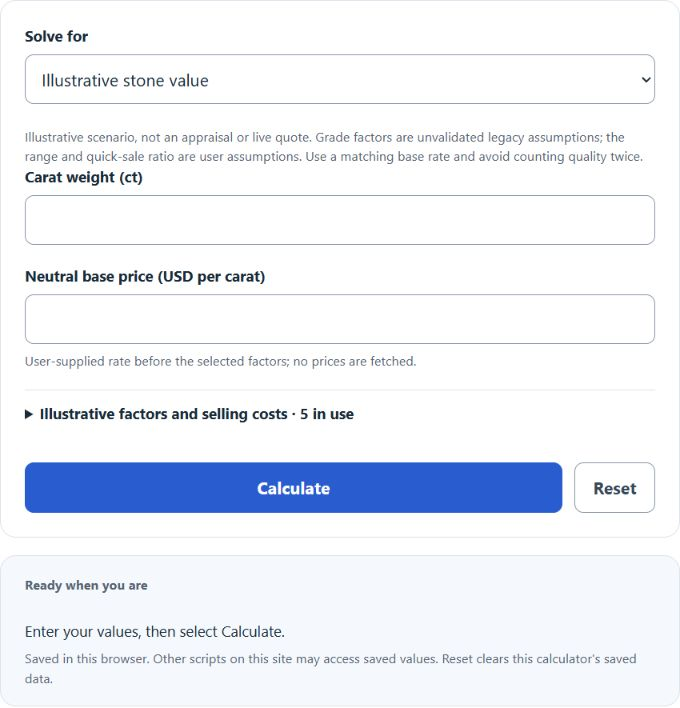
Explore an illustrative diamond-value scenario or required base price per carat using weight, legacy grade factors, selling costs, and your own range and quick-sale assumptions. This is not an appraisal or a live market quote.
Diamond Value Formula
The calculator multiplies a user-supplied neutral price per carat by selected illustrative factors. These inherited factors are not validated market adjustments or GIA pricing recommendations:
V = W * P * F1 * F2 * F3 * F4 * F5
To find the neutral base price per carat needed to support a target value, the same equation is rearranged:
P = V / (W * F1 * F2 * F3 * F4 * F5)
Variables:
- V is illustrative gross stone value before selling costs
- W is stone weight in carats
- P is neutral base price per carat taken from a relevant market comparable
- F1 through F5 are the selected illustrative color, clarity, cut, shape, and origin/report multipliers
The base price per carat is user-supplied. Choose a comparable for the same origin, weight bracket, market, and value purpose; avoid double-counting quality already reflected in that price. The fixed grade factors are illustrative legacy assumptions. The optional range defaults to ±15% and quick-sale share to 68% when blank; both are editable scenario assumptions, not market evidence or confidence bounds. Selling fees and fixed costs default to zero when blank. Negative net proceeds are shown as a shortfall.
Diamond Value Adjustment Reference
The table lists the inherited illustrative factors, not empirically validated prices. Multipliers are applied together, so avoid double-counting a quality feature already included in your base rate. GIA uses Excellent, not Ideal, as its highest cut grade, and its cut grade applies to standard round brilliant diamonds in the D–Z range.
| Adjustment | Benchmark selection | Available multiplier span |
|---|---|---|
| Color grade | H–I (benchmark) | 0.62× to 1.45× |
| Clarity grade | SI1 (benchmark) | 0.52× to 1.55× |
| Cut quality | Good (benchmark) | 0.65× to 1.18× |
| Shape / demand | Oval / emerald / cushion | 0.82× to 1.15× |
| Certification and origin | Natural, independent report | 0.14× to 1.08× |
Example Problems
Example 1: Estimate the value of a 1.20-carat natural diamond.
Assume a neutral comparable price of $4,000 per carat and a combined multiplier of 1.32 after color, clarity, cut, shape, and certification adjustments:
V = 1.20 * 4000 * 1.32 = $6,336.
Example 2: Find the base price per carat required to support an $8,000 estimate for a 1.50-carat stone with a combined multiplier of 1.20:
P = 8000 / (1.50 * 1.20) = $4,444.44 per carat.
Frequently Asked Questions
Does this calculator use live diamond prices?
No. You supply the base price. The controls perform arithmetic with illustrative legacy factors; they do not establish current natural or lab-grown prices or a universal ratio between them.
Why is the result a range instead of one exact price?
The displayed band is simply the gross scenario value plus or minus your assumed percentage (15% when blank). It is not a measured valuation range or confidence interval. A grading report describes quality; a professional appraisal and relevant comparables are needed for an actual value assessment.
Should I use retail price or resale price per carat?
Use a base rate that matches your purpose. Retail comparables estimate replacement or shopping value; completed resale or dealer-bid comparables are better for estimating what an owner may actually receive.