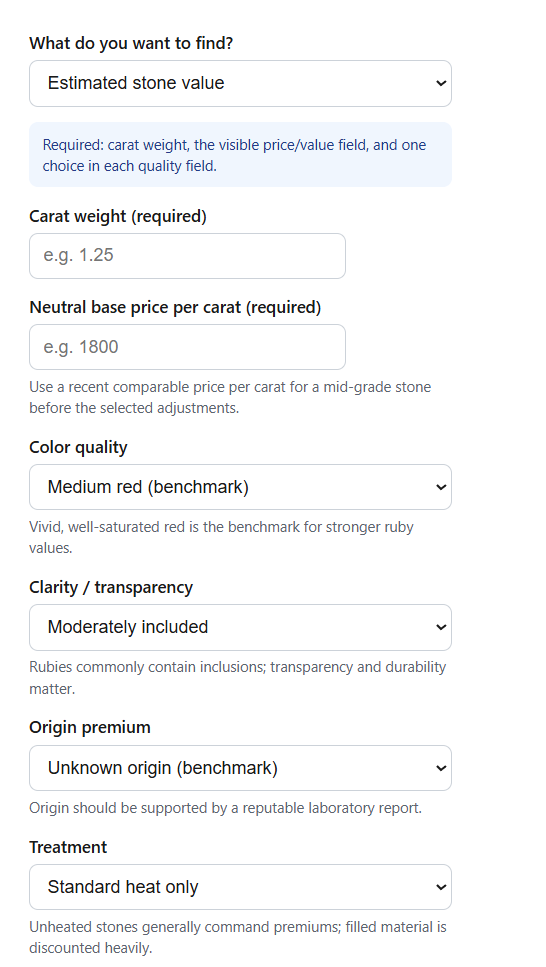
Estimate ruby value or the base price per carat from weight, color, clarity, origin, treatment, cut, certification, selling fees, and resale assumptions.
Ruby Value Formula
The calculator starts with a current neutral price per carat and then adjusts it for the selected stone characteristics:
V = W * P * F1 * F2 * F3 * F4 * F5
To find the neutral base price per carat needed to support a target value, the same equation is rearranged:
P = V / (W * F1 * F2 * F3 * F4 * F5)
Variables:
- V is estimated stone value
- W is stone weight in carats
- P is neutral base price per carat taken from a relevant market comparable
- F1 through F5 are the selected quality, treatment, origin, cut, certification, and demand multipliers
The base price per carat is intentionally user-supplied because gemstone prices change with the market and with the stone’s size bracket. Use a recent comparable that matches the stone type and intended value level, then apply only adjustments that can be supported by a grading report or careful inspection. The result panel also shows an indicative range, a quick-sale reference, and estimated net proceeds after selling costs.
Ruby Value Adjustment Reference
The table summarizes the benchmark and the range available in each adjustment. Multipliers are applied together, so avoid double-counting the same quality feature in the base comparable and again in the selectors.
| Adjustment | Benchmark selection | Available multiplier span |
|---|---|---|
| Color quality | Medium red (benchmark) | 0.48× to 1.60× |
| Clarity / transparency | Moderately included | 0.35× to 1.35× |
| Origin premium | Unknown origin (benchmark) | 0.88× to 1.55× |
| Treatment | Standard heat only | 0.12× to 1.55× |
| Cut and certification | Good cut, no report | 0.62× to 1.18× |
Example Problems
Example 1: Estimate a 1.50-carat ruby using a $1,800 neutral price per carat and a combined quality multiplier of 1.40.
V = 1.50 * 1800 * 1.40 = $3,780.
Example 2: A 2.00-carat ruby is believed to be worth $7,500 and its combined multiplier is 1.25.
P = 7500 / (2.00 * 1.25) = $3,000 per carat.
Frequently Asked Questions
How much does heat treatment affect ruby value?
Standard heat treatment is common, while documented unheated stones can command premiums. Flux healing, diffusion, lead-glass filling, or composite construction can reduce value sharply, so use a laboratory report for an important stone.
Can origin be identified by color alone?
No. Geographic origin is a laboratory opinion based on internal features and chemistry, not a reliable visual guess. Select an origin premium only when a reputable report supports it.
Why can two rubies of the same carat weight have very different values?
Color saturation and tone, transparency, clarity, treatment, origin, cut, and certification all affect price. Larger fine rubies can also rise nonlinearly in price per carat because top material is scarce.