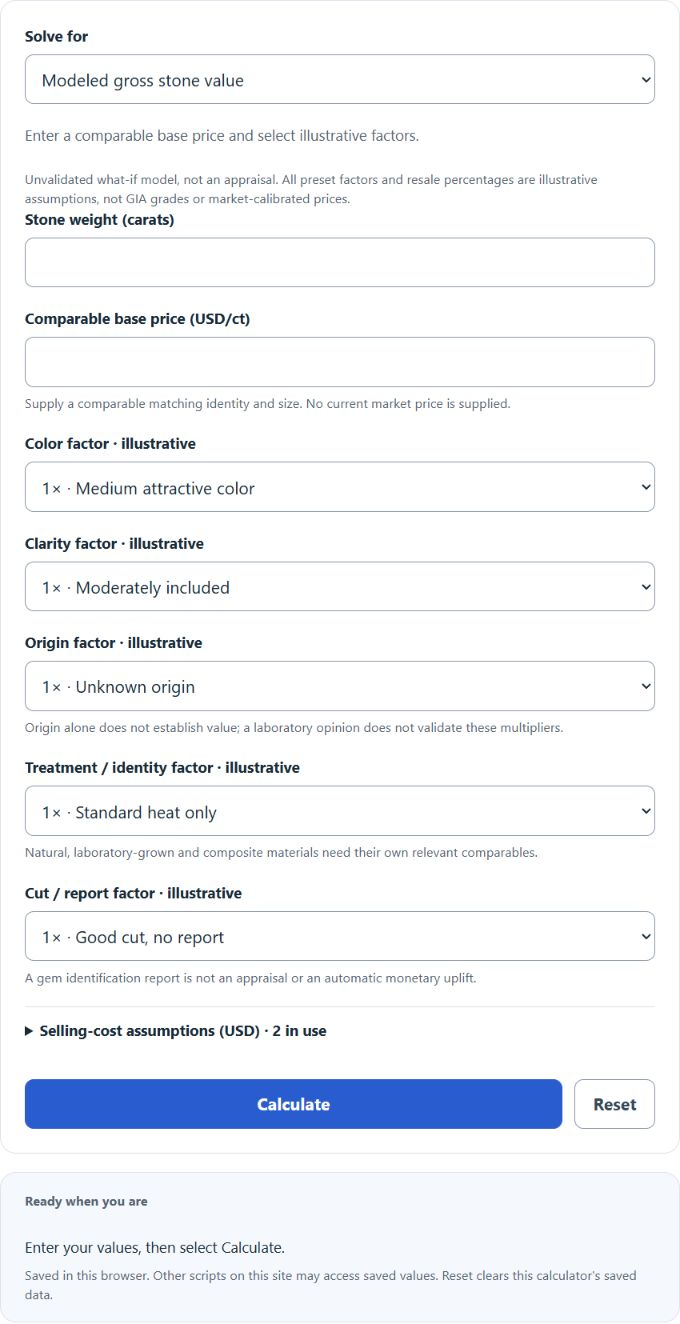
Estimate a sapphire’s value from carat weight, a comparable price per carat and illustrative color, clarity, origin, treatment and cut factors.
Sapphire Value Formula
The calculator uses your comparable base price per carat and multiplies it by the selected illustrative factors. Let F be the product of the five color, clarity, origin, treatment/identity and cut/report factors:
V = W * P * F
For the base price per carat required by this model for a gross target, rearrange the same equation. Selling fees and fixed costs do not change this inverse target:
P = V / (W * F)
Variables:
- V is modeled gross stone value in USD, before selling costs
- W is stone weight in carats
- P is your comparable base price in USD per carat
- F is the product of the five selected illustrative factors: color, clarity, origin, treatment/identity and combined cut/report. There is no separate demand input.
The base price is user-supplied; the calculator supplies no current gemstone prices. A comparable must match identity, size, condition and selling context, and characteristics should not be counted twice. Natural sapphire, laboratory-grown material and composites need relevant comparables of their own. The fixed 78%–122% gross scenario and 62% resale scenario are not an observed market range, confidence interval or quick-sale prediction. Net payout is floored at zero after fees and fixed costs; a separate signed balance and shortfall expose costs above the after-fee value. Fee defaults to an illustrative 12%, fixed costs to 0, and blanks use 0. Money displays round half-up to cents; a positive sub-half-cent amount is marked less than USD 0.01.
Illustrative Sapphire Adjustment Reference
The table preserves this model’s benchmark choices and available preset spans. These numerical factors have not been calibrated to market sales or validated by GIA. A laboratory report does not prove a fixed origin, treatment or cut premium. Multipliers are applied together, so avoid counting the same feature in both the comparable and the selectors.
| Adjustment | Benchmark selection | Available multiplier span |
|---|---|---|
| Color quality | Medium attractive color (benchmark) | 0.50× to 1.55× |
| Clarity / transparency | Moderately included | 0.42× to 1.30× |
| Origin premium | Unknown origin (benchmark) | 1.00× to 1.65× |
| Treatment | Standard heat only | 0.18× to 1.50× |
| Cut and certification | Good cut, no report | 0.62× to 1.18× |
Example Problems
Example 1: For illustrative arithmetic, enter 2.00 carats, a USD 1,200 base price per carat and a combined factor of 1.35. That product can be selected with the 1.25 origin preset and 1.08 cut/report preset, with all other factors at 1. These are example assumptions, not supported market premiums.
V = 2.00 * 1200 * 1.35 = $3,240.
Example 2: For a 1.50-carat stone, enter a gross target of USD 4,500 and an illustrative combined factor of 1.25 (the origin preset at 1.25, all others at 1). This target is before fees and fixed costs.
P = 4500 / (1.50 * 1.25) = $2,400 per carat.
Frequently Asked Questions
Does sapphire color matter more than clarity?
GIA describes color as a major value factor alongside clarity, cut and carat weight. Desirability depends on the sapphire and its context; those qualitative observations do not establish this model’s numerical presets. See the GIA sapphire buyer’s guide.
What is the difference between heated and unheated sapphire?
Heat and other treatments can affect how a stone is described and compared. Natural, laboratory-grown and composite identities are distinct; this calculator’s treatment/identity factors are illustrative only. GIA does not grade sapphire. Its reports identify characteristics and detectable treatments, with geographic origin opinions where possible; they are not appraisals.
Does an origin report prove a fixed premium?
No. An origin opinion can support identification, but does not validate the preset multiplier or guarantee added value. GIA notes that material from a prized origin need not receive added value when its quality is poor. Compare like stones rather than inferring a price from origin alone; see GIA’s discussion of colored-stone value factors.