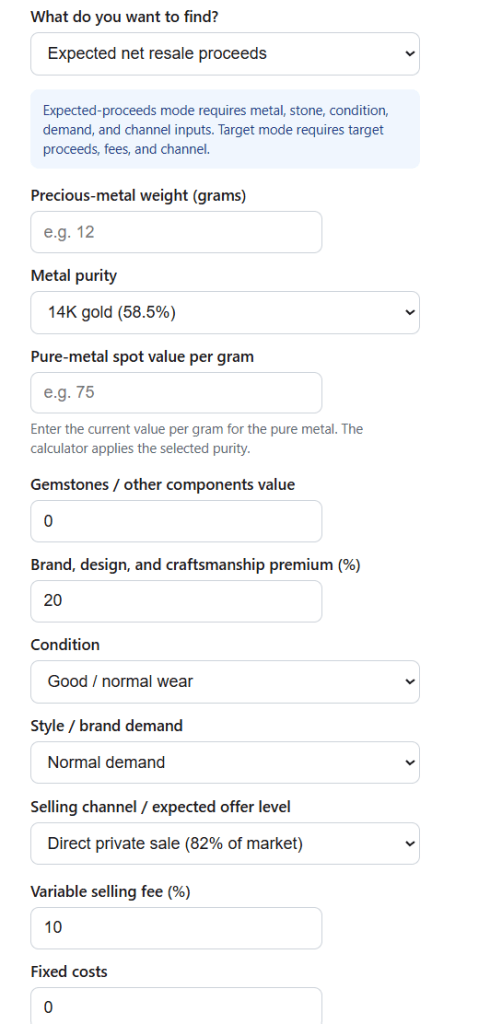
Estimate jewelry resale value and net proceeds from metal purity, gemstone value, brand premium, condition, demand, selling channel, and transaction fees.
Jewelry Resale Value Formula
The calculator first estimates the intrinsic value of the precious metal and any separately estimated gemstones:
M = W * P * S
 I = M + G
It then applies design, condition, demand, and selling-channel adjustments before subtracting selling costs:
V = I * (1 + B) * C * D
 Gross = V * H
 Net = Gross * (1 - f) - K
Variables:
- M is precious-metal intrinsic value
- W is metal weight in grams
- P is metal purity as a decimal
- S is the current pure-metal value per gram
- I is total intrinsic component value
- G is the separately estimated gemstone or component value
- B is the brand, design, and craftsmanship premium as a decimal
- C is the condition multiplier
- D is the demand multiplier
- H is the selected selling-channel factor
- f is the variable selling fee
- K is fixed authentication, repair, shipping, or transaction cost
The reverse mode starts with target net proceeds and works backward through the fee and channel assumptions to show the gross sale price and open-market value required. Do not include the weight of stones, non-precious findings, or watch movements in the precious-metal weight.
Jewelry Resale Channel Reference
A resale estimate depends not only on the jewelry but also on how it is sold. The factors below are editable model assumptions represented by the calculator’s channel choices, not guaranteed offers.
| Selling route | Example channel factor | Typical trade-off |
|---|---|---|
| Direct private sale | 0.82 | More work and risk, but a larger share of market value |
| Consignment / marketplace | 0.68 | Broader exposure with commission, payment, or return costs |
| Jeweler / estate buyer | 0.48 | Faster transaction with a wholesale margin |
| Pawn / immediate cash | 0.35 | Fast liquidity, usually the lowest offer level |
Example Problems
Example 1: A 12-gram 14K gold piece uses a pure-gold value of $75 per gram. It contains stones estimated at $600, receives a 20% design premium, and has benchmark condition and demand.
M = 12 * 0.585 * 75 = $526.50. I = 526.50 + 600 = $1,126.50. V = 1126.50 * 1.20 = $1,351.80.
Using a direct-sale factor of 0.82 and a 10% fee, estimated net proceeds are 1351.80 * 0.82 * 0.90 = $997.63.
Example 2: You want $1,500 after a 12% selling fee and $50 of fixed costs.
Required gross sale price = (1500 + 50) / (1 – 0.12) = $1,761.36. At a 0.68 marketplace channel factor, the implied open-market value is $2,590.24.
Frequently Asked Questions
Should I use total jewelry weight as metal weight?
No. Subtract gemstones, beads, non-precious components, watch movements, and other materials when possible. A jeweler or refiner can provide a more reliable metal-weight and purity test.
Why is an appraisal value usually higher than resale value?
Insurance appraisals often estimate retail replacement cost, while resale value reflects what a buyer will pay after dealer margin, selling friction, authentication, and market demand. Use a resale-oriented gemstone input for this calculator.
How should branded jewelry be handled?
Use recent completed sales for the exact maker, collection, model, material, and size. A recognized signature, serial number, original packaging, receipt, and authentication can support a premium, while an uncertain attribution should not.