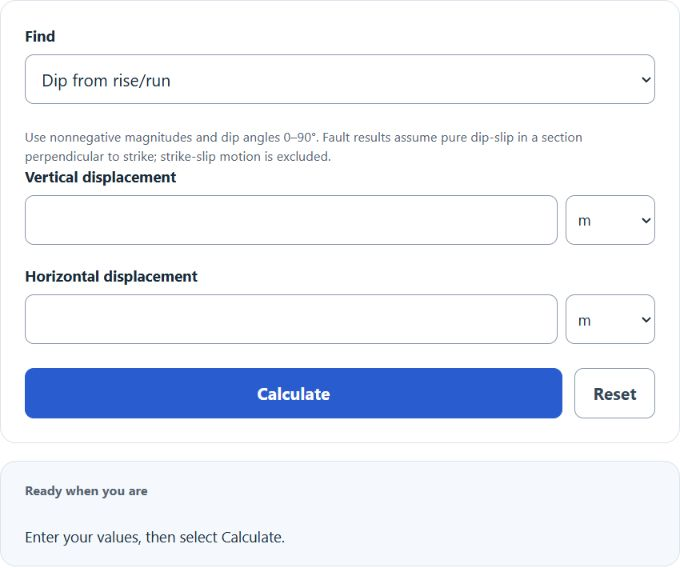
Calculate dip angle from nonnegative vertical and horizontal displacement, true or apparent dip, and fault dip-slip displacement components. Fault calculations assume pure dip-slip motion in a section perpendicular to strike.
- All Construction Calculators
- Hopper Angle Calculator
- Ideal Banking Angle Calculator
- Angle to Slope Calculator
- Slope to Degrees Calculator
- Vertical Angle Calculator
- Angle of Elevation Calculator
Dip Angle Formula
The following formula is used to calculate the dip angle for a given vertical and horizontal displacement.
Variables:
- (theta) is the dip angle in degrees
- V is the vertical displacement
- H is the horizontal displacement
For positive horizontal displacement, take arctan(V/H) and convert radians to degrees. Use the same length units for both magnitudes. Zero horizontal displacement with positive vertical displacement gives 90°; both zero cannot determine an angle.
What is a Dip Angle?
A dip angle, also known as the angle of dip, is the angle formed between the horizontal plane and the inclined surface. It is commonly used in geology to describe the orientation of rock layers, faults, and other geological structures. The dip angle is measured in degrees and indicates the steepness of the slope. A higher dip angle means a steeper slope, while a lower dip angle indicates a gentler slope. Understanding the dip angle is crucial for various applications, including construction, mining, and geological mapping.
How to Calculate Dip Angle?
The following steps outline how to calculate the Dip Angle.
- First, determine the vertical displacement (V).
- Next, determine the horizontal displacement (H).
- Next, calculate θ = arctan(V/H) in degrees for H > 0.
- Finally, calculate the Dip Angle.
- After inserting the values and calculating the result, check your answer with the calculator above.
Example Problem :
Use the following variables as an example problem to test your knowledge.
Vertical Displacement (V) = 10 meters
Horizontal Displacement (H) = 5 meters