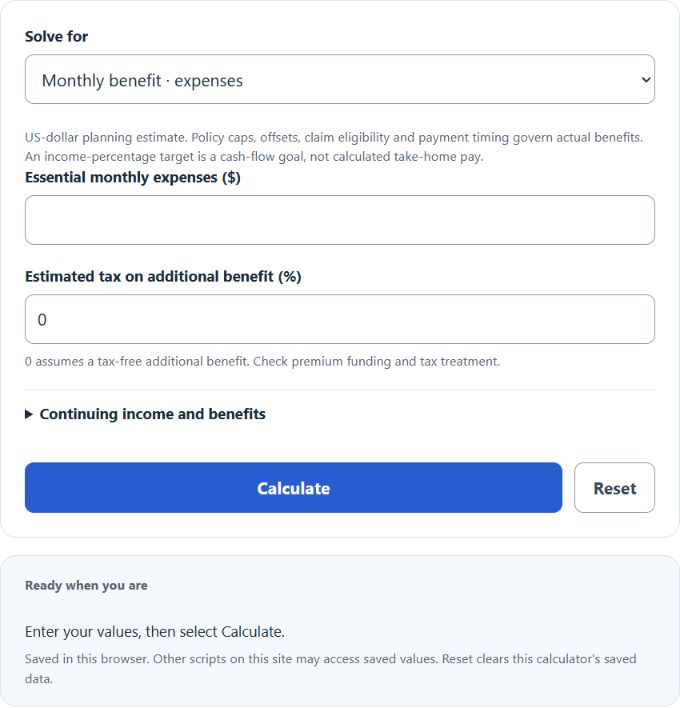
Disability insurance needs calculator to estimate monthly benefit gaps or waiting-period reserves from income, expenses, taxes, other benefits, and savings.
Disability Insurance Needs Formula
The ongoing benefit need starts with a target monthly cash flow and subtracts income or benefits that would continue during disability:
Net Benefit Gap = max(0, Target Monthly Need - Other After-Tax Income - Existing After-Tax Disability Benefits)
When disability benefits are expected to be taxable, the gross benefit needed is increased for the estimated tax rate:
Gross Benefit Needed ≈ Net Benefit Gap / (1 - Benefit Tax Rate / 100)
The waiting-period reserve multiplies the monthly gap before benefits by an average-month approximation: 30.4375 days = 365.25 / 12. Actual policy payment timing can differ.
Reserve Needed ≈ Monthly Waiting-Period Gap * Elimination Days / 30.4375
Reserve Shortfall = max(0, Reserve Needed - Available Savings)
Variables:
- Target Monthly Need is either essential expenses or a selected percentage of gross income
- Other Income is after-tax household income available during the modeled period
- Existing Disability Benefits are the after-tax amounts available after the waiting period and applicable offsets
- Benefit Tax Rate is the estimated tax rate on the additional proposed benefit only
- Elimination Days is the time between disability and the start of benefits
Whether benefits are taxable often depends on who paid the premiums and how they were paid. Enter continuing income and existing benefits after tax and applicable offsets. Apply the entered tax rate only to the additional proposed benefit; 0 assumes that additional benefit is tax-free.
Disability Benefit Reference
The table shows the gross monthly benefit required when the desired after-tax benefit gap is subject to different tax rates.
| Net monthly gap | 0% tax | 15% tax | 25% tax |
|---|---|---|---|
| $2,000 | $2,000 | $2,353 | $2,667 |
| $3,000 | $3,000 | $3,529 | $4,000 |
| $4,000 | $4,000 | $4,706 | $5,333 |
| $5,000 | $5,000 | $5,882 | $6,667 |
Example Problems
Example 1: Size an additional monthly benefit.
Gross monthly income is $9,000 and the cash-flow target is 60% of gross income, or $5,400. Other household income after tax is $1,000 and an employer policy provides $2,000 monthly after tax and applicable offsets.
The net additional gap is $2,400. If the additional benefit is expected to be tax-free, the modeled benefit need is $2,400 per month.
Example 2: Fund a 90-day elimination period.
Essential expenses are $5,500 per month, other household income is $1,000, and the policy has a 90-day waiting period.
The monthly gap is $4,500 and 90 days is about 2.96 months, creating a reserve need near $13,306 before available savings.
Frequently Asked Questions
How much income does disability insurance usually replace?
Disability policies generally replace only part of prior earnings. Contract limits, offsets, tax treatment and eligibility rules determine actual benefits; this calculator does not determine an available coverage limit.
What is an elimination period?
It is the waiting period after a qualifying disability begins and before policy benefits become payable. A longer elimination period can reduce premiums but requires a larger cash reserve.
Should I base coverage on income or expenses?
Use the expenses method to protect essential household cash flow. Use the replacement method when you want a stated share of income for broader lifestyle and savings goals, subject to insurer limits.