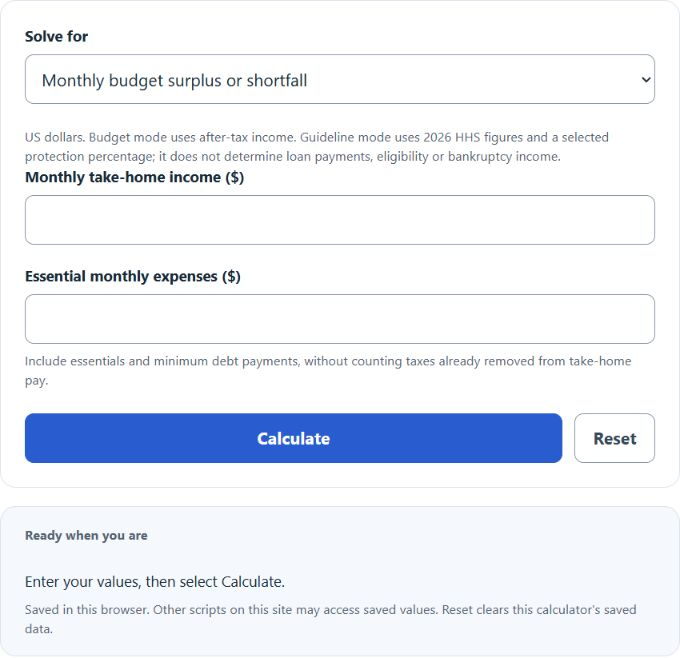
Estimate monthly take-home pay minus essentials, or compare annual AGI with a selected percentage of the 2026 HHS poverty guideline.
Discretionary Income Formula
In everyday budgeting, discretionary income is what remains of your take-home pay after essential living costs:
D = N - E
A poverty-guideline illustration instead compares annual AGI with a selected protection percentage. It is not a complete repayment or eligibility calculation:
D = max(0, AGI - (P * G))
Variables:
- D is discretionary income (per month in the everyday formula, per year in the federal formula)
- N is monthly take-home (after-tax) income and E is essential monthly expenses
- AGI is adjusted gross income from your tax return
- G is the 2026 HHS guideline for the selected family size and region. In the 48 contiguous states and D.C., use $15,960 for one person plus $5,680 for each additional person; separate Alaska and Hawaii figures apply.
- P is the selected protection multiplier: 1.5 for a 150% illustration or 1.0 for 100%. Confirm the applicable program definition; this is not a bankruptcy means test.
Choose the mode at the top. Budget mode returns a surplus or shortfall and annual/weekly equivalents; shares are undefined when income is zero. Guideline mode returns annual and monthly equivalents and a separate 10% monthly illustration, not an actual loan payment.
2026 Poverty Guidelines by Household Size
These are the 2026 HHS guidelines for the 48 contiguous states and D.C., with a 150% illustration. See HHS ASPE poverty guidelines. The applicable protection percentage, year and family-size definition depend on the program.
| Household size | Guideline (100%) | Protected at 150% |
|---|---|---|
| 1 | $15,960 | $23,940 |
| 2 | $21,640 | $32,460 |
| 3 | $27,320 | $40,980 |
| 4 | $33,000 | $49,500 |
| 5 | $38,680 | $58,020 |
| 6 | $44,360 | $66,540 |
Example Problems
Example 1: Everyday discretionary income.
Take-home pay is $4,800 per month and essentials total $3,100:
D = 4,800 - 3,100 = $1,700 per month, about 35% of take-home pay, or $20,400 per year to direct at wants, extra savings, and extra debt payments.
Example 2: Federal discretionary income for student loans.
AGI is $60,000, household of 2, in the 48 contiguous states, at 150%:
Using 2026 guidelines, G = 15,960 + 5,680 = $21,640. At 150%, the protected amount is $32,460 and D = max(0, 60,000 − 32,460) = $27,540 per year. A 10% monthly illustration is $229.50; actual repayment rules may differ.
Frequently Asked Questions
What is the difference between disposable and discretionary income?
Disposable income is what remains after taxes - essentially your take-home pay. Discretionary income goes one step further and also subtracts necessities like housing, food, and insurance. Disposable pays for everything; discretionary is what is genuinely free to allocate.
Which expenses count as essential?
Housing, utilities, groceries, transportation to work, insurance, childcare you cannot skip, and minimum debt payments. Streaming services, dining out, hobbies, and vacations are discretionary by definition - the test is whether the spending could stop next month without breaking your household or your credit.
Why does my student loan servicer calculate a different number?
Servicers apply the rules for your actual plan and recertification, including the applicable guideline year, family size, income and any caps. This calculator uses 2026 HHS guidelines with a selected protection percentage and a separate 10% illustration. It does not determine eligibility or an actual payment; confirm current terms with Federal Student Aid and your servicer.