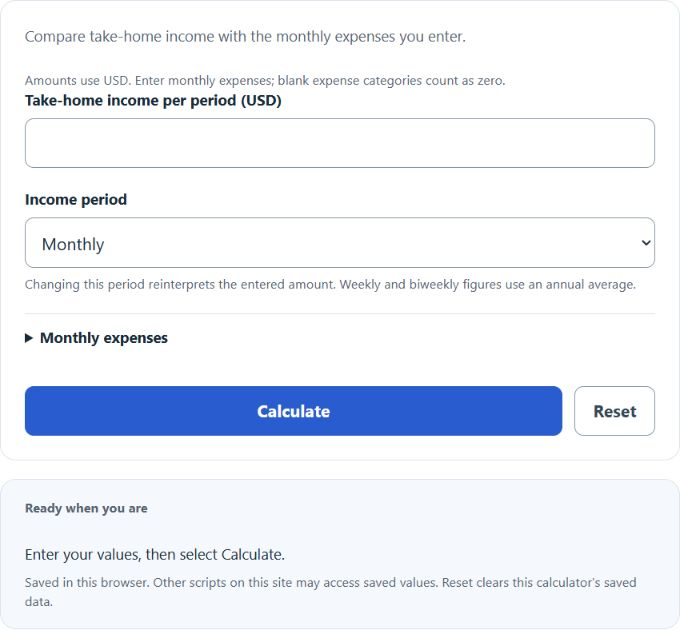
Enter take-home income and monthly expenses to see the unallocated balance or deficit and each category’s share of income. A remainder is not automatically saved.
Monthly Budget Formula
The calculator converts your income to a monthly figure, totals your expenses, and shows what is left:
L = I - (E1 + E2 + ... + En)
Variables:
- L is the money left over each month (a negative result is a monthly deficit)
- I is your monthly take-home income. Biweekly pay is converted as pay x 26 / 12, weekly pay as pay x 52 / 12, and annual pay as pay / 12
- E1 through En are your monthly expenses by category: housing, utilities and bills, groceries and food, transportation, insurance and healthcare, debt payments, subscriptions and fun, and everything else
Select your income period and enter take-home pay in USD, then enter whichever monthly expense categories apply. Blank expense categories count as zero. Weekly and biweekly income use annual averages of 52 and 26 pay periods, divided by 12; choose Monthly for actual income in a specific month. The result shows the unallocated balance or deficit and income shares, not measured savings. With zero income, percentages are unavailable.
Illustrative Budget Shares of Take-Home Pay
These ranges are independent arithmetic illustrations, not recommendations or typical-household data. They do not form a complete allocation: choosing all upper bounds would exceed 100%. Use your actual monthly expenses. Budget rules of thumb can be adapted to individual circumstances; see the CFPB spending worksheet.
| Category | Illustrative share | On $4,500/month |
|---|---|---|
| Housing | 25% – 35% | $1,125 – $1,575 |
| Utilities & bills | 5% – 10% | $225 – $450 |
| Groceries & food | 10% – 15% | $450 – $675 |
| Transportation | 10% – 15% | $450 – $675 |
| Insurance & healthcare | 5% – 10% | $225 – $450 |
| Debt payments | 0% – 10% | $0 – $450 |
| Subscriptions & fun | 5% – 10% | $225 – $450 |
| Possible leftover allocation | 15% – 20%+ | $675 – $900+ |
Example Problems
Example 1: A monthly budget with a surplus.
Your take-home pay is $2,250 biweekly. Monthly income = 2,250 x 26 / 12 = $4,875. Your expenses are $1,500 housing, $300 utilities, $650 food, $400 transportation, $250 insurance, $200 debt, and $300 fun, totaling $3,600.
L = 4,875 – 3,600 = $1,275 left over each month, an unallocated share of about 26%. This is available surplus, not a record of actual saving.
Example 2: Spotting a deficit.
Monthly income is $3,800 and expenses total $4,050. L = 3,800 – 4,050 = -$250, a monthly deficit. Review the actual category amounts and commitments; these totals alone do not determine a housing percentage or a suitable expense to reduce.
Frequently Asked Questions
Should I budget with gross or take-home income?
Use take-home (net) income: the amount received after taxes and payroll deductions. Deductions vary, so use actual net pay. Contributions already deducted from pay are outside this calculator’s take-home cash-flow estimate; do not subtract them again as monthly cash expenses.
What should I do with the leftover amount?
Choose an allocation based on upcoming bills, irregular costs, cash reserves, debts and your own goals. The calculator does not establish an order of priorities or count an unallocated remainder as money already saved.
How much should I keep for irregular expenses?
Annual and surprise costs – car repairs, gifts, insurance premiums – are the most common budget breakers. A practical fix is a sinking fund: total your irregular costs for the year, divide by 12, and set that amount aside monthly so those bills never feel like emergencies.