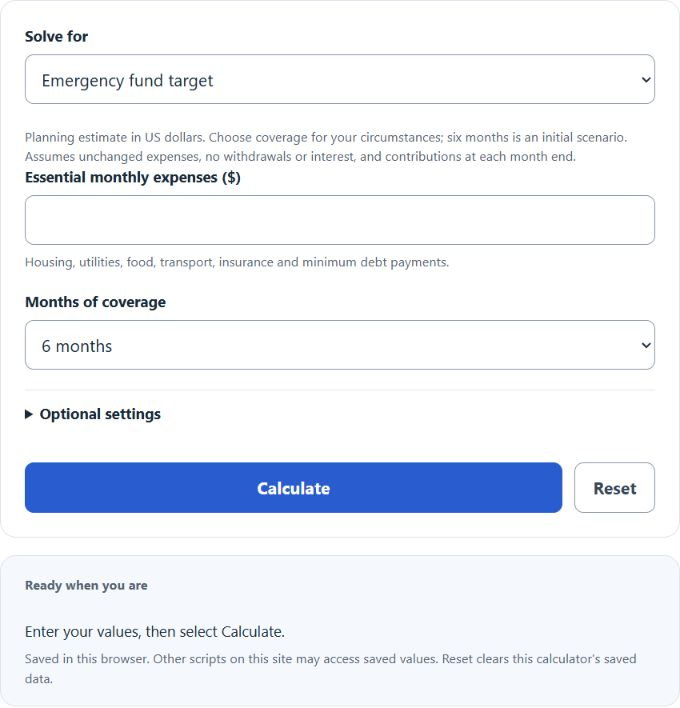
Size your fund at 3-12 months of essential expenses and see how long reaching your savings target will take each month.
Emergency Fund Formula
The calculator sizes your fund by multiplying essential monthly expenses by the months of coverage you want:
T = E * M
To estimate how long it will take to get there, it divides what you still need by your monthly contribution:
t = ceil(max(0, T - S) / C)
Variables:
- T is the emergency fund target, in dollars
- E is your essential monthly expenses - housing, utilities, food, transportation, insurance, and minimum debt payments
- M is the months of coverage (3, 6, 9, 12, or a custom number)
- S is what you have already saved, and C is your monthly contribution
- t is the number of months to reach the target, rounded up
Pick what you want to find at the top. "How big my fund should be" returns the target, the gap remaining, and how many months your current savings already cover. "How long it will take" adds your monthly contribution and returns the timeline, plus how much faster it goes if you double the contribution. The estimate ignores interest, which keeps it slightly conservative.
Coverage Scenarios
The appropriate amount depends on your circumstances, essential costs and possible emergencies. These are illustrative coverage scenarios, not recommendations for specific household types.
| Situation | Coverage | Target at $3,200/mo essentials |
|---|---|---|
| 3-month scenario | 3 months | $9,600 |
| 6-month scenario | 6 months | $19,200 |
| 9-month scenario | 9 months | $28,800 |
| 12-month scenario | 12 months | $38,400 |
| Starter fund while paying off high-interest debt | $1,000 - 1 month | $1,000 - $3,200 |
Example Problems
Example 1: Sizing the fund.
Your essential expenses are $3,200 per month and you want 6 months of coverage:
T = 3,200 x 6 = $19,200. If you already have $5,000 saved, the gap is $14,200, and your current savings cover about 1.6 months.
Example 2: Timeline to reach it.
You need $14,200 more and can save $400 per month:
t = 14,200 / 400 = 35.5, rounded up to 36 months, or 3 years. At $800 per month the timeline drops to 18 months.
Frequently Asked Questions
Why essential expenses instead of income?
An emergency fund exists to cover your bills when income stops, so it should be sized to what you must spend, not what you earn. Using essential expenses also means the target stays realistic: someone who earns $8,000 but needs only $3,500 to keep the household running does not need to bank six months of full paychecks.
Where should I keep an emergency fund?
In a high-yield savings account or money market account - somewhere liquid, FDIC-insured, and separate from your everyday checking. It should be reachable in a day or two but not visible next to your spending money. Investing it in stocks defeats the purpose, because market drops and job losses tend to arrive together.
Should I build the fund before paying off debt?
A common approach is a starter fund of $1,000 to one month of essentials first, then attack high-interest debt, then build toward the full 3-6 months. Without any cushion, a single surprise bill tends to land right back on the credit card you are trying to pay off.