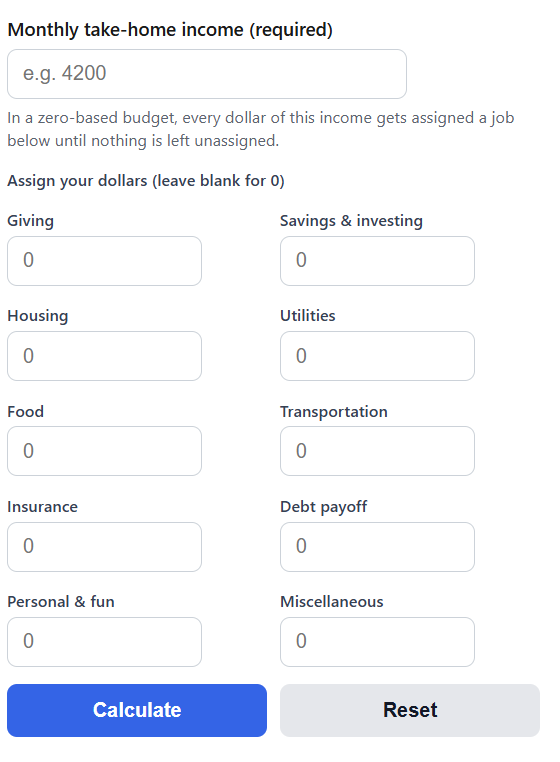
Assign every dollar of monthly income to a category and instantly see what’s left to assign or where you are over budget.
Zero-Based Budget Formula
A zero-based budget assigns every dollar of income a job before the month begins, so that:
I - (A1 + A2 + ... + An) = 0
Variables:
- I is your monthly take-home income
- A1 through An are your category assignments: giving, savings and investing, housing, utilities, food, transportation, insurance, debt payoff, personal and fun, and miscellaneous
- The goal is a difference of exactly zero - no unassigned dollars, and no over-assignment
Enter your income and assign amounts to each category. The calculator totals the assignments and reports one of three outcomes: money still left to assign (give it a job - extra savings and debt payoff are the usual candidates), a perfect zero (every dollar has a job), or over-assignment (your plan spends more than you earn and needs trimming). The table shows every category's share of income so you can sanity-check the plan.
Sample Zero-Based Budget on $4,200/Month
One way a completed zero-based budget can look. Every row is a deliberate assignment, and the total equals income exactly.
| Category | Assigned | Share of income |
|---|---|---|
| Housing | $1,300 | 31% |
| Utilities | $250 | 6% |
| Food | $550 | 13% |
| Transportation | $380 | 9% |
| Insurance | $270 | 6% |
| Debt payoff | $400 | 10% |
| Savings & investing | $630 | 15% |
| Giving | $100 | 2% |
| Personal & fun | $220 | 5% |
| Miscellaneous | $100 | 2% |
| Total | $4,200 | 100% |
Example Problems
Example 1: Finding the unassigned amount.
Income is $4,200. You assign $1,300 housing, $250 utilities, $550 food, $380 transportation, $270 insurance, $400 debt, and $220 fun - a total of $3,370:
4,200 - 3,370 = $830 left to assign. Directing $630 to savings, $100 to giving, and $100 to miscellaneous brings the difference to zero.
Example 2: Catching over-assignment.
Income is $3,500 but assignments total $3,720. The difference is -$220, so the plan over-spends by $220 and categories must be trimmed until the total matches income.
Frequently Asked Questions
Does zero-based budgeting mean my bank account hits zero?
No - it means every dollar has a named purpose, including the dollars assigned to savings. Your account balance can grow every month; what hits zero is the amount of income without a job. It is a planning discipline, not a spend-it-all instruction.
What if my income varies month to month?
Budget on your lowest realistic month. In stronger months, the extra income becomes one more assignment decision - top up savings, prepay debt, or fund next month's buffer. Many variable earners build a one-month cushion first, then live on last month's income.
How is this different from a regular monthly budget?
A regular budget totals expenses and looks at what is left over; zero-based budgeting requires you to allocate that leftover too, before the month starts. The difference sounds small but changes behavior - unassigned money quietly disappears, while assigned money tends to reach its destination.