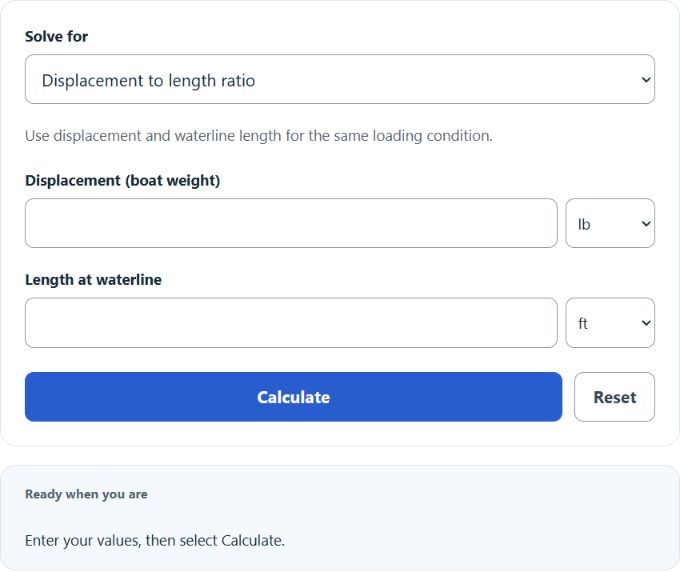
Calculate a boat’s displacement-to-length ratio, displacement, or waterline length using an explicit solve mode with weight and length unit options.
- All Physics Calculators
- All Ratio Calculators
- Length to Beam Ratio Calculator
- Height to Base Ratio Calculator
- Slenderness Ratio Calculator
Displacement to Length Ratio Formula
The displacement to length ratio, often written as DLR or D/L ratio, compares a boat’s displacement to its waterline length. The calculator uses long tons for displacement and feet for length at waterline.
To calculate displacement when DLR and LWL are known:
To calculate length at waterline when displacement and DLR are known:
- DLR = displacement to length ratio, a dimensionless ratio
- DispLT = displacement in long tons
- LWLft = length at waterline in feet
- 0.01 * LWL = waterline length divided by 100, used in the standard DLR formula
Select the value to solve for, then enter the two required measurements. If you enter displacement and LWL, it calculates DLR. If you enter DLR and LWL, it calculates displacement. If you enter displacement and DLR, it calculates LWL. Unit selections are converted internally to long tons and feet before the formula is applied.
Typical Displacement to Length Ratio Ranges
DLR is commonly used to describe how light or heavy a sailboat is for its waterline length. Lower values generally indicate lighter displacement relative to length.
| DLR Range | General Category | Typical Meaning |
|---|---|---|
| Under 100 | Ultra-light | Very light for its length, often performance-oriented |
| 100 to 200 | Light | Moderate to light displacement, common in faster cruising or racing designs |
| 200 to 300 | Moderate | Balanced cruising range for many monohull sailboats |
| 300 to 400 | Heavy | Heavier cruising designs with more displacement for their length |
| Over 400 | Very heavy | Traditional heavy-displacement designs or short waterline boats |
Unit Conversions Used for DLR
| Input Type | Unit | Conversion Used |
|---|---|---|
| Displacement | Pounds | 1 long ton = 2,240 lb |
| Displacement | Kilograms | 1 long ton = 1,016.0469088 kg |
| Length | Meters | 1 m = 3.280839895 ft |
| Length | Inches | 12 in = 1 ft |
Example Problems
Example 1: Calculate DLR
A boat has a displacement of 14,000 lb and a waterline length of 30 ft.
First convert displacement to long tons:
Apply the DLR formula:
The displacement to length ratio is 231.48.
Example 2: Calculate Displacement
A boat has a DLR of 180 and a waterline length of 35 ft.
Convert long tons to pounds:
The displacement is 17,287.2 lb.
FAQ
What does a lower displacement to length ratio mean?
A lower DLR means the boat is lighter relative to its waterline length. In general, lighter boats need less power or sail force to move, may accelerate more easily, and are often associated with performance-oriented designs. DLR does not describe everything about speed or comfort because hull shape, ballast, beam, sail area, and loading also matter.
Should I use LOA or LWL for the calculation?
Use length at waterline, or LWL. The standard DLR formula is based on waterline length, not length overall. Using LOA instead of LWL can make the ratio appear lower than it should, especially on boats with long overhangs.
Is displacement the same as boat weight?
For this calculation, displacement is treated as the boat’s weight. It should represent the weight of the water displaced by the boat, which equals the boat’s weight in floating condition. Use the displacement value that matches the loading condition you want to evaluate, such as lightship displacement or loaded cruising displacement.