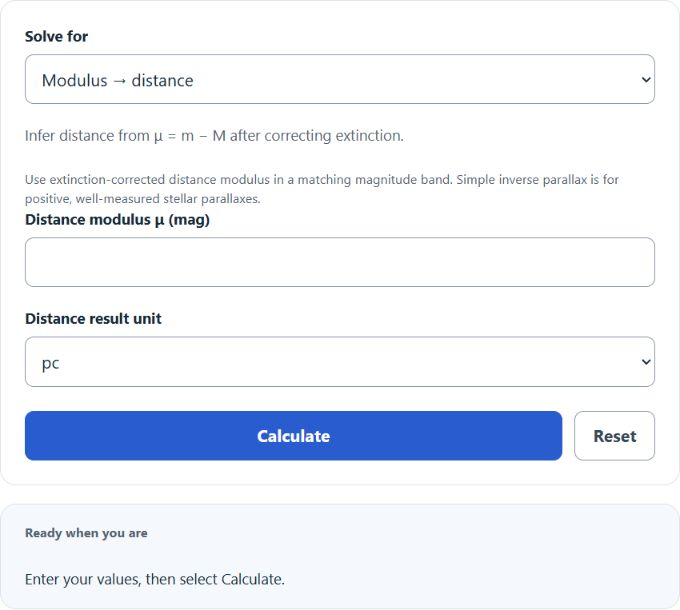
Calculate distance modulus, distance in parsecs, or parallax to distance using μ, kpc, Mpc, ly, km, arcseconds, mas, or μas values.
- All Physics Calculators
- Absolute Magnitude Calculator
- Parallax Angle Calculator
- Light Intensity Calculator
- Luminosity Radius Temperature Calculator
Distance Modulus Formula
The following formula is used to calculate a distance modulus.
- Where m-M is the distance modulus
- r is the positive distance from the observer to the object in parsecs
To calculate a distance modulus, take the base-10 logarithm of the distance in parsecs divided by 10, then multiply by 5.
What is a distance modulus?
Definition:
Distance modulus is the difference between apparent magnitude m (corrected for extinction) and absolute magnitude M in the same band. It relates to distance through μ = 5 log₁₀(r/10 pc).
Distance modulus is used to understand the distance of extragalactic objects that are extremely far away in relative terms.
How to calculate distance modulus?
Example problem:
The following example outlines how to calculate a distance modulus.
First, determine the distance from the observer to the object in parsecs. For this example, the object is 25 parsecs away.
Next, use the formula above to calculate the distance modulus.
m − M = 5*log10(r/10)
m − M = 5*log10(25/10)
m-M = 1.9897