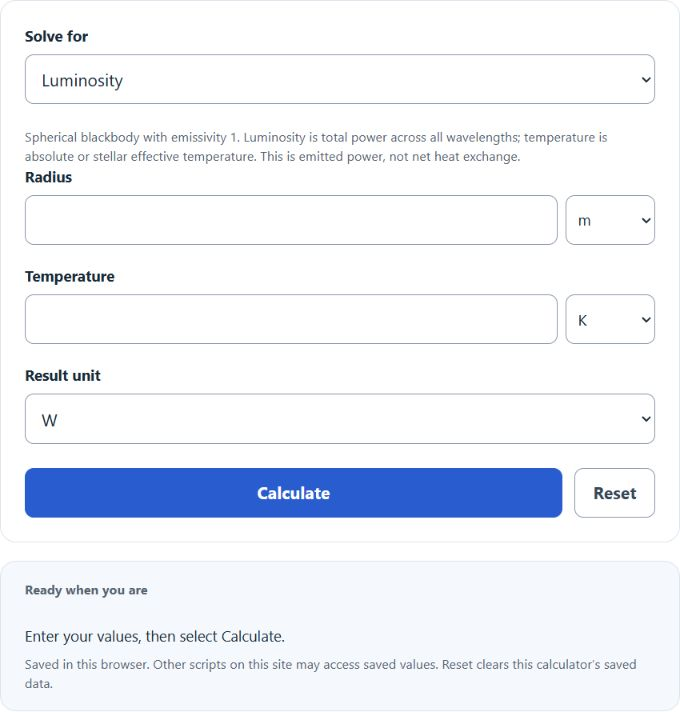
Calculate luminosity, radius or temperature from the other two values using the Stefan-Boltzmann formula and unit conversions for W, m and K as needed.
Related Calculators
- Initial Temperature Calculator
- Polarization Calculator
- Tidal Force Calculator
- Heat of Condensation Calculator
- All Physics Calculators
Luminosity Radius Temperature Formula
The calculator uses the Stefan-Boltzmann law for a spherical blackbody radiator. Choose the quantity to solve and enter the other two values. Luminosity is bolometric power and temperature is blackbody or stellar effective temperature; this is not net heat transfer.
To calculate radius:
To calculate temperature:
- L = luminosity, in watts (W)
- R = radius, in meters (m)
- T = absolute temperature, in kelvin (K)
- sigma = Stefan-Boltzmann constant, approximately 5.670374419 × 10⁻⁸ W/(m2 K4)
- pi ≈ 3.141592653589793
The luminosity function calculates total radiated power from radius and temperature. The radius function solves for the size needed to produce a given luminosity at a given temperature. The temperature function solves for the blackbody temperature needed for a given luminosity and radius.
Unit selections are converted to base units before the formula is applied: luminosity to watts, radius to meters, and temperature to kelvin. The result is then converted back to your selected output unit.
Common Units and Base Conversions
| Quantity | Unit | Conversion to base unit |
|---|---|---|
| Luminosity | kW | 1 kW = 1,000 W |
| Luminosity | MW | 1 MW = 1,000,000 W |
| Radius | cm | 1 cm = 0.01 m |
| Radius | km | 1 km = 1,000 m |
| Temperature | °C | K = °C + 273.15 |
| Temperature | °F | K = (°F – 32) × 5/9 + 273.15 |
Typical Reference Values
| Object or surface | Approximate temperature | Notes |
|---|---|---|
| Room-temperature object | 293 K | About 20 °C |
| Boiling water temperature | 373 K | About 100 °C at standard pressure |
| Incandescent filament | 2,500 K to 3,000 K | Approximate glowing tungsten range |
| Sun’s photosphere | About 5,772 K | Often used as a stellar reference temperature |
Examples
Example 1: Calculate luminosity
Suppose an object has a radius of 1 m and a temperature of 300 K.
The result is approximately 5,772 W, or about 5.77 kW.
Example 2: Calculate radius
Suppose an object has a luminosity of 1,000 W and a temperature of 500 K.
The result is approximately 0.15 m.
FAQ
Why does temperature have such a large effect on luminosity?
Temperature is raised to the fourth power in the Stefan-Boltzmann law. If radius stays the same and temperature doubles, luminosity increases by 24, or 16 times. This is why small temperature changes can produce large changes in emitted power.
Why does the calculator use kelvin for temperature?
The formula requires absolute temperature, so kelvin is used internally. Celsius and Fahrenheit can be entered, but they must be converted to kelvin before the fourth-power calculation is applied.
Does this give the true luminosity of any real object?
It gives the blackbody luminosity for a spherical object. Real objects may emit less or more at certain wavelengths depending on emissivity, surface properties, atmosphere, and geometry. For many physics and astronomy problems, this formula is the standard starting point.