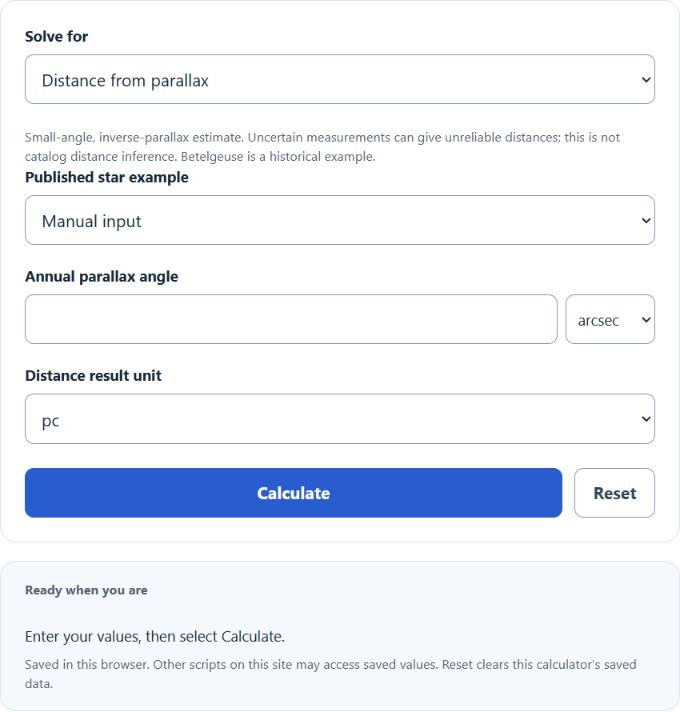
Calculate stellar parallax angle or distance from arcseconds, mas, µas, baseline shift, and uncertainty, with results in pc, ly, AU, and km.
Related Calculators
- Arc Seconds Per Pixel Calculator
- Parallax Error Calculator
- Distance Modulus Calculator
- Absolute Magnitude Calculator
- Arcmin to Arcsec Conversion Calculator
- All Physics Calculators
Parallax Angle Formula
The following formula is used to calculate the distance to a star based on its parallax angle.
Variables:
- d is the distance to the star in parsecs
- p is the parallax angle in arcseconds
For the small-angle geometric estimate, divide 1 by the annual parallax angle measured in arcseconds to obtain distance in parsecs. Inverting a noisy parallax can give an unreliable distance; this tool does not perform statistical distance inference.
What is a Parallax Angle?
Annual stellar parallax is the angle associated with a 1 AU projected baseline. It is half the maximum apparent displacement of a nearby star against distant background objects across a fully projected 2 AU Earth-orbit baseline. It is measured in arcseconds; a smaller positive parallax corresponds to a larger geometric distance. Actual measurements require observing geometry and other apparent motions to be accounted for.
How to Calculate Parallax Angle?
The following steps outline how to calculate the Parallax Angle.
- First, obtain the parallax-only angular displacement between two observing positions, correcting for other apparent motions.
- Next, divide that displacement in arcseconds by the projected baseline in AU. A fully projected 2 AU baseline gives an annual parallax equal to half the total displacement.
- Finally, use the formula d = 1 / p to calculate the distance to the star.
- After inserting the values and calculating the result, check your answer with the calculator above.
Example Problem :
Use the following variables as an example problem to test your knowledge.
Parallax Angle (p) = 0.1 arcseconds
Distance to Star (d) = 10 parsecs