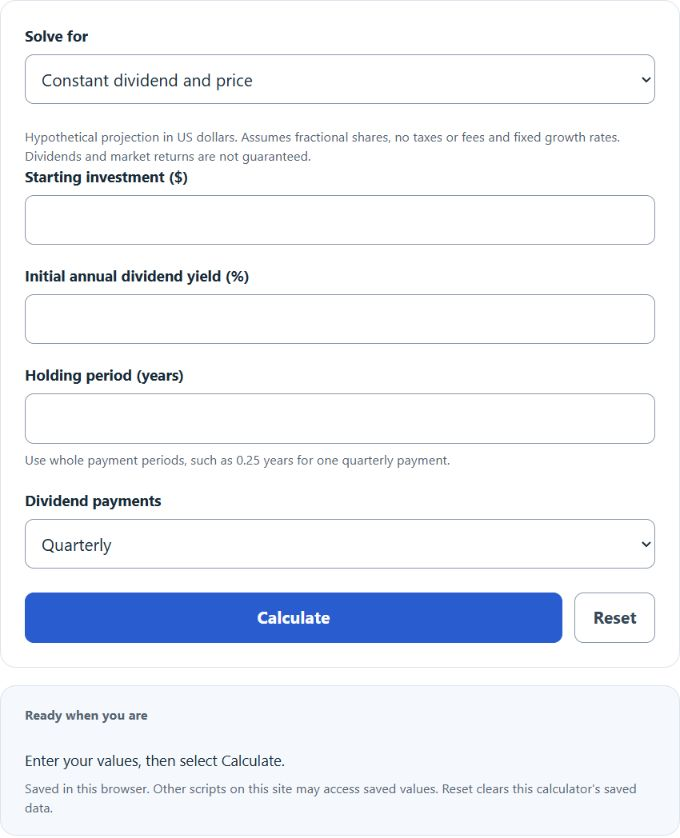
Dividend reinvestment calculator with dividend growth and share price growth. See ending balance, shares, and income with and without DRIP reinvesting.
Dividend Reinvestment Formula
Each period, the dividends received buy more shares at the current price, so the share count compounds:
Shares(t+1) = Shares(t) + (Shares(t) * D(t) / n) / P(t)
The ending value is simply the final share count times the final share price:
V = Shares(end) * P(end)
Variables:
- Shares(t) is the number of shares held in period t
- D(t) is the annual dividend per share in period t, growing at the dividend growth rate
- n is the number of dividend payments per year (12, 4, or 1)
- P(t) is the share price in period t, growing at the price growth rate
- V is the ending portfolio value ($)
Enter your starting investment, the initial annual dividend yield, and a holding period containing whole payment periods; the calculator simulates every payment. The simple mode holds the dividend and price flat, while the growth mode compounds both the dividend and the share price each year. Results show your ending value, total dividends reinvested, share count growth, the annualized dividend-income run rate at the end, and - the key comparison - how much more you end with versus taking every dividend in cash.
Reinvesting vs Taking Cash
The table shows $10,000 invested at a 3% yield with 5% annual dividend growth and 6% annual price growth, dividends paid quarterly.
| Years | Value with DRIP | Value without (incl. cash) | DRIP advantage |
|---|---|---|---|
| 5 | $15,488 | $15,071 | $417 |
| 10 | $23,827 | $21,752 | $2,075 |
| 20 | $55,329 | $42,175 | $13,154 |
| 30 | $125,507 | $77,736 | $47,771 |
Each value is rounded independently to the nearest dollar, so displayed differences may differ by $1 from subtracting rounded totals. Payments are reinvested before that period’s price and dividend growth; cash dividends earn no interest. These fixed assumptions are illustrative, not forecasts.
Example Problems
Example 1: Simple reinvestment.
You invest $10,000 at a steady 4% yield paid quarterly for 10 years with no growth. Each quarter pays 1% of the position, which buys new shares at an unchanged price. After 40 quarters the position compounds to 10,000 * (1 + 0.01)^40 = $14,889 - $4,889 of reinvested dividends versus $4,000 if you had taken them as cash.
Example 2: Income after growth.
You invest $25,000 at a 3% yield with 5% dividend growth, reinvesting quarterly for 15 years. The calculator compounds the share count while the per-share dividend grows, and reports the annualized dividend-income run rate at the end. With zero price growth, this model gives about $48,158 in ending value and $3,004 in annualized ending income; this is not the actual cash paid during the final year.
Frequently Asked Questions
What is a DRIP?
A dividend reinvestment plan uses cash dividends to buy additional shares, potentially including fractional shares. Enrollment, timing, commissions and other fees depend on the provider. This model excludes all fees.
Are reinvested dividends still taxed?
In a US taxable account, reinvesting generally does not remove tax on a taxable dividend; new shares have their own cost basis. Tax-exempt dividends and retirement-account rules differ. This calculator excludes taxes and is not a tax calculation.
When does reinvesting matter most?
Over long horizons and with higher yields. The advantage over taking cash is modest in the first few years but widens sharply past a decade, because reinvested shares generate their own dividends. Retirees who need the income are the usual exception.