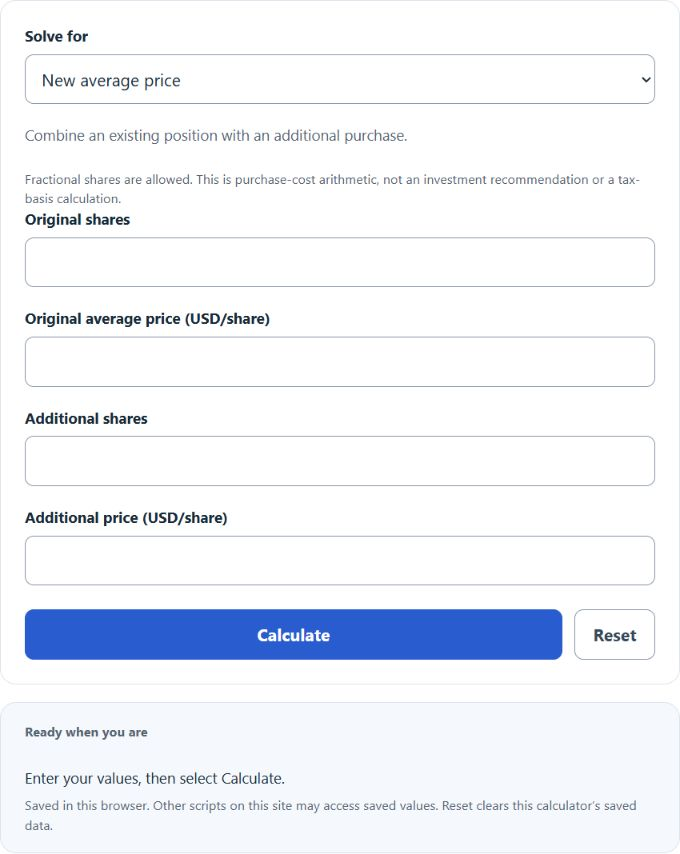
Calculate stock double-down average price after buying more shares, find shares needed for a target average, or estimate a budget-based average down.
Double Down Stock Formula
The following equation calculates average purchase cost before new fees. Target-average and budget modes also include the entered fixed and per-share purchase fees.
- Where NAC is the new average cost ($/share)
- CS is the current number of shares (#)
- P1 is the original share price ($)
- NS is the number of new shares purchased (#)
- P2 is the new purchase share price ($)
To calculate the new average cost for a doubled-down stock position, first determine the total cost of all shares (existing plus newly purchased), then divide by the total number of shares held.
What is a Double Down Stock?
Definition:
Doubling down on a stock refers to purchasing additional shares of an existing position, often at a lower share price, with the goal of lowering the average purchase cost. This strategy can be used when an investor believes the stock’s price will recover over time.
How to Calculate Double Down Stock?
Example Problem:
The following example outlines the steps and information needed to calculate the new average cost when doubling down on a stock.
First, determine the current holdings. In this example, an investor holds 100 shares at $20 per share.
Next, decide how many more shares to purchase and at what price. The investor buys 50 additional shares at $15 per share.
Finally, calculate the new average cost using the formula above:
NAC = (CS * P1 + NS * P2) / (CS + NS)
NAC = (100 * $20 + 50 * $15) / (100 + 50)
NAC = ($2,000 + $750) / 150
NAC = $18.33 per share
FAQ
Is doubling down always a good idea?
Not necessarily. Doubling down should align with an investor’s risk tolerance and confidence in the stock’s potential recovery. Additional market research and awareness of the company’s fundamentals are crucial.
What factors should I consider before doubling down on a stock?
Factors include the stock’s fundamentals, your investment objectives, the broader market conditions, and your overall portfolio strategy. It is also helpful to consider your time horizon and liquidity needs.
How does doubling down affect my risk exposure?
Doubling down increases both your potential returns and your losses since you are allocating more capital to a single position. A careful assessment of these risks is important before making any additional investment.