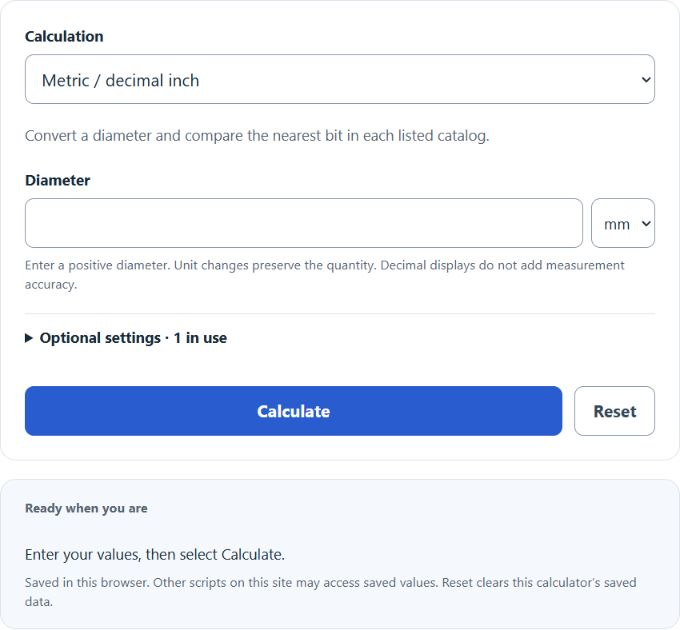
Calculate drill bit sizes in metric, decimal inch, fraction, and wire/letter formats, or find the nearest standard bit for a hole diameter.
Related Calculators
- Gauge to Inches Calculator
- Gauge to Fraction Converter
- Gauge to Decimal Converter
- Gauge to mm Calculator
- mm to Fraction Calculator
- Fraction to mm Calculator
- All Unit Converters
Drill Bit Conversion Formula
The calculator converts every input into decimal inches first, then derives the other formats from that single value.
- x = diameter in decimal inches; n/d is a fractional inch diameter
- mm = diameter in millimeters
- numerator / denominator = fractional inch input (for example 1/4)
- Nearest fractional drill: compare the listed 1/64-inch sizes from 1/64 to 1 inch; equally close sizes choose the smaller diameter.
Wire gauge numbers (#1 to #80) and letter sizes (A to Z) do not follow a formula. They are nominal lookup diameters published in manufacturer drill-size charts, so the calculator looks them up directly. The constant 25.4 is exact by definition of the inch.
The two calculator modes use these relationships differently:
- Convert a size: takes one input, converts to decimal inches, then reports the metric value, the nearest 1/64 fraction, and the closest wire or letter bit. It also flags whether the fraction match is exact or rounded.
- Find nearest bit: takes a hole or measured diameter and searches the selected bounded catalog: fractional 1/64–1 inch in 1/64 steps, number #80–#1, letter A–Z, or a metric comparison grid of 0.1–25.4 mm in 0.1 mm steps. The metric grid does not imply stock availability or a universal standard set. The “at least” option returns the smallest bit greater than or equal to the target. The “no larger than” option returns the largest bit less than or equal to the target. “Closest overall” minimizes the absolute difference.
Common Drill Bit Reference Tables
These are the standard sizes you will see most often on the bench. Decimals are exact for fractions and rounded to four places for wire and letter bits.
| Fraction | Decimal (in) | mm | Closest wire/letter |
|---|---|---|---|
| 1/16 | 0.0625 | 1.588 | #52 |
| 3/32 | 0.0938 | 2.381 | #42 |
| 1/8 | 0.1250 | 3.175 | #30 |
| 5/32 | 0.1563 | 3.969 | #22 |
| 3/16 | 0.1875 | 4.763 | #12 |
| 7/32 | 0.2188 | 5.556 | #2 |
| 1/4 | 0.2500 | 6.350 | E |
| 5/16 | 0.3125 | 7.938 | O |
| 3/8 | 0.3750 | 9.525 | V |
| 1/2 | 0.5000 | 12.700 | – |
The next table covers the metric-to-fraction substitutions that come up most often when a metric drawing meets an inch-based bit set.
| Metric size | Decimal (in) | Closest fraction | Off by (thou) |
|---|---|---|---|
| 3 mm | 0.1181 | 1/8 | 6.9 |
| 5 mm | 0.1969 | 13/64 | 6.3 |
| 6 mm | 0.2362 | 15/64 | 1.8 |
| 8 mm | 0.3150 | 5/16 | 2.5 |
| 10 mm | 0.3937 | 25/64 | 3.1 |
| 12 mm | 0.4724 | 15/32 | 3.7 |
Examples and FAQ
Example 1: Convert 6.5 mm to inches. Divide by 25.4 to get 0.2559 in. The nearest listed 1/64 fraction is 1/4 (0.2500), about 5.9 thousandths smaller. The closest wire/letter is letter F at 0.2570 in, off by only 1.1 thousandths. F is closer by diameter; use the specified tap drill chart and required thread engagement before choosing a tap drill.
Example 2: Find the right bit for a 0.201 in hole. Set the mode to “at least this diameter.” The smallest standard bit that meets or exceeds 0.201 is #7 at 0.2010 in. The inclusive “no larger than” rule also returns #7 at 0.2010 in, since it exactly equals the target; #8 at 0.1990 in is smaller.
Why does my 1/4-inch bit show as 6.35 mm and not 6 mm? One inch equals exactly 25.4 mm, so 1/4 in is 6.35 mm. A 6 mm bit is 0.2362 in, which is about 13.8 thousandths (0.35 mm) smaller than 1/4 in. They are not interchangeable for press fits or reamed holes.
What are wire and letter sizes? Wire gauge bits run from #80 (smallest, 0.0135 in) to #1 (0.2280 in). Letter bits pick up where the wire set ends, running A (0.2340 in) through Z (0.4130 in). They fill the gaps between fractional sizes and are standard for tap drill charts.
How accurate is the nearest 1/64 fraction? Within the listed fractional catalog range, the maximum nearest-size error is half of 1/64 in, or 7.8125 thousandths; the calculator does not extrapolate a named bit outside the catalog. The calculator tells you when the match is exact so you know whether to trust the fraction or use the decimal value.
Which result should I use for a tap drill? Use the decimal inch value and match it against a published tap drill chart. Do not round to the nearest fraction unless the chart calls for one. A few thousandths of error changes thread engagement noticeably.