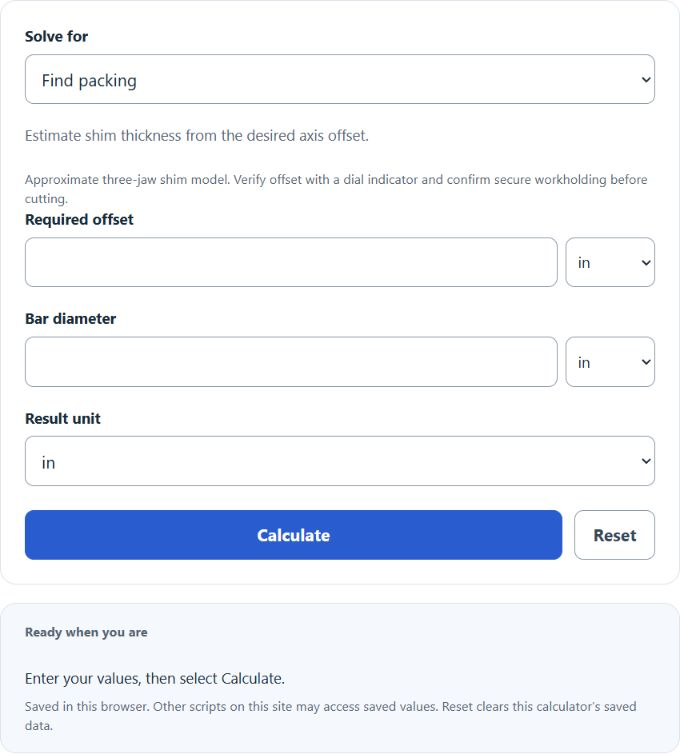
Calculate eccentric turning packing thickness from offset and bar diameter, or find offset from packing thickness in inches, mm or cm.
- All Miscellaneous Calculators
- Lathe RPM Calculator
- Stripping Force Calculator
- Chip Load Calculator
- Eccentricity Calculator
Eccentric Turning Packing Formula
To turn an eccentric feature on a round bar, you offset the bar in the chuck by shimming one jaw with packing. An approximate packing thickness estimate for a given offset is:
- P = packing thickness placed under one chuck jaw
- e = required offset (eccentricity) between original and new axis
- D = bar diameter
The leading factor of 1.5 comes from the geometry of a 3-jaw chuck: shimming one jaw shifts the bar axis by roughly two-thirds of the shim thickness, so the shim must be 1.5 times the desired offset. The (1 - 0.125 e/D) term is the correction in this approximate model; actual packing also depends on jaw contact geometry. For small offsets (e/D below about 0.05) the correction is under 1% and you can use the simpler P ≈ 1.5e.
To go the other direction (find the offset produced by a known packing), the calculator solves the quadratic 0.1875 e² − 1.5 D e + P D = 0 and returns the smaller positive root.
Assumes an appropriate 3-jaw self-centering chuck setup with rigid packing under one jaw. Follow the chuck and machine manufacturer’s procedures, verify the achieved offset with a dial indicator, and confirm secure workholding, clearance and balance before cutting. The mathematical limit e < D/2 does not certify a safe setup.
Reference Tables
Quick-reference packing thickness for common bar sizes (inches), using the stated approximate formula:
| Bar Dia. | Offset 1/32" | Offset 1/16" | Offset 1/8" | Offset 1/4" |
|---|---|---|---|---|
| 0.75" | 0.0466 | 0.0928 | 0.1836 | 0.3594 |
| 1.00" | 0.0467 | 0.0930 | 0.1846 | 0.3633 |
| 1.50" | 0.0468 | 0.0933 | 0.1855 | 0.3672 |
| 2.00" | 0.0468 | 0.0934 | 0.1860 | 0.3691 |
| 3.00" | 0.0468 | 0.0935 | 0.1865 | 0.3711 |
How to read the offset-to-diameter ratio the calculator reports:
| e/D Ratio | Interpretation |
|---|---|
| below 0.05 | The correction to P ≈ 1.5e is below 0.625% in this model; verify the actual setup. |
| 0.05 to 0.20 | The model’s correction is 0.625% to 2.5%; this is not a recommended operating range. |
| 0.20 to 0.40 | The model’s correction is 2.5% to 5%; verify jaw travel, clearance and secure workholding. |
| above 0.40 | The correction exceeds 5%; choose appropriate workholding and verify the setup. |
Example
You need a 0.125" eccentric on a 1.500" diameter bar.
- e/D = 0.125 / 1.500 = 0.0833
- Correction = 1 − 0.125 × 0.0833 = 0.9896
- P = 1.5 × 0.125 × 0.9896 = 0.1855"
Place a 0.186" shim against the jaw opposite the side you want the new axis to shift toward, then re-clamp and indicate the new center before cutting.
FAQ
Why isn't the packing just equal to the offset? Shimming one jaw of a 3-jaw chuck moves the bar axis by about two-thirds the shim thickness, because the other two jaws constrain it. In this approximate model, the correction slightly reduces the 1.5× estimate.
Does this work on a 4-jaw chuck? No. With an independent 4-jaw, you set the offset directly by moving one jaw. This formula is only for shimming a self-centering 3-jaw chuck.
What should the packing be made of? Use a hard, non-compressible material such as steel shim stock or gauge plate. Soft packing crushes under clamp load and changes the offset.