Calculate eccentricity from ellipse axes, focus and vertex distances, or orbital periapsis and apoapsis with formulas and unit conversion.
- All Math and Numbers Calculators
- Unit Circle Calculator
- Sector Area Formula
- Spherical Cap Calculator
- Pipe Ovality Calculator
Eccentricity Formula
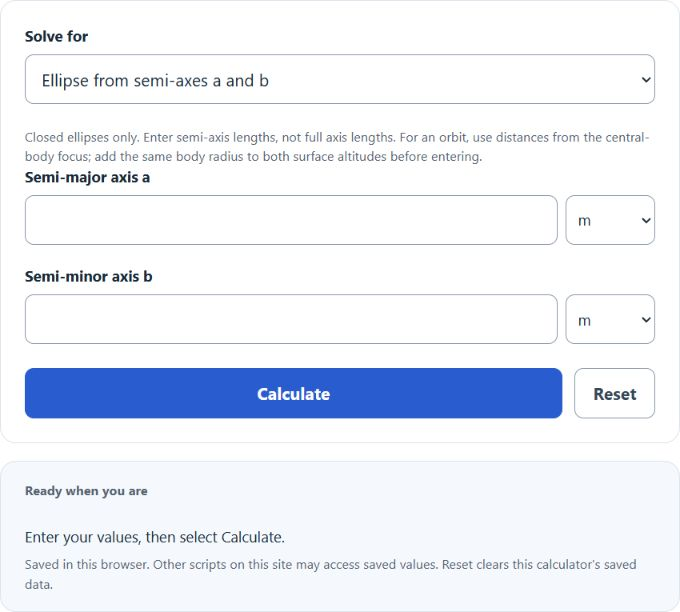
For a closed ellipse, the center-to-focus distance c divided by semi-major axis a gives dimensionless eccentricity. The calculator also supports semi-axes and Keplerian apsides radii.
- Where e is the eccentricity
- c is the distance from the center to the focus point
- a is the distance from the center to the vertex
To calculate eccentricity, divide the distance from the center to the focus point by the distance from the center to the vertex.
Eccentricity Definition
For an ellipse, eccentricity e = c/a = sqrt(1 − b²/a²), with a ≥ b > 0. For a Keplerian ellipse from central-focus radii, e = (ra − rp)/(ra + rp), with ra ≥ rp > 0. Circular e = 0; nondegenerate closed ellipses have e below 1. Parabolas, hyperbolas and degenerate ellipses are outside this tool.
Eccentricity Example
How to calculate eccentricity?
- First, measure the distance c.
C is the measure of the distance from the center of the ellipse to the focus point.
- Next, measure the distance a.
A is the measure of the distance between the center and the vertex.
- Finally, calculate the eccentricity.
Divide the value c by the value a to calculate the eccentricity of the shape.
FAQ
For a closed ellipse, eccentricity is the dimensionless ratio c/a. A circle has e = 0; larger e below 1 means a more elongated ellipse. Enter semi-axis lengths, not full axes. Orbit inputs are radii from the same central-body focus, not surface altitudes; add the same body radius to both altitudes first. The orbital relation assumes a Keplerian ellipse and does not assess safety or perturbations.