Calculate pipe ovality, out-of-roundness, or a missing OD with metric and imperial units and compare nominal, mean-diameter, ISO/DNV, and API conventions.
- All Construction Calculators
- Area of an Oval Calculator
- Pipe Price Calculator
- Surface Area of a Pipe Calculator
- Pipe Flow Calculator
- Pipe Volume Calculator
- Depth of Flow in Pipe Calculator
Pipe Ovality Formula
Pipe ovality is the percentage difference between the largest and smallest outside diameters of the same pipe cross-section, normalized by the nominal outside diameter. It is a quick way to describe how far a pipe has shifted from a true circle.
| Term | Meaning |
|---|---|
| O | Pipe ovality, expressed as a percentage |
| ODmax | Maximum measured outside diameter |
| ODmin | Minimum measured outside diameter |
| ODnom | Nominal outside diameter used as the reference diameter |
Use the same unit for every diameter input. Inches, millimeters, centimeters, and meters all work as long as the units are consistent. Because the diameter difference is divided by a diameter, the result is dimensionless and then converted to a percent.
Rearranged Forms
If you know any three values, the missing one can be found from the same relationship:
If ovality is 0%, then the maximum and minimum diameters are equal. In that special case, the nominal OD cannot be back-solved from ovality alone.
What Pipe Ovality Means
In practical terms, ovality is a measure of out-of-roundness. A perfectly round pipe has the same outside diameter in every direction, so its ovality is 0%. As the largest and smallest diameters move farther apart, the ovality percentage increases.
- Low ovality indicates a rounder pipe section.
- High ovality indicates more distortion, flattening, or eccentricity.
- 0% means the measured section is perfectly round based on the two diameters used.
Ovality matters because excessive out-of-roundness can affect fit-up, gasket sealing, couplings, alignment, liners, supports, and any process that depends on a predictable outside diameter.
How to Calculate Pipe Ovality
- Measure the largest outside diameter of the pipe section.
- Measure the smallest outside diameter on that same section.
- Identify the nominal outside diameter used for the pipe specification.
- Subtract the minimum OD from the maximum OD.
- Divide that difference by the nominal OD.
- Multiply by 100 to convert the ratio into a percentage.
Example
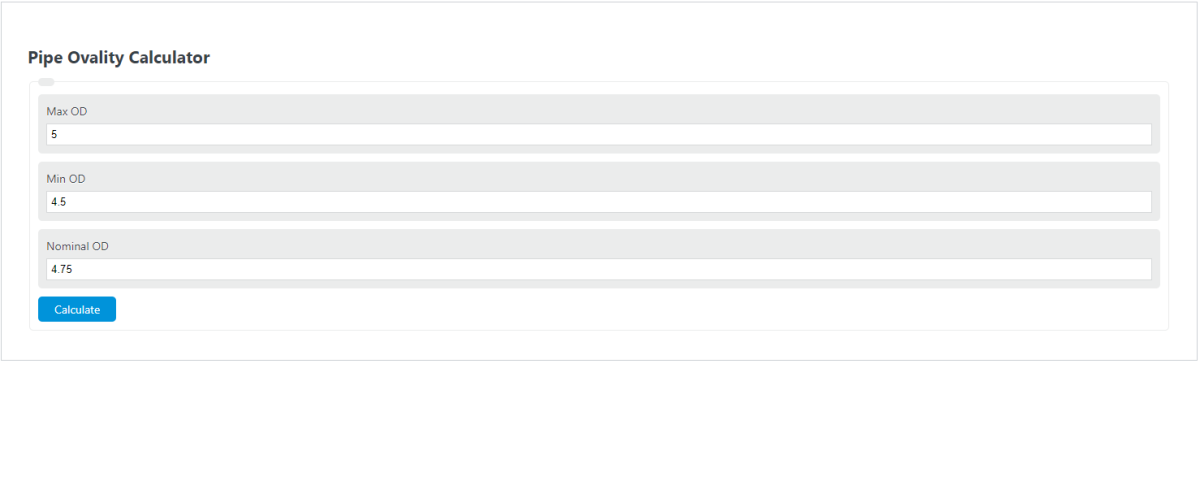
For a pipe with a maximum OD of 5.00 in, a minimum OD of 4.50 in, and a nominal OD of 4.75 in:
This means the measured spread between the largest and smallest outside diameters is equal to about 10.53% of the nominal outside diameter.
Measurement Tips
- Take both diameter readings on the same cross-section of pipe.
- Measure at several clock positions if needed to find the true maximum and minimum values.
- Use a suitable tool such as calipers, a diameter tape, or another inspection method appropriate for the pipe size.
- Do not mix units between inputs.
- Always subtract the smaller diameter from the larger diameter so ovality remains non-negative.
Important Notes
- This calculator uses nominal outside diameter in the denominator. Some specifications use a different reference diameter, so the reported percentage may differ if another method is required.
- Do not confuse a nominal pipe size label with the actual outside diameter reference if your standard treats them differently.
- A large diameter spread with the same nominal OD produces a higher ovality value.
- Acceptable ovality limits are usually set by the applicable drawing, code, material specification, or project requirement.
Why Engineers and Fabricators Check Ovality
- To verify manufacturing quality and dimensional consistency
- To confirm a pipe will fit with clamps, couplings, saddles, and mating components
- To evaluate deformation after transport, bending, storage, or installation
- To reduce sealing and alignment problems during assembly