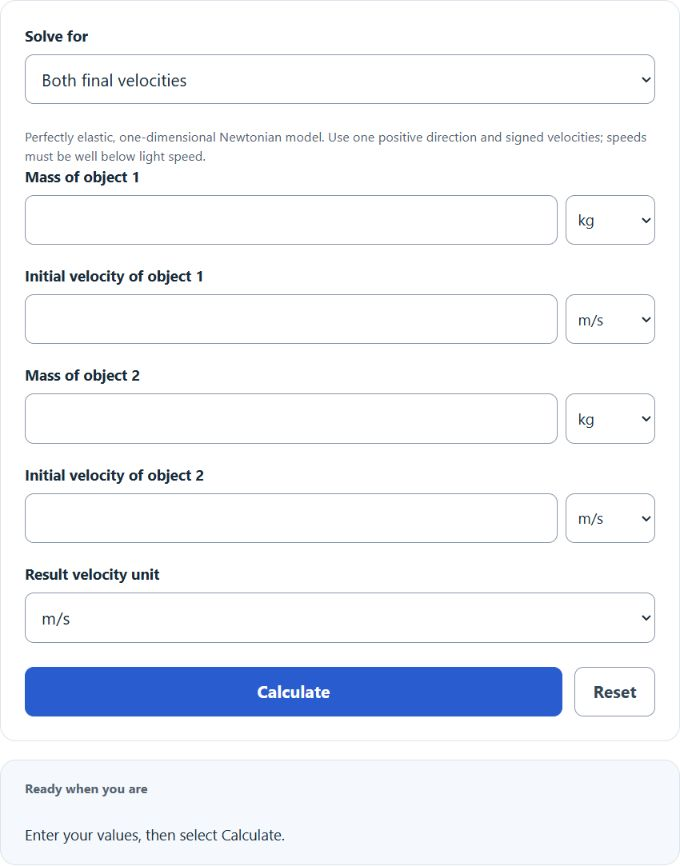
Calculate the missing mass or initial/final velocity in a one-dimensional elastic collision using two objects’ masses and velocities.
- All Physics Calculators
- Conservation of Momentum Calculator
- Inelastic Collision Velocity Calculator
- Final Velocity Calculator
- Initial Velocity Calculator
- Total Momentum Calculator
- Kinetic Energy to Velocity Calculator
Elastic Collision Formula
For a one-dimensional perfectly elastic collision, both momentum and kinetic energy are conserved. The calculator uses the following equations, with all values converted to base units before solving.
- m1 = mass of object 1
- m2 = mass of object 2
- u1 = initial velocity of object 1
- u2 = initial velocity of object 2
- v1 = final velocity of object 1
- v2 = final velocity of object 2
Choose the value to solve. The both-velocity modes need two masses and two velocities. Single-value modes preserve the five-known-value solves and check the other supplied velocity for consistency. Mass solves rearrange momentum and then verify the elastic velocity equations; inconsistent or nonunique inputs are rejected.
Common Elastic Collision Patterns
| Situation | Typical result | What it means |
|---|---|---|
| Equal masses, object 2 starts at rest | Object 1 stops, object 2 takes object 1’s speed | The moving object transfers its velocity to the other object. |
| Object 1 is much lighter than object 2 | Object 1 rebounds strongly | A light object bouncing off a heavy object reverses direction. |
| Object 1 is much heavier than object 2 | Object 1 changes little, object 2 moves away quickly | The heavier object keeps most of its motion. |
| Objects move toward each other | One velocity should be entered as negative | Velocity signs show direction in a one-dimensional setup. |
Supported Unit Conversions
| Quantity | Input units | Base unit used for calculation |
|---|---|---|
| Mass | kg, lb | kg |
| Velocity | m/s, ft/s | m/s |
Elastic Collision Examples
Example 1: Find both final velocities for equal masses
Suppose object 1 has a mass of 2 kg and starts at 6 m/s. Object 2 has a mass of 2 kg and starts at 0 m/s.
- m1 = 2 kg
- u1 = 6 m/s
- m2 = 2 kg
- u2 = 0 m/s
For equal masses where the second object starts at rest, the velocities exchange. The final velocity of object 1 is 0 m/s, and the final velocity of object 2 is 6 m/s.
Example 2: Find final velocities for unequal masses
Suppose object 1 has a mass of 3 kg and starts at 4 m/s. Object 2 has a mass of 1 kg and starts at 0 m/s.
The final velocity of object 1 is 2 m/s, and the final velocity of object 2 is 6 m/s.
Elastic Collision FAQ
Can velocity be negative in an elastic collision?
Yes. Velocity is directional. In a one-dimensional collision, choose one direction as positive and enter motion in the opposite direction as negative. For example, if object 1 moves right at 5 m/s and object 2 moves left at 3 m/s, you can enter 5 m/s and -3 m/s.
What makes a collision elastic?
A collision is elastic when total momentum and total kinetic energy are conserved. In real life, many collisions lose some kinetic energy to heat, sound, deformation, or rotation. The calculator assumes a perfectly elastic, one-dimensional collision.
How many known values does each solve need?
Choose both final or both initial velocities for a four-value solve. A single missing mass or velocity uses five known values, with a consistency check. Only fields relevant to the selected task are shown.