Calculate CO2 emissions from electricity use in kWh using country grid or fuel emission factors, with results in kg, lbs, and tons plus real-world equivalents.
- All Everyday Life & Education Calculators
- Recycling Energy Savings Calculator
- Carbon Offset Cost Calculator
- Flight Carbon Footprint Calculator
- Carbon Footprint of Driving Calculator
Electricity kWh to CO2 Emissions Formula
The calculator converts electricity use into carbon dioxide emissions with a single relationship:
CO2 (kg) = kWh * EF / 1000
In the reverse mode, it rearranges the same relationship to find how much electricity produces a given amount of CO2:
kWh = CO2 (kg) * 1000 / EF
Variables:
- CO2 (kg) is the mass of carbon dioxide emitted, in kilograms
- kWh is the electricity consumed, in kilowatt-hours
- EF is the emission factor of the electricity source, in grams of CO2 per kWh
- 1000 converts grams to kilograms
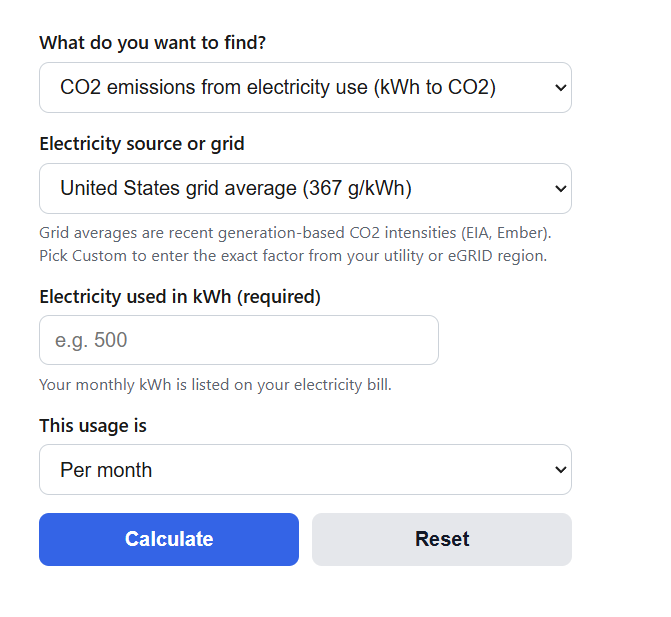
Pick what you want to find at the top of the calculator. In the kWh to CO2 mode you enter your electricity use for a day, a month, a year, or a one-time total, and the tool returns the CO2 in kilograms, pounds, and metric tons, plus an annualized figure. In the CO2 to kWh mode you enter a CO2 amount and the tool returns the electricity use that would produce it at the selected factor. The source menu sets EF using recent generation-based intensities from the EIA and Ember, and the custom option accepts factors in g/kWh, kg/kWh, lb/kWh, lb/MWh, or kg/MWh, which covers the lb per MWh format used by EPA eGRID subregions.
The real-world equivalents shown with the result use EPA greenhouse gas equivalency factors: 393 grams of CO2e per mile driven by an average gasoline car, 8.887 kg of CO2 per gallon of gasoline, 12.4 grams per full smartphone charge, and about 60 kg absorbed per urban tree per year.
CO2 Emission Factors by Grid and Fuel Source
Emissions per kWh depend almost entirely on how the electricity was generated. The table below lists approximate recent emission factors for major grids and for individual fuel types, based on EIA, EPA, and Ember data. These are the values behind the calculator presets.
| Source or grid | g CO2/kWh | lb CO2/kWh | kg CO2 per 1,000 kWh |
|---|---|---|---|
| Coal power plant | 1,043 | 2.30 | 1,043 |
| Oil / petroleum power plant | 1,080 | 2.38 | 1,080 |
| Natural gas power plant | 440 | 0.97 | 440 |
| India grid | 708 | 1.56 | 708 |
| China grid | 560 | 1.23 | 560 |
| Australia grid | 525 | 1.16 | 525 |
| Japan grid | 480 | 1.06 | 480 |
| World average | 473 | 1.04 | 473 |
| United States grid | 367 | 0.81 | 367 |
| Germany grid | 330 | 0.73 | 330 |
| European Union average | 213 | 0.47 | 213 |
| United Kingdom grid | 207 | 0.46 | 207 |
| Canada grid | 130 | 0.29 | 130 |
| Brazil grid | 100 | 0.22 | 100 |
| France grid | 44 | 0.10 | 44 |
| Wind, solar, hydro, nuclear (at the source) | 0 | 0 | 0 |
A second way to read the same data is to ask how much electricity it takes to emit one metric ton of CO2, the unit used for carbon footprints and offsets. The cleaner the grid, the more electricity you can use before reaching one ton.
| Source or grid | kWh to emit 1 metric ton CO2 | Months of average U.S. home use (899 kWh/mo) |
|---|---|---|
| France grid | 22,727 | 25.3 |
| Canada grid | 7,692 | 8.6 |
| United Kingdom grid | 4,831 | 5.4 |
| United States grid | 2,725 | 3.0 |
| World average | 2,114 | 2.4 |
| China grid | 1,786 | 2.0 |
| India grid | 1,412 | 1.6 |
| Coal power plant | 959 | 1.1 |
Example Problems
Example 1: CO2 from monthly electricity use.
Your home uses 500 kWh per month on the U.S. grid average of 367 g CO2/kWh. Multiply and convert to kilograms:
CO2 = 500 * 367 / 1000 = 183.5 kg per month, which is about 404.5 lb. Over a year that is 2,202 kg, or about 2.2 metric tons, roughly the same CO2 as driving a gasoline car 5,600 miles.
Example 2: Electricity from a CO2 amount.
You want to know how much coal-fired electricity produces 250 kg of CO2. Using the coal factor of 1,043 g CO2/kWh:
kWh = 250 * 1000 / 1043 = 239.7 kWh, so a little under 240 kWh of coal power emits a quarter ton of CO2.
Frequently Asked Questions
How much CO2 does 1 kWh of electricity produce?
On the U.S. grid, about 367 grams, or 0.81 pounds, of CO2 per kWh based on EIA generation data. The world average is higher, around 473 g/kWh, because coal still supplies a large share of global generation. The range by source is wide: a coal plant emits roughly 1,000 g per kWh, a natural gas plant around 440 g, and wind, solar, hydro, and nuclear essentially zero at the point of generation.
How many kWh does it take to emit one ton of CO2?
At the U.S. average of 367 g/kWh, about 2,725 kWh produces one metric ton of CO2, which is roughly three months of electricity for an average American home. On a coal-heavy supply it takes under 1,000 kWh, while on France’s nuclear-dominated grid it takes over 22,000 kWh. You can check any factor with the calculator’s CO2 to kWh mode.
Is electricity from solar, wind, or nuclear really zero CO2?
At the point of generation, yes, nothing is burned, so the direct emission factor is zero. Over their full life cycle, manufacturing, construction, and disposal give wind and nuclear roughly 10 to 15 g CO2e per kWh and utility solar roughly 30 to 50 g CO2e per kWh, still about 20 to 100 times lower than coal. This calculator uses direct generation factors, which is the standard approach for grid emission accounting.