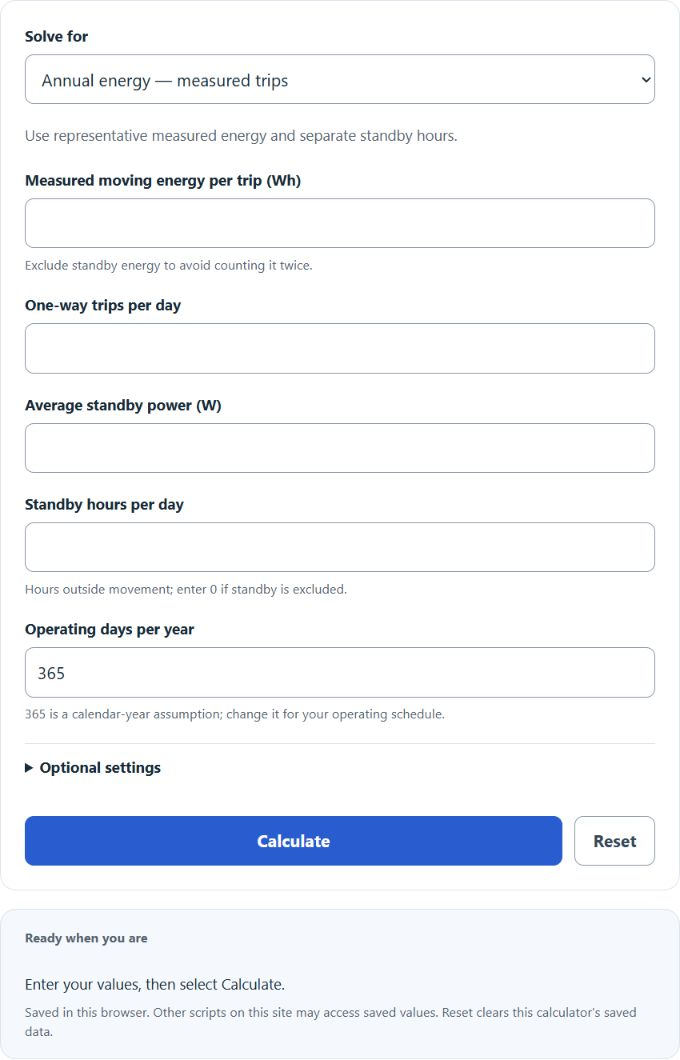
Estimate elevator or lift power consumption in kWh per day and year from measured trip energy, average power and run time, or a traction model.
Related Calculators
- Heat Load Calculator
- ISEER Rating Calculator
- Scissor Lift Force Calculator
- Gross Floor Area Calculator
- All Construction Calculators
Elevator Energy Consumption Formula
The following formula is used to calculate the energy consumption of an elevator for a given power rating and operating time.
Variables:
- E is the energy consumption in kilowatt-hours (kWh)
- P is the average electrical input power in kilowatts (kW), not necessarily the motor nameplate rating
- T is the operating time in hours (h)
For the power × time model, multiply average electrical input power by moving time, then add separately measured standby energy. The trip-based models instead use net moving Wh per one-way trip; the traction model is an ideal imbalance estimate that excludes friction, acceleration and auxiliary systems.
Lift Power in kW
The Steady-speed traction power (kW) mode estimates ideal full-load upward input power from rated payload Q (kg), car speed v (m/s), counterweight balance b (a fraction of rated payload), and overall drive efficiency η. It assumes that the counterweight equals the empty car mass plus bQ. The empty car masses then cancel, leaving an imbalance of (1 − b)Q.
For example, a 1,000 kg rated load at 1 m/s, 50% counterweight balance and 80% overall efficiency gives 4.903325 kW of mechanical imbalance power and about 6.129156 kW of input power. The displayed 50% balance is an editable scenario assumption. Use the actual balance and efficiency for your lift. This ideal estimate excludes acceleration, friction, doors, controls, auxiliaries and design margins; it is not a motor nameplate rating or an electrical supply-sizing result. Use the manufacturer’s motor and drive specifications for those purposes.
Escalator Energy and Cost
For an escalator with known average electrical input power and operating hours, the Cost per kWh Calculator’s appliance running-cost mode calculates energy and cost from watts, hours and your electricity rate. Use measured average input for the relevant operating state, rather than assuming the motor’s nameplate output is continuously drawn. Calculate running, slow-speed and standby periods separately and add their energy; do not apply the elevator counterweight model to an escalator. Rise and step width alone do not determine its electricity consumption.
What is Elevator Energy Consumption?
Elevator energy consumption refers to the amount of electrical energy used by an elevator system over a given period. This energy consumption is typically measured in kilowatt-hours (kWh) and is influenced by factors such as the power rating of the elevator motor, the frequency and duration of elevator use, and the efficiency of the elevator system. Understanding and optimizing elevator energy consumption is important for reducing operational costs and minimizing the environmental impact of building operations.
How to Calculate Elevator Energy Consumption?
The following steps outline how to calculate the Elevator Energy Consumption.
- First, determine the average electrical input power while moving (P), not simply the motor nameplate rating.
- Next, determine the operating time of the elevator (T).
- Finally, calculate the energy consumption using the formula E = P * T.
- After inserting the values and calculating the result, check your answer with the calculator above.
Example Problem :
Use the following variables as an example problem to test your knowledge.
Average electrical input power (P) = 5 kW
Operating Time (T) = 3 hours. Moving energy is 15 kWh, before separate standby consumption.