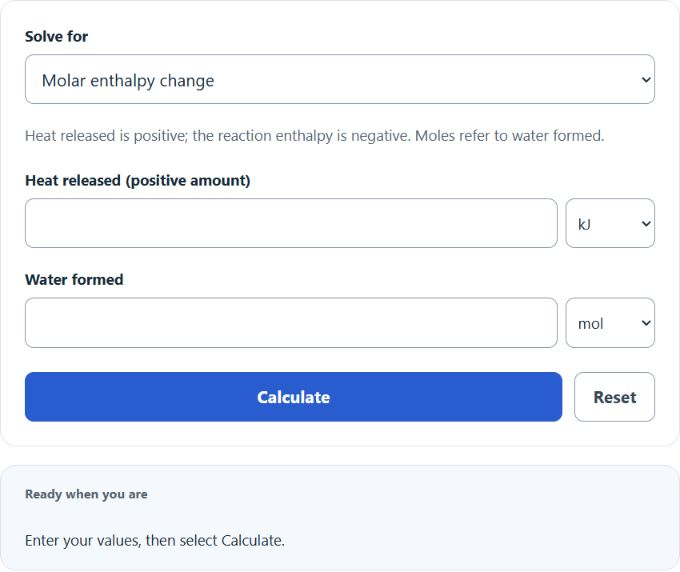
Choose molar enthalpy change, heat released, or moles of water formed, then enter the two required values. Heat released is positive; exothermic reaction enthalpy is negative.
Related Calculators
- Enthalpy of Water Calculator
- Solution Strength Calculator
- Water Dilution Calculator
- mEq/L Calculator
- All Chemistry Calculators
Enthalpy Change of Neutralisation Formula
The following formula is used to calculate the enthalpy change of neutralisation for a given amount of heat energy released and moles of water formed.
Variables:
- ΔH is the enthalpy change of neutralisation (kJ/mol)
- Q is the positive amount of heat released (kJ), the negative of signed reaction heat
- n is the number of moles of water formed (mol)
At constant pressure, divide the positive heat released by the moles of water formed, then apply a negative sign for the reaction enthalpy. Use moles of water produced by the balanced reaction, accounting for the limiting reactant.
What is Enthalpy Change of Neutralisation?
The enthalpy change of neutralisation is the heat energy change that occurs when an acid and a base react to form one mole of water. This reaction is typically exothermic, meaning it releases heat. The enthalpy change of neutralisation is an important concept in thermochemistry and is used to understand the energy changes that occur during chemical reactions. It is usually measured in kilojoules per mole (kJ/mol).
How to Calculate Enthalpy Change of Neutralisation?
The following steps outline how to calculate the Enthalpy Change of Neutralisation.
- First, determine the heat energy released (Q) during the reaction.
- Next, determine the number of moles of water formed (n).
- Finally, calculate the enthalpy change of neutralisation using the formula ΔH = -Q / n.
- After inserting the values and calculating the result, check your answer with the calculator above.
Example Problem :
Use the following variables as an example problem to test your knowledge.
Heat Energy Released (Q) = 50 kJ
Number of Moles of Water Formed (n) = 2 mol; ΔH = -50 / 2 = -25 kJ/mol.