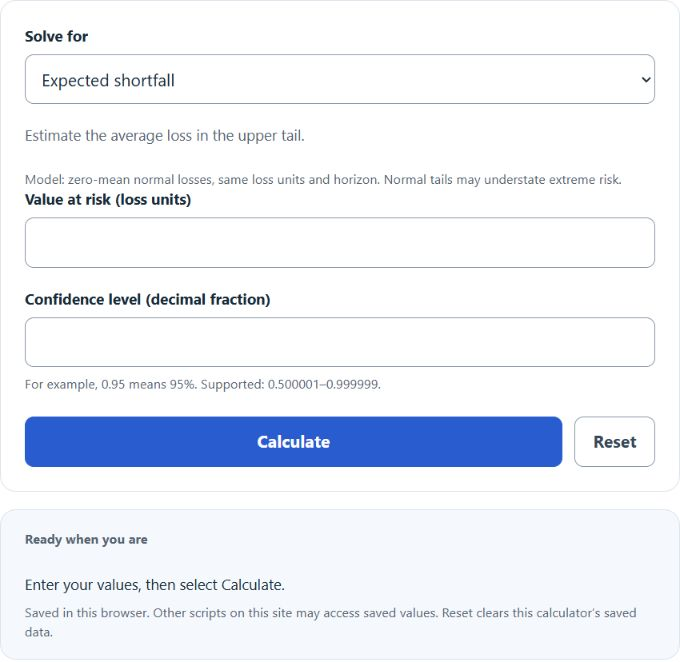
Calculate expected shortfall, confidence level, or value at risk under a zero-mean normal loss model. The supported confidence range is 0.500001–0.999999; the normal-tail assumption may understate extreme losses.
Related Calculators
- Credit Default Rate Calculator
- Insurance Loss Ratio Calculator
- Short Squeeze Calculator
- Proprietary Ratio Calculator
- All Business Calculators
Expected Shortfall Formula
Expected shortfall (ES), also called conditional value at risk (CVaR), is the average loss over the worst (1 − CL) fraction of the loss distribution. For continuous distributions this equals the conditional mean above VaR; discrete distributions require allocation of probability mass at the cutoff. If you assume a normal distribution with mean 0, ES and VaR can be related using the standard normal PDF/CDF, which is the approximation used by the calculator above.
Variables:
- ES is the expected shortfall
- VaR is the value at risk
- CL is the confidence level
In general, ES is computed from the loss distribution (for example using historical data, Monte Carlo simulation, or a parametric model) by averaging the tail losses beyond the VaR threshold. Under the normal-approximation shown above, ES can be estimated from VaR and CL using the standard normal z-score and density.
What is Expected Shortfall?
Expected shortfall, also known as conditional value at risk (CVaR), is a risk measure used in finance to assess the risk of extreme losses in a portfolio. It estimates the average loss in the worst (1 − CL) fraction of outcomes beyond a chosen confidence level. Unlike value at risk (VaR), which gives a loss threshold (a quantile) at a specific confidence level, expected shortfall accounts for the severity of losses in the tail of the loss distribution, offering a more comprehensive view of tail risk. This makes it a valuable tool for risk management and regulatory compliance in financial institutions.
How to Calculate Expected Shortfall?
The following steps outline how to calculate the Expected Shortfall.
- First, determine the value at risk (VaR) for the portfolio at your chosen horizon and confidence level.
- Next, choose the confidence level (CL) for the risk assessment (commonly 0.90, 0.95, or 0.99).
- If using the normal-approximation used by the calculator, compute the z-score zCL = Φ-1(CL) and the standard normal density φ(zCL).
- Finally, estimate expected shortfall using ES = VaR · φ(zCL) / ((1 − CL) · zCL), then check your answer with the calculator above.
Example Problem :
Use the following variables as an example problem to test your knowledge.
Value at risk (VaR) = 100,000
Confidence level (CL) = 0.95. Under the zero-mean normal model, z ≈ 1.644853627 and φ(z) ≈ 0.1031356404. Using unrounded values gives ES ≈ 100,000 × φ(z) / (0.05 × z) ≈ 125,404.03 loss units.