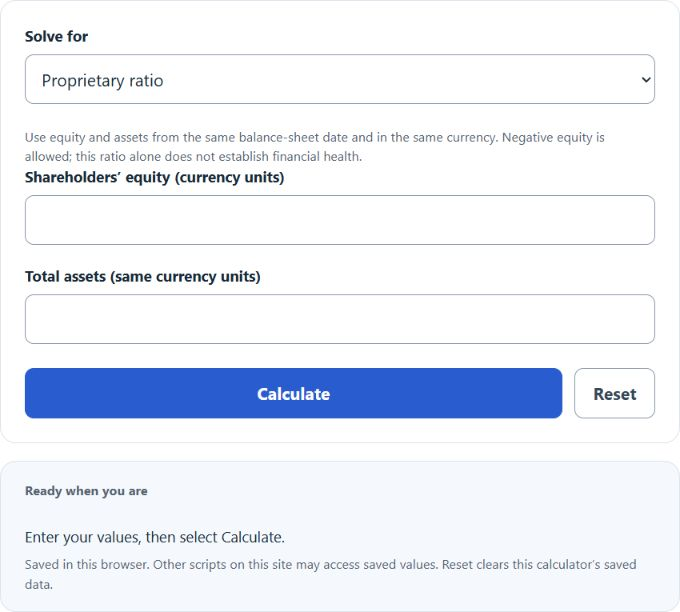
Calculate Proprietary Ratio, Shareholders' Equity, or Total Assets by selecting the value to solve and entering the two known values. Enter a decimal ratio: 0.5 means 50%.
Related Calculators
- Efficiency Ratio Calculator
- Gross Profit Rate Calculator
- Internal Rate of Return Calculator (IRR) up to 5 years
- Revenue Share (revshare) Calculator
- All Business Calculators
Proprietary Ratio Formula
The following formula is used to calculate the proprietary ratio for a given set of financial data.
Variables:
- PR is the proprietary ratio
- SE is the shareholders’ equity
- TA is the total assets
To calculate the proprietary ratio, divide the shareholders’ equity by the total assets. This ratio indicates the proportion of total assets that are financed by shareholders’ equity.
What is a Proprietary Ratio?
The proprietary ratio is a financial metric that indicates the proportion of a company’s total assets that are financed by shareholders’ equity. It is a measure of the financial stability and solvency of a company. A higher ratio indicates a larger equity share of assets, but the ratio alone does not establish financial health. Negative equity produces a negative ratio; compare consistent balance-sheet dates, accounting bases and industry context.
How to Calculate Proprietary Ratio?
The following steps outline how to calculate the Proprietary Ratio.
- First, determine the shareholders’ equity (SE).
- Next, determine the total assets (TA).
- Finally, calculate the proprietary ratio using the formula PR = SE / TA.
- After inserting the values and calculating the result, check your answer with the calculator above.
Example Problem :
Use the following variables as an example problem to test your knowledge.
Shareholders’ Equity (SE) = 500,000
Total Assets (TA) = 1,000,000