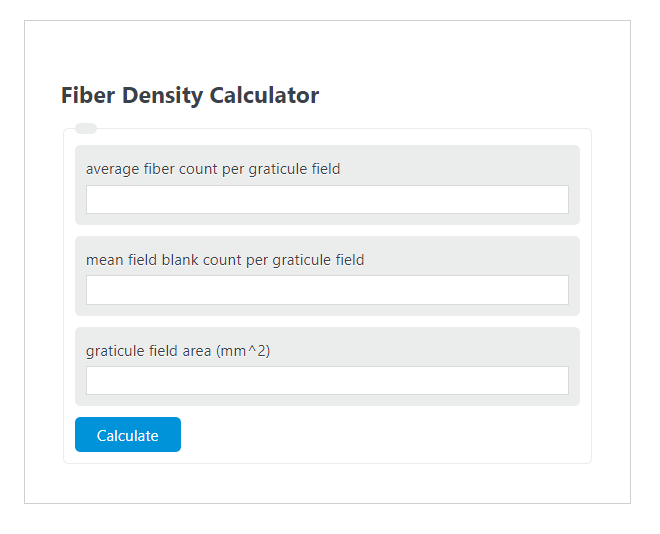
Calculate fiber density from a counting sheet or average counts, with blank correction and results in fibers/mm², cm², m², or in².
Related Calculators
- Air Density Calculator
- Mass Ratio Calculator
- Sheet Resistance Calculator
- Ohms Per Foot Calculator
- All Physics Calculators
Fiber Density Formula
The calculator converts a fiber count and a known field area into a density value. Both modes use the same core formula, with the counting sheet mode adding a step to compute the average count and field area first.
Counting sheet mode also uses:
- D = fiber density (fibers per unit area)
- C_avg = average fiber count per graticule field
- B = mean field blank count per graticule field
- A = graticule field area
- N = total fibers counted across all fields
- F = number of graticule fields counted
- d = graticule field diameter
Counting sheet mode takes raw lab data: total fibers, fields counted, blank, and the graticule diameter. It computes the average count, the circular field area from the diameter, applies the blank correction, and divides by area.
Average counts mode skips straight to the division. Use it when you already have an average count per field and a known field area in any common unit (mm², µm², cm², m², or in²).
The output unit selector rescales the result. 1 fiber/mm² equals 100 fibers/cm² and 1,000,000 fibers/m².
Reference Values
Most phase contrast microscopy (PCM) work for airborne asbestos fibers uses a Walton-Beckett graticule with a 100 µm field diameter. The table below shows common graticule sizes and the area each one covers.
| Field diameter | Field area (mm²) | Field area (µm²) |
|---|---|---|
| 80 µm | 0.005027 | 5,027 |
| 100 µm | 0.007854 | 7,854 |
| 150 µm | 0.017671 | 17,671 |
| 200 µm | 0.031416 | 31,416 |
| 250 µm | 0.049087 | 49,087 |
Use this table to sanity-check counting practice and detection limits.
| Counting condition | Typical target |
|---|---|
| Fibers per field (counting range) | 0.1 to 1.3 fibers/field |
| Minimum fields per sample | 20 fields (or 100 fibers) |
| Maximum fields per sample | 100 fields |
| Field blank limit | ≤ 7 fibers per 100 fields |
Example Problems
Example 1 — Counting sheet mode. You count 180 fibers across 100 graticule fields. The mean blank is 0.05 fibers/field. The graticule diameter is 100 µm.
- Average count = 180 / 100 = 1.8 fibers/field
- Net count = 1.8 − 0.05 = 1.75 fibers/field
- Field area = π × (0.05 mm)² = 0.007854 mm²
- Density = 1.75 / 0.007854 = 222.8 fibers/mm²
Example 2 — Average counts mode. You already know the average is 50 fibers/field, the blank is 20 fibers/field, and the field area is 0.007854 mm².
- Net count = 50 − 20 = 30 fibers/field
- Density = 30 / 0.007854 = 3,820 fibers/mm²
FAQ
What if I do not have a blank? Leave the blank field at 0. The calculator will report raw density without correction.
Why is the field area 0.007854 mm² for a 100 µm graticule? Area = π × r². With r = 50 µm = 0.05 mm, area = π × 0.0025 = 0.007854 mm².
Why does the result show "negative blank-corrected count"? Your blank value is higher than the sample average. Recheck the inputs; a sample cannot have fewer fibers than its own background.
Can I use this for fabric or composite fiber counts instead of air samples? Yes. Any time you have a fiber count and a known viewing area, the formula applies. Just match the area unit to the scale of your sample.