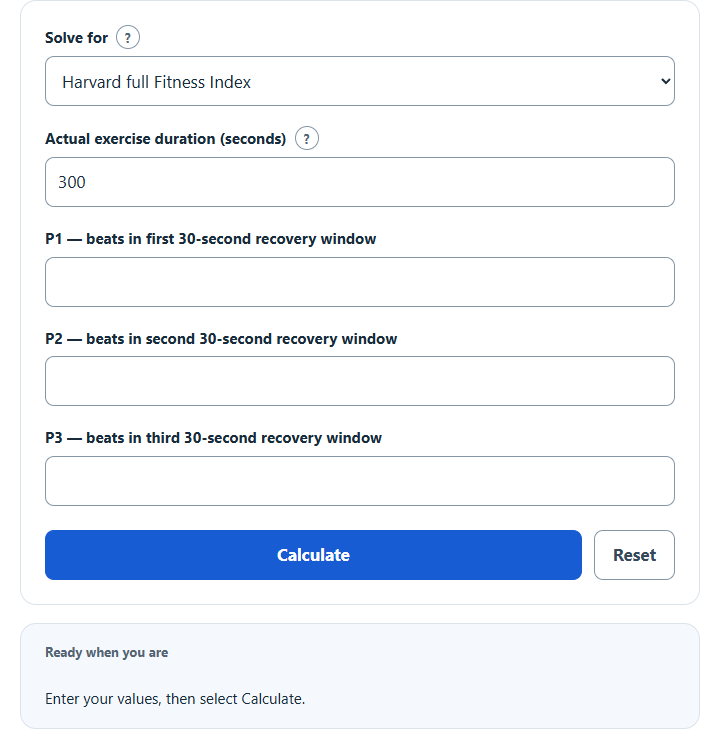
Calculate full or short Harvard Fitness Index values, solve for a target pulse sum, or convert a YMCA step-test recovery pulse to BPM.
Harvard and YMCA Step-Test Results
Harvard and YMCA step tests are separate protocols. Harvard modes produce a Fitness Index from exercise duration and timed recovery pulse counts. The YMCA mode reports recovery heart rate in BPM from the exact counting interval and does not apply the Harvard equation.
Formula and Method
Full Harvard FI = duration seconds x 100 / (2 x (P1 + P2 + P3)). Short Harvard FI = duration seconds x 100 / (5.5 x P1). YMCA recovery BPM = counted beats x 60 / counting seconds. The standard YMCA recovery measurement uses a full one-minute count; scaling a shorter count gives an average rate for a different interval and does not reproduce the standard measurement. For the inverse full Harvard comparison, P1 + P2 + P3 = 50 x duration / specified index; fractional output is algebraic, not an observed beat count or a prescribed pulse goal.
Keep each step-test protocol distinct
| Reference | Range or value | Use or interpretation |
|---|---|---|
| Harvard full | Duration plus three 30-second pulse counts | Full Fitness Index |
| Harvard short | Duration plus first 30-second pulse count | Short-form index |
| Harvard target | Duration plus target index | Required three-count sum |
| YMCA 3-minute | Recovery pulse and count interval | Recovery BPM, not Harvard FI |
How to Use the Result
Use the exact step height, cadence, duration, recovery posture, and pulse timing specified by your protocol. Compare repeat results only when those conditions and the formula version are unchanged.
Assumptions and Limitations
The two tests are not interchangeable, and the YMCA output here is intentionally a recovery-heart-rate conversion rather than an invented Fitness Index. Fitness classification tables vary by population and protocol; apply only a table that exactly matches the test performed. Harvard pulse inputs are positive whole beats counted during 1:00–1:30, 2:00–2:30 and 3:00–3:30 after stopping in the contemporary protocol used here, not BPM; the short form uses the first count. Exercise duration is actual elapsed seconds up to 300. The broad numerical input limits are not clinical normal or safe ranges. This calculator uses already recorded results and does not decide whether exercise testing is appropriate.
Sources
- Brouha L. The Step Test: A Simple Method of Measuring Physical Fitness for Muscular Work in Young Men, 1943. Contemporary equations: CBSE official marking scheme. Protocol variants require matching procedures and interpretation.
- ACE: YMCA Submaximal Step Test protocol. Standard recovery measurement is a full one-minute pulse count; shorter interval scaling is only a rate conversion.