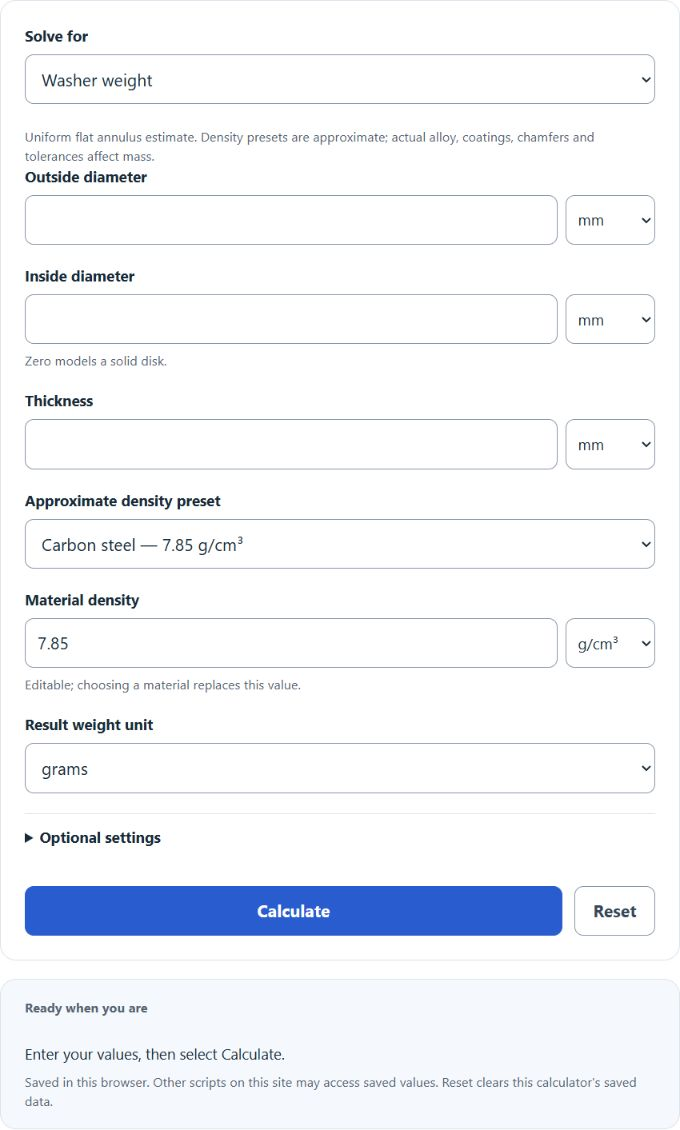
Estimate flat washer weight from outside diameter, inside diameter, thickness and material density in metric or imperial units. Quantity is optional (blank means one). Inverse mode finds thickness from single-piece weight. Density presets are approximate; alloy, coatings and manufacturing tolerances affect actual mass.
- All Construction Calculators
- All Weight Calculators
- Bolt Length Calculator
- Dimension to Weight Calculator
- Bolt Area Calculator
- Bolt Preload Calculator
- Screw Length Calculator
Flat Washer Weight Formula
The following formula is used to calculate the Flat Washer Weight.
Variables:
- FWW is the Flat Washer Weight (lbs)
- OD is the washer outer diameter (in)
- ID is the washer inner diameter (in)
- T is the washer thickness (in)
- d is the material density (lbs/in^3)
How to Calculate Flat Washer Weight?
The following two example problems outline the steps and information needed to calculate the Flat Washer Weight.
Example Problem #1
- First, determine the washer outer diameter (in).
- The washer outer diameter (in) is calculated to be 10.
- Next, determine the washer inner diameter (in).
- The washer inner diameter (in) is measured to be 5.
- Next, determine the washer thickness (in).
- The washer thickness (in) is found to be 2.
- Next, determine the density.
- Assume carbon steel at approximately 0.2836 lb/in³ (about 7.85 g/cm³).
- Finally, calculate the Flat Washer Weight using the formula above:
FWW = pi*(OD^2/4 – ID^2/4) * T * d
The values provided above are inserted into the equation below and computed.
FWW = π/4 × (10² − 5²) × 2 × 0.2836 ≈ 33.41084 lb for one washer.
Example Problem #2
The variables required for this problem are provided below:
washer outer diameter (in) = 30
washer inner diameter (in) = 20
washer thickness (in) = 5; assumed density = 0.2836 lb/in³
Test your knowledge and check your answer with the calculator.
FWW = π/4 × (30² − 20²) × 5 × 0.2836 ≈ 556.84730 lb for one washer. Multiply single-piece mass by quantity for a batch. Inverse mode uses a known single-piece mass to solve thickness.