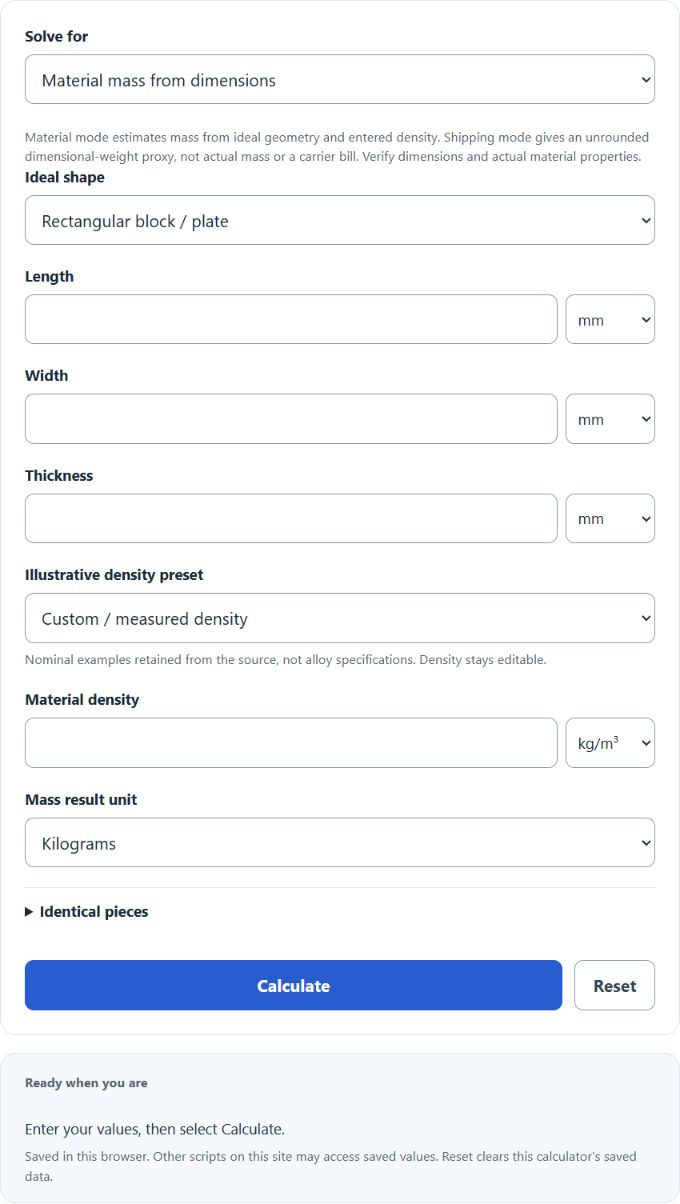
Calculate material weight from dimensions, shape, density, and quantity for blocks, plates, round bars, and tubes, or solve for material density.
- All Unit Converters
- Mass to Volume Calculator
- Weight to Density Calculator
- Density to Volume Calculator
- Weight per Volume Calculator
- Bulk Density Calculator
Dimension To Weight Formula
For actual material mass, use mass = geometric volume × material density. The separate shipping mode uses the following dimensional-weight proxy; it does not determine actual mass.
- Dimensional weight is a shipping volume proxy, in the mass unit associated with the divisor
- Length is the length of the object
- Width is the width of the object
- Height is the height of the object
- Divisor has compatible volume-per-mass units, such as in³/lb or cm³/kg; it is not material density
Multiply the box dimensions and divide by the specified dimensional divisor. The table gives unrounded proxy values to three decimals; carrier measurement and billing rounding are separate. Material modes instead use block, solid-bar or tube volume and density.
| Box size (L×W×H, in) | Dimensional weight (lb) |
|---|---|
| 6 × 4 × 4 | 0.691 |
| 6 × 6 × 6 | 1.554 |
| 8 × 6 × 4 | 1.381 |
| 8 × 8 × 8 | 3.683 |
| 9 × 6 × 3 | 1.165 |
| 10 × 8 × 6 | 3.453 |
| 12 × 9 × 4 | 3.108 |
| 12 × 8 × 6 | 4.144 |
| 12 × 10 × 8 | 6.906 |
| 12 × 12 × 10 | 10.360 |
| 12 × 12 × 12 | 12.432 |
| 14 × 10 × 8 | 8.058 |
| 15 × 12 × 10 | 12.950 |
| 16 × 12 × 8 | 11.050 |
| 18 × 12 × 12 | 18.647 |
| 18 × 14 × 6 | 10.878 |
| 20 × 16 × 10 | 23.022 |
| 20 × 16 × 12 | 27.626 |
| 22 × 18 × 12 | 34.187 |
| 24 × 18 × 12 | 37.295 |
| * Rounded to 3 decimals. Uses the common imperial dimensional weight divisor of 139 in³/lb. Formula: weight = L × W × H ÷ 139. | |
What is a Dimension To Weight Calculator?
Definition:
This calculator estimates material mass from dimensions and density, or infers density from dimensions and known mass. Its separate shipping mode calculates unrounded dimensional weight using an entered volume-per-mass divisor.
How to Calculate Weight from Dimensions?
Example Problem:
The following example outlines the steps and information needed to calculate the weight from dimensions.
In shipping mode, use a box measuring 10 in × 5 in × 2 in.
For this illustration, choose a divisor of 139 in³/lb. Verify the rules for the actual carrier service.
Finally, calculate the weight using the formula above:
Dimensional weight = (Length × Width × Height) / Divisor.
Dimensional weight = (10 × 5 × 2)/139 lb.
Unrounded dimensional weight ≈ 0.7194245 lb. No carrier billing rounding is applied. For comparison, a 1000 mm × 500 mm × 10 mm block at an entered density of 7850 kg/m³ has a material mass of 39.25 kg.
FAQ
What factors can affect the calculated weight?
The calculated weight can be influenced by measurement precision, the accuracy of the conversion factor, consistent use of units, and rounding during calculations.
How can I adjust the conversion factor for different materials?
In material-mass mode, enter density or select an approximate editable example. Shipping divisors describe carrier volume pricing and must not be used as material density.
Can this calculator determine a missing dimension if weight is provided?
No. Choose a mode explicitly: material mass, density from known mass and complete dimensions, or shipping dimensional weight. Required fields must be entered; leaving a dimension blank does not solve it.