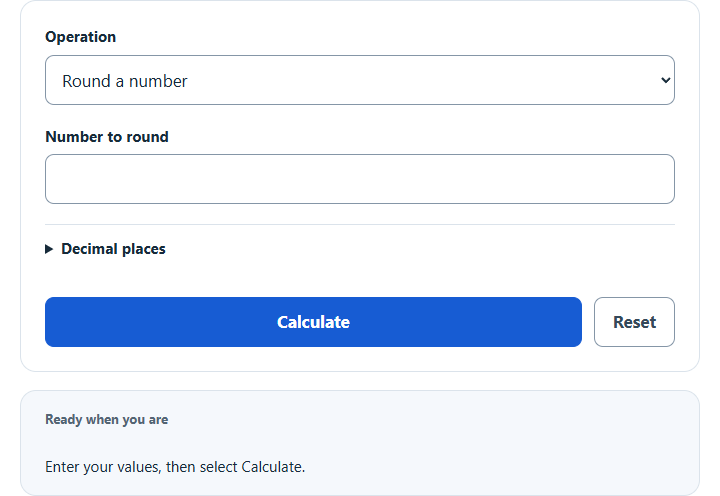
Round any number to four decimal places, or add, subtract, multiply or divide two numbers and get the result rounded to 4 decimal places.
Related Calculators
- Round To The Nearest Dollar Calculator
- Time Percentage Calculator
- Capacity Percentage Calculator
- Percentage Points Calculator
- All Math and Numbers Calculators
Four Decimal Places Formula
The following equation is used to calculate the result rounded to four decimal places.
- Where R is the result (rounded to 4 decimal places)
- N1 is the first number
- op is the arithmetic operator (+, -, *, /)
- N2 is the second number
To compute the result, perform the specified arithmetic operation and then round the outcome to four decimal places.
What is a Four Decimal Places Calculator?
Definition:
A Four Decimal Places Calculator is a tool designed to perform basic arithmetic operations and round the resulting value to a consistent display of four decimal places. Rounding does not improve the accuracy of the inputs.
How to Calculate with the Four Decimal Places Calculator?
Example Problem:
The following example outlines the steps and information needed to perform an arithmetic calculation and round the result to four decimal places.
First, enter the first number. In this example, the first number is 12.3456.
Next, select the operator. For example, choose multiplication (*).
Then, enter the second number. In this example, the second number is 7.8910.
Finally, calculate the result using the formula above:
R = round( N1 op N2, 4 )
R = round( 12.3456 * 7.8910, 4 )
R = 97.4191
FAQ
What types of operations can this calculator perform?
This calculator rounds a single number, or the result of addition, subtraction, multiplication, or division, to four decimal places by default; you can also choose another number of decimal places.
How does the calculator ensure results are rounded to four decimal places?
The calculator performs exact decimal arithmetic and rounds the final result once to four decimal places. Exact ties round away from zero, and trailing zeros are retained.
Can I use negative numbers and decimals with this calculator?
Yes, the calculator is designed to handle both negative numbers and decimal values, using exact decimal arithmetic for supported inputs. Division by zero is rejected; each number is limited to 200 characters and scientific exponents from -200 to 200.