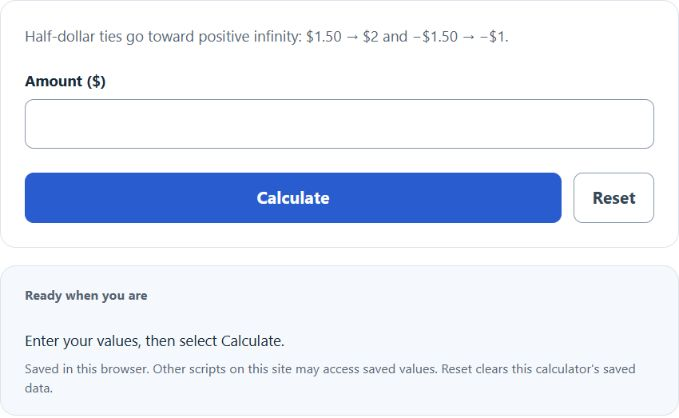
Calculate the nearest whole dollar for any entered amount, rounding cents up or down to show the final rounded dollar value after selecting Calculate.
Related Calculators
- Rounding Calculator
- Round to 2 Decimal Places Calculator
- Round to the Nearest Tenth Calculator
- Four Decimal Places Calculator
- Final Price Calculator
- All Math and Numbers Calculators
Round To The Nearest Dollar Formula
The following equation is used to round an amount to the nearest dollar.
- Where R is the rounded dollar amount ($)
- A is the original amount ($)
- The round() function rounds to the nearest integer, with exact ties toward positive infinity (for example, −1.50 becomes −1)
To round an amount to the nearest dollar, apply the round() function to the original amount.
| Amount ($) | Rounded Amount ($) |
|---|---|
| 0.01 | 0 |
| 0.25 | 0 |
| 0.49 | 0 |
| 0.50 | 1 |
| 0.51 | 1 |
| 0.75 | 1 |
| 0.99 | 1 |
| 1.00 | 1 |
| 1.25 | 1 |
| 1.49 | 1 |
| 1.50 | 2 |
| 1.99 | 2 |
| 2.00 | 2 |
| 2.25 | 2 |
| 2.50 | 3 |
| 2.75 | 3 |
| 2.99 | 3 |
| 10.49 | 10 |
| 10.50 | 11 |
| 123.45 | 123 |
| *Rounded to the nearest whole dollar; exact ties go toward positive infinity, matching the original Math.round tie rule. The calculator uses decimal integer arithmetic to avoid floating-point boundary errors. | |
What is a Rounded Dollar Amount?
Definition:
A rounded dollar amount refers to the monetary value after rounding an original amount to the nearest whole dollar, making transactions and budgeting simpler.
How to Round to the Nearest Dollar?
Example Problem:
The following example outlines the steps and information needed to round an amount to the nearest dollar.
First, determine the original amount. In this example, the amount is $5.75.
Next, apply the round function to obtain the rounded dollar value. In this case, the round() function is applied.
Finally, calculate the rounded amount using the formula above:
R = round(A)
R = round(5.75)
R = 6
FAQ
When is it appropriate to round an amount to the nearest dollar?
Rounding to the nearest dollar is useful in day-to-day transactions, budgeting, and simplifying calculations when cents are not required.
How does the round() function determine whether to round up or down?
The calculator chooses the nearest integer. Exact half-dollar ties choose the higher integer: $1.50 becomes $2 and −$1.50 becomes −$1.
Can rounding cause a noticeable difference in financial calculations?
Rounding changes the amount. Keep original values for accurate records and use the rule required for the particular transaction or report.