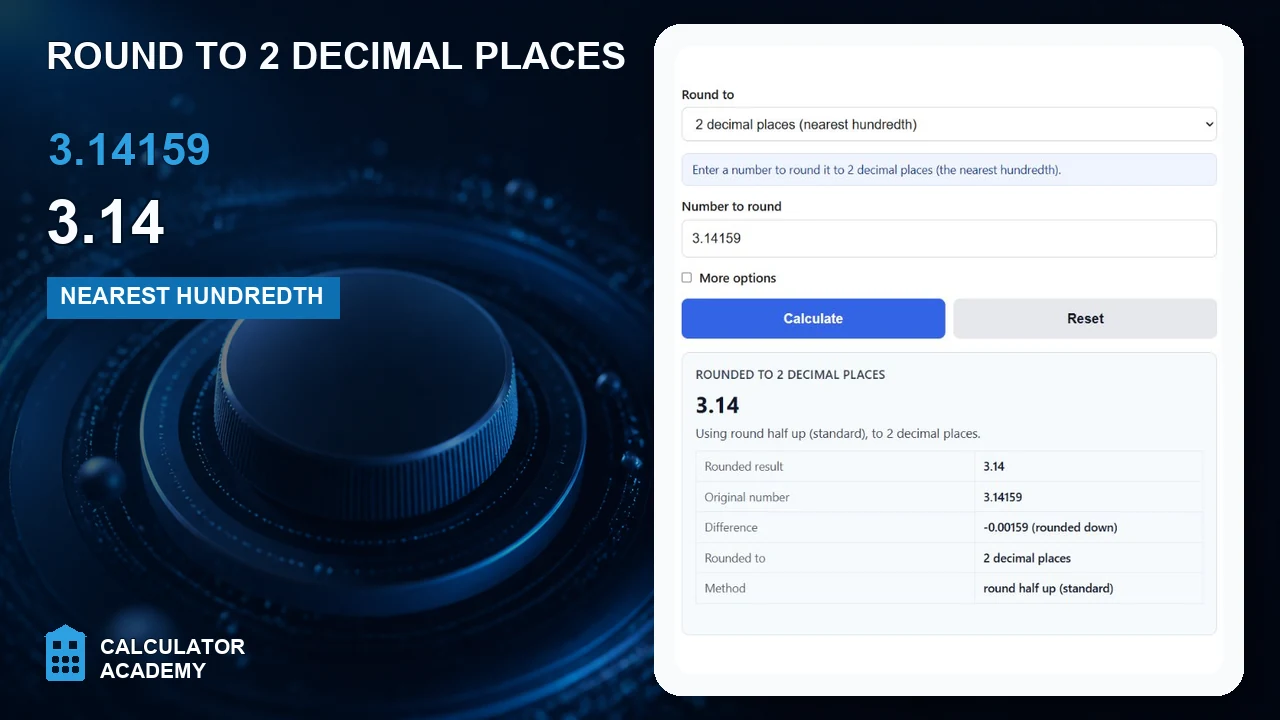
Calculate any number rounded to 2 decimal places by entering a value and getting the nearest hundredth with two digits after the decimal.
Related Calculators
- Rounding Calculator
- Round to the Nearest Tenth Calculator
- Four Decimal Places Calculator
- Round to the Nearest Dollar Calculator
- Fraction to Decimal to Percentage Calculator
- All Math and Numbers Calculators
Round to 2 Decimal Places Formula
To round a number to two decimal places, multiply it by 100, round to the nearest whole number, then divide by 100:
rounded = round(x * 100) / 100
The same method works for any number of decimal places by changing the power of ten:
rounded = round(x * 10^n) / 10^n
For the nearest multiple, the number is divided by the step, rounded, then multiplied back:
rounded = round(x / m) * m
Variables:
- x is the original number you enter
- n is the number of decimal places to keep (2 for two decimal places)
- m is the multiple to round to the nearest of, such as 0.5, 5, or 10
- round( ) applies the chosen rounding rule to the nearest whole number
Set “Round to” to 2 decimal places for the standard case, to Decimal places when you want a different count, to Significant figures to keep a fixed number of meaningful digits, or to Nearest multiple to snap the value to a step. The rounding method under More options decides what happens to a digit that falls exactly halfway: round half up sends it away from zero, round half to even (banker’s) sends it to the nearest even digit, ceiling always rounds up, floor always rounds down, and truncate drops the extra digits without adjusting.
Rounding Rules and Method Comparison
When you round to 2 decimal places you look at the third decimal digit. If it is 5 or greater the second decimal goes up by one; if it is 4 or less the second decimal stays the same. The table below shows this rule with standard (round half up) rounding.
| Number | Digit in 3rd decimal place | Rounded to 2 dp |
|---|---|---|
| 3.14159 | 1 (round down) | 3.14 |
| 2.71828 | 8 (round up) | 2.72 |
| 0.125 | 5 (tie, round up) | 0.13 |
| 1.005 | 5 (tie, round up) | 1.01 |
| 12.996 | 6 (round up, carries) | 13.00 |
| 99.994 | 4 (round down) | 99.99 |
The rounding method only changes the result when a digit is exactly halfway or when you force every value up or down. This table rounds two numbers to 2 decimal places under each method the calculator offers.
| Method | 0.125 to 2 dp | 2.341 to 2 dp |
|---|---|---|
| Round half up (standard) | 0.13 | 2.34 |
| Round half to even (banker’s) | 0.12 | 2.34 |
| Ceiling (always up) | 0.13 | 2.35 |
| Floor (always down) | 0.12 | 2.34 |
| Truncate (cut off) | 0.12 | 2.34 |
Example Problems
Example 1: round down. Round 3.14159 to 2 decimal places. The third decimal digit is 1, which is less than 5, so the second decimal stays the same. The result is 3.14.
Example 2: a tie that carries. Round 1.005 to 2 decimal places. The third decimal digit is 5, so standard rounding pushes the second decimal up by one, giving 1.01. Many calculators and spreadsheets return 1.00 here because 1.005 cannot be stored exactly in binary. This calculator shifts the digits as text before rounding, so it returns the expected 1.01.
FAQ
What does it mean to round to 2 decimal places?
It means keeping two digits after the decimal point so the value lands on the nearest hundredth. You look at the third decimal digit: if it is 5 or more you add one to the second decimal, and if it is 4 or less you leave the second decimal alone. For example, 4.567 rounds to 4.57 and 4.564 rounds to 4.56.
How do you round a number that ends in exactly 5?
That is a tie, and the result depends on the rule you use. Standard rounding (round half up) pushes the digit away from zero, so 2.345 becomes 2.35. Banker’s rounding (round half to even) sends it to the nearest even digit instead, so 2.345 becomes 2.34 and 2.355 becomes 2.36. Switch between them with the rounding method under More options.
Why is rounding to two decimal places used for money?
Most currencies use two places after the decimal point, one for each cent, so a money value only needs two decimals. Rounding a longer figure, such as a tax or interest amount, to the nearest hundredth gives a number you can actually charge or record. Banker’s rounding is sometimes chosen for money because it avoids the small upward bias you get when many halfway values are always rounded up.