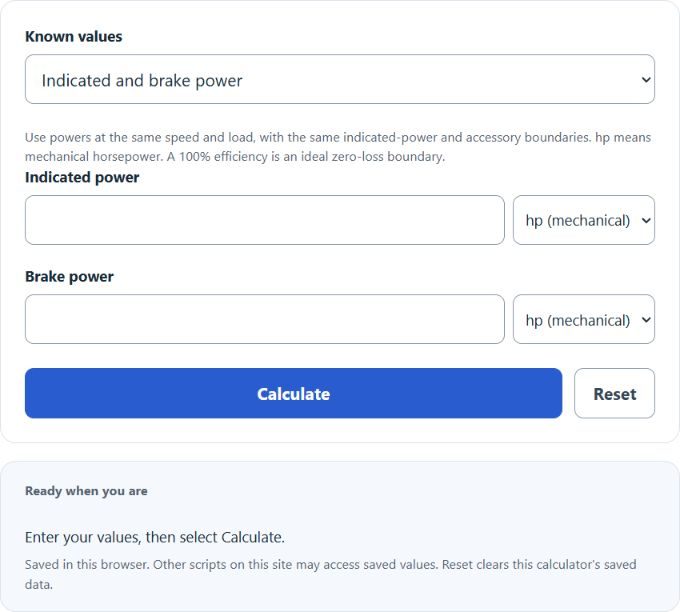
Calculate friction horsepower from indicated and brake horsepower, or from mechanical efficiency, and see how much engine power is lost to internal friction.
Friction Horsepower Formula
Friction power is the difference between indicated and brake power at the same operating condition. With gross indicated power it includes pumping losses; with net indicated power those losses have already been accounted for:
FP = IP - BP
The calculator accepts indicated and brake power, or one of those powers with mechanical efficiency:
ME = (BP / IP) * 100
 IP = BP / (ME / 100)
Variables:
- FP is the friction power, in hp or kW
- IP is the indicated power — the power developed by combustion pressure inside the cylinders
- BP is the brake power — the usable power measured at the crankshaft (what a dyno reads)
- ME is the mechanical efficiency, in percent
Pick what you know at the top of the calculator. If you have both indicated and brake power (from an engine simulation, an indicator diagram, or a motoring test), the tool returns friction power and mechanical efficiency directly. If you only have one power figure plus a mechanical efficiency estimate, the tool reconstructs the missing value first and then reports the friction power.
Use consistent indicated-power and accessory boundaries. Losses depend on speed, load, temperature and design; this calculator does not predict an RPM trend.
Friction Power at Illustrative Mechanical Efficiencies
This table illustrates FP = BP × (100 − ME) / ME at assumed efficiencies of 85% and 90%. These are examples, not universal engine-efficiency bounds.
| Brake HP | FHP at 85% ME | FHP at 90% ME |
|---|---|---|
| 100 hp | 17.6 hp | 11.1 hp |
| 200 hp | 35.3 hp | 22.2 hp |
| 300 hp | 52.9 hp | 33.3 hp |
| 400 hp | 70.6 hp | 44.4 hp |
| 500 hp | 88.2 hp | 55.6 hp |
| 600 hp | 105.9 hp | 66.7 hp |
| 700 hp | 123.5 hp | 77.8 hp |
Example Problems
Example 1: Friction power from indicated and brake power.
An engine develops 460 hp indicated power in its cylinders but delivers 400 hp at the crankshaft. The friction power is:
FP = 460 – 400 = 60 hp, and the mechanical efficiency is (400 / 460) × 100 ≈ 86.96%.
Example 2: Friction power from brake power and mechanical efficiency.
A 350 hp engine is assumed to be 88% mechanically efficient. The indicated power is 350 / 0.88 ≈ 397.7 hp, so:
FP = 350 × (100 − 88) / 88 ≈ 47.7 hp between the chosen power boundaries.
Frequently Asked Questions
What makes up friction horsepower?
The largest share comes from the piston rings and skirts rubbing on the cylinder walls, followed by the crankshaft and camshaft bearings, the valvetrain, and the oil and coolant pumps the engine drives. Pumping losses are included when this difference uses gross indicated power. Do not add them again when using net indicated power.
What is a typical mechanical efficiency for a car engine?
There is no single efficiency range valid for every engine and operating condition. Use measured data or a stated assumption with matching power boundaries.
How can friction losses be reduced?
Builders reduce friction with lower-tension piston rings, roller lifters and rocker bearings, tighter-tolerance machining, lighter valve springs where the cam allows it, and lower-viscosity synthetic oils. The effect depends on the engine and operating condition; compare matched tests rather than assume a fixed power gain.