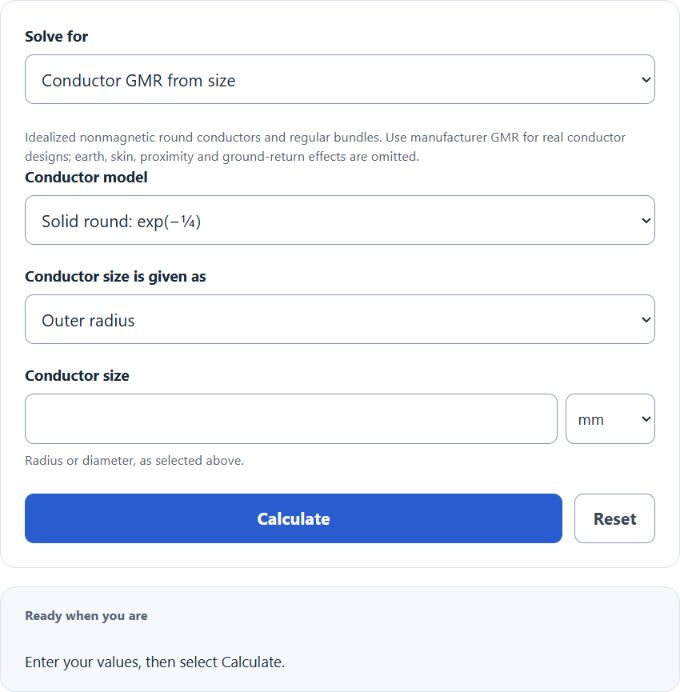
Calculate the geometric mean radius (GMR) of solid, stranded and bundled conductors from radius, diameter, AWG or kcmil, plus GMD, inductance and reactance.
- All Statistics Calculators
- Parallel Wire Capacitance Calculator
- Transmission Line Calculator
- Electrical Length Calculator
- Wire Resistance Calculator
- Line Current Calculator
Geometric Mean Radius Formula
The following two example problems outline the steps and information needed to calculate the Geometric Mean Radius.
Variables:
- GMR is the Geometric Mean Radius (mm)
- r is the solid conductor radius (mm)
For a uniform solid nonmagnetic round conductor, GMR = exp(−¼) × radius, approximately 0.7788 × radius. The stranded options use the non-compacted circular-conductor K factors verified in IEC 60287-1-3:2002 Table 1; actual manufacturer GMR takes precedence. AWG and kcmil represent metal area, so the calculator uses ideal equal-strand packing to infer an outside diameter, not an arbitrary product diameter.
Bundle modes assume equal sub-conductors on a regular polygon, equal current sharing and phase spacing large compared with bundle size. Line results distinguish per-phase inductance from a two-wire loop and distinguish three-phase capacitance to neutral from two-wire line-to-line capacitance. Capacitive reactance is labeled for a 1 km or 1 mile section. SIL is lossless three-phase natural loading, not a thermal limit. See the NPTEL bundle derivation and two-wire capacitance derivation.
How to Calculate Geometric Mean Radius?
The following steps outline how to calculate the Geometric Mean Radius.
- First, determine the solid conductor radius (mm).
- Next, gather the formula from above: GMR = .7788 * r.
- Finally, calculate the Geometric Mean Radius.
- After inserting the variables and calculating the result, check your answer with the calculator above.
Example Problem :
Use the following variables as an example problem to test your knowledge.
solid conductor radius (mm) = 15
GMR = .7788 * r = ?