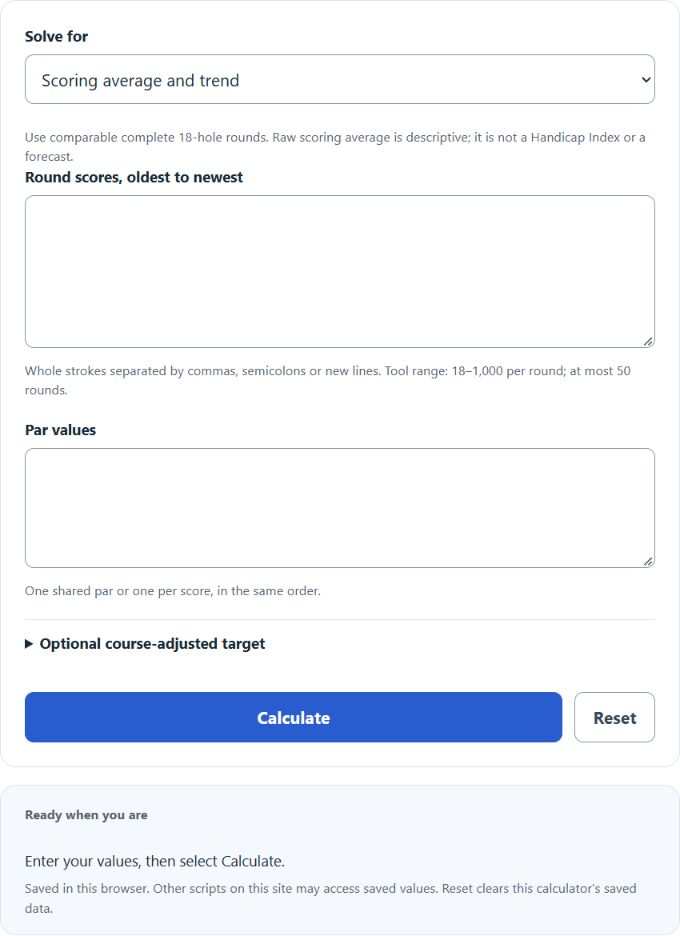
Calculate scoring average, relative-to-par performance, consistency, and recent trend, or solve for the next score needed to reach a target average.
How the Golf Scoring Average Calculator Works
Analyze mode averages chronological round scores, normalizes them relative to each round's par, measures population variability, and compares a recent window with the immediately preceding window. Target mode rearranges the average equation to find the highest whole next-round score that reaches or improves the target average; a threshold below 18 strokes is unreachable for a complete 18-hole round.
Formula: Scoring average = total strokes / rounds; recent trend = recent-window average - prior-window average
Choosing the Right Inputs
List comparable complete 18-hole scores oldest to newest so the trend has meaning. Enter one shared par when every round used the same par, or a matching par list for mixed courses. The optional handicap target is appropriate only for one consistent rating, slope, and par.
| Metric | Meaning | Helpful interpretation |
|---|---|---|
| Scoring average | Mean raw score | Overall scoring level |
| Average to par | Mean score minus each round's par | Cross-course context |
| Recent trend | Recent average minus prior average | Negative means lower recent scoring |
| Standard deviation | Typical spread around average | Lower suggests more consistency |
| Target score | Par plus Course Handicap | Course-adjusted comparison, not an index |
Understanding Your Results
Scoring average leads, followed by average to par, best and worst, range, standard deviation, recent-versus-prior trend, and an optional course-adjusted target comparison.
Worked Example
Scores of 80, 78, 79, 76, 77, and 75 average 77.5. The last three average 76.0 versus 79.0 for the prior three, so the -3.0-stroke trend indicates lower recent scores.
Assumptions and Limitations
A raw average is not a Handicap Index and does not adjust every round for rating, slope, PCC, exceptional-score reductions, or caps. Small samples and mixed course difficulty can distort comparisons.
Sources
PGA TOUR. Scoring Average (Actual), Stat 108.
USGA and The R&A. Rules of Handicapping, Rule 6.1a, 2024.