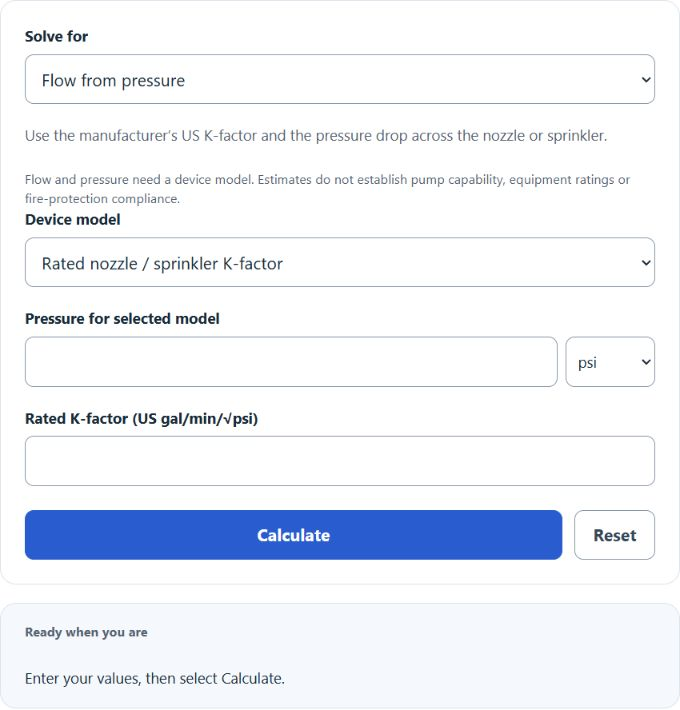
Calculate GPM, PSI, horsepower, or efficiency from pump flow, pressure, and efficiency, or find required horsepower from GPM and PSI.
- All Unit Converters
- Thermodynamics and Fluid Unit Converters
- GPM to Pipe Size Calculator
- m3/h to gpm Calculator
- PSI To Volume Calculator
- PSI to Force Calculator
PSI from GPM Formula
The following formula is used to calculate the PSI from GPM.
Variables:
- PSI is the PSI from GPM (pounds per square inch)
- HP is the pump shaft input horsepower (mechanical HP)
- E is the pump overall efficiency in percent; use E/100 as a fraction
- GPM is the gallons per minute of flow (GPM)
To calculate PSI from GPM, multiply the pump shaft horsepower by 1714 times efficiency divided by 100, then divide by the gallons per minute (GPM).
Why GPM and PSI Cannot Be Directly Converted
GPM measures volumetric flow rate (how much fluid moves per unit time), while PSI measures pressure (force per unit area). These are fundamentally different physical quantities, similar to how speed and weight cannot be converted into each other. The relationship between them always requires at least one additional variable: power input (horsepower), pump efficiency, pipe geometry, or a discharge coefficient. The formula above uses the hydraulic horsepower relationship to bridge the two. In open flow scenarios such as nozzle discharge, pressure and flow are linked instead through the orifice equation Q = K * sqrt(P), where K is a device-specific flow coefficient with units GPM/√PSI.
Where the Constant 1714 Comes From
The constant 1714 is derived from three unit conversion factors: 1 horsepower = 33,000 ft*lb/min, 1 US gallon = 231/1728 ft³ (about 0.13368056 ft³), and 1 PSI = 144 lb/ft2. Dividing 33,000 by the product of 144 and (231/1728) yields 1,714.285714…, which is rounded to 1714 in standard hydraulic engineering. This means 1 hydraulic horsepower is equivalent to 1,714 PSI*GPM. The derivation links the imperial units of power, pressure, and flow into a single convenient constant used across all hydraulic pump sizing calculations.
| Flow (GPM) | Pressure (PSI) |
|---|---|
| 5 | 2913.800 |
| 7.5 | 1942.533 |
| 10 | 1456.900 |
| 12 | 1214.083 |
| 15 | 971.267 |
| 20 | 728.450 |
| 25 | 582.760 |
| 30 | 485.633 |
| 35 | 416.257 |
| 40 | 364.225 |
| 45 | 323.756 |
| 50 | 291.380 |
| 60 | 242.817 |
| 70 | 208.129 |
| 75 | 194.253 |
| 80 | 182.113 |
| 90 | 161.878 |
| 100 | 145.690 |
| 120 | 121.408 |
| 150 | 97.127 |
| * Rounded to 3 decimals. Assumes input power 10 HP and pump efficiency η = 85%. Formula used: PSI = (1714 × HP × η) ÷ GPM. | |
Horsepower Required for Common GPM and PSI Combinations
The table below shows the input horsepower needed to drive a hydraulic pump at various flow rates and pressures, assuming 85% overall pump efficiency. Values are calculated using HP = (GPM * PSI) / (1714 * 0.85).
| GPM \ PSI | 500 | 1000 | 1500 | 2000 | 3000 | 5000 |
|---|---|---|---|---|---|---|
| 5 | 1.7 | 3.4 | 5.1 | 6.9 | 10.3 | 17.2 |
| 10 | 3.4 | 6.9 | 10.3 | 13.7 | 20.6 | 34.3 |
| 15 | 5.1 | 10.3 | 15.4 | 20.6 | 30.9 | 51.5 |
| 20 | 6.9 | 13.7 | 20.6 | 27.5 | 41.2 | 68.6 |
| 30 | 10.3 | 20.6 | 30.9 | 41.2 | 61.8 | 103.0 |
| 50 | 17.2 | 34.3 | 51.5 | 68.6 | 103.0 | 171.6 |
| 75 | 25.7 | 51.5 | 77.2 | 103.0 | 154.4 | 257.4 |
| 100 | 34.3 | 68.6 | 103.0 | 137.3 | 205.9 | 343.2 |
| HP = (GPM * PSI) / (1714 * 0.85). Values rounded to 1 decimal. | ||||||
The Rule of 1500: Quick HP Estimation
The “Rule of 1500” uses shaft HP ≈ GPM × pressure rise(PSI) ÷ 1500 (about 0.000667 times the product). In the conventional 1714 model this corresponds to about 87.5% pump efficiency. It is only a rough power estimate; use the actual pump efficiency and operating curve for design.
Pump Efficiency by Type
Pump efficiency determines how much shaft input power becomes hydraulic power. It varies with pump design, fluid, speed, wear and operating point. Use measured or manufacturer-supplied overall efficiency. The tables here use 85% as an illustrative assumption, not a universal standard. Motor or drive losses are separate from the pump shaft-input model.
K-Factor Method: Flow from Pressure Without Horsepower
In fire protection, irrigation, and nozzle discharge applications, the relationship between PSI and GPM is expressed through the K-factor equation: Q = K * sqrt(P), where Q is the flow rate in GPM, P is the pressure in PSI, and K is a constant specific to the nozzle or orifice. This method does not require horsepower as an input because the pressure is measured at the discharge point rather than calculated from pump power. Use the exact manufacturer-listed K-factor, pressure limits and application requirements; there is no universal K-factor for a sprinkler category. For example, a K-5.6 standard sprinkler operating at 7 PSI discharges approximately 14.8 GPM, while the same head at 20 PSI discharges about 25.0 GPM. Pitot tube measurements at fire hydrant outlets use a variation of this formula with a discharge coefficient (c) that accounts for the orifice shape: Q ≈ 29.84 * c * d² * sqrt(P), where d is the outlet inside diameter in inches and P is measured pitot (velocity) pressure in PSI, not static or residual pressure.
Pressure Drop and Friction Losses in Piping Systems
For a horizontal pipe, friction reduces pressure along the flow direction; elevation changes and velocity changes also affect pressure. These losses increase with flow rate, pipe length, and the number of fittings, and decrease with larger pipe diameters and smoother pipe walls. The Darcy-Weisbach equation is the standard method for calculating friction loss: hf = f * (L/D) * (v^2 / 2g), where f is the friction factor, L is pipe length, D is inside diameter, v is fluid velocity, and g is gravitational acceleration. Acceptable velocity and fitting-loss coefficients depend on the fluid, fitting and system. Use manufacturer or engineering data rather than universal velocity or equivalent-length limits. Undersized piping generates excessive heat, wastes energy, and can cause cavitation at the pump inlet if suction line losses reduce the available Net Positive Suction Head (NPSH) below the pump’s required NPSH.
Common Applications
The GPM to PSI relationship appears in a wide range of engineering and industrial contexts. Hydraulic power units on construction and manufacturing equipment are sized by matching pump GPM output to the cylinder or motor pressure (PSI) demand and then selecting a motor with sufficient horsepower. Log splitters typically operate at 2500 to 3500 PSI with 8 to 16 GPM, requiring 10 to 30 HP engines. Pressure washers are rated by both PSI and GPM, where the cleaning power (sometimes called Cleaning Units or CU) equals PSI multiplied by GPM. A 3000 PSI, 2.5 GPM pressure washer produces 7,500 CU, while a 2000 PSI, 4.0 GPM unit produces 8,000 CU but that product alone does not establish cleaning effectiveness. Fire protection engineers use the K-factor method above to verify that municipal water supply pressure can deliver adequate GPM through sprinkler systems. Irrigation system designers balance pump PSI against friction losses in lateral lines to ensure uniform GPM delivery to each sprinkler head across a field.