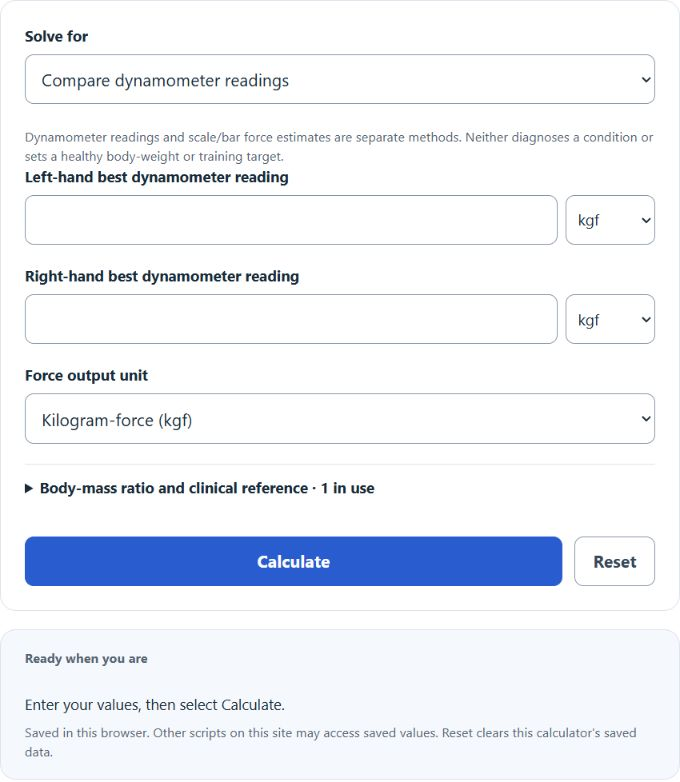
Compare dynamometer grip readings, left-right asymmetry and grip/body-mass ratios, or calculate a separate static scale/bar support-force estimate. Force units are kgf, lbf or newtons.
Dynamometer Grip Strength Calculations
Enter calibrated left and right hand-dynamometer readings from a consistent validated protocol. The calculator reports the stronger reading, the two-hand mean and asymmetry = absolute(left −right) /stronger ×100. An optional body-mass ratio divides stronger grip in kgf by body mass in kg. No universal asymmetry or ratio target is assumed.
The inverse modes multiply body mass by a chosen kgf/kg ratio, or divide known grip by that ratio to give an equivalent body mass. These are algebraic results, not recommended training targets, healthy body weights or weight-loss goals.
The optional EWGSOP2 older-adult clinical reference uses low-strength cut points below27kg for men and below16kg for women; equality is not below. It is not an age percentile or a diagnosis. Protocol, equipment, population and clinical context matter; low muscle quantity/quality and professional assessment are needed to confirm sarcopenia. It is never applied to the scale/bar model.
Separate Scale/Bar Support-Force Formula
The scale/bar modes estimate the vertical force on the person from a resting scale load W and a scale load R during a stationary bar interaction. Upward force on the person is positive. The equal-and-opposite force on the bar has the opposite sign. These are static force-balance calculations, not standardized handgrip measurements.
Variables
| Variable | Meaning | Unit |
|---|---|---|
| F | Signed vertical force on the person from the bar (+ up, − down) | Same unit shown by the scale |
| W | Body weight reading at rest on the scale | lb or kg |
| Wscale | Scale reading during the stationary bar interaction | lb or kg |
If you know any two of the three values, you can solve for the third. The calculator uses these equivalent rearrangements when needed:
Why This Formula Works
For a stationary person, vertical equilibrium gives R + F − W =0, so F =W −R. An upward supporting force from the bar unloads the scale. If you pull upward on a fixed bar, its reaction on you is downward and the scale reading increases; F is then negative. The force you exert on the bar is R −W. This follows Newton’s third law and static force balance.
This is a scale/bar force-balance estimate. It includes the whole interaction with the bar and is not a standardized hand dynamometer test. Its value cannot be interpreted using the optional clinical grip reference.
How to Use the Scale/Bar Modes
- Enter the known resting scale reading using the appropriate force-equivalent unit.
- Enter the known scale reading during a stationary vertical interaction.
- Choose the support-force mode, or select the resting/loaded-reading inverse when that is unknown.
- For an entered support force, use positive for upward force on the person and negative for downward force.
- Read the force on the person and its equal-and-opposite force on the bar separately.
This arithmetic does not establish equipment capacity or a safe test protocol. Do not use an improvised bar/scale setup as a clinical grip assessment.
Example
If a hypothetical resting scale load is180lbf and the supported scale load is100lbf, the inferred upward force on the person is:
The person receives80lbf of upward support and exerts80lbf downward on the bar. Pulling upward on the bar would increase the scale load instead, giving a negative value for upward support.
Unit Notes
Choose the input and output force units. Mass-calibrated bathroom-scale displays are interpreted as force-equivalent loads at standard gravity:
- If you enter pounds, the result is effectively in pounds-force (lbf).
- If you enter kilograms from a bathroom scale, the result is effectively in kilogram-force (kgf).
If you want to express the result in newtons, use the following conversions:
Expected Limits of the Test
For an unloading case, with no other supports and no acceleration, the loaded scale reaction lies between zero and the resting load. Positive upward support then satisfies:
A zero scale reaction corresponds to full upward support in this model. A reading above the resting load implies negative upward support (a downward reaction on the person), as when the person pulls upward on the fixed bar. Movement or extra supports invalidate this simple balance; negative loaded scale reactions are rejected.
What This Calculator Measures vs. What It Does Not
| The scale/bar model can describe | The scale/bar model does not provide |
|---|---|
| Estimating signed vertical support from a static load change | Diagnosing low grip strength |
| Comparing your own performance under the same setup | Comparing directly with hand dynamometer norms |
| Comparing repeat measurements under a controlled protocol | Separating finger, hand, and forearm force precisely |
| Solving the support-force or scale-reading inverses | Replacing clinical strength testing |
Factors That Change the Result
- Bar height: Different arm and shoulder positions change leverage and muscle contribution.
- Pull angle: The formula describes the vertical component only. Horizontal forces and moments are not estimated.
- Body movement: Jerking, bouncing, or swaying can make the scale fluctuate.
- Foot pressure shifts: Leaning forward or backward alters how force is distributed through the scale.
- Scale quality: Digital scales may lag or smooth readings; mechanical scales may have parallax or calibration error.
- Grip surface: Slippery bars reduce how much force you can apply before your hands give out.
- Fatigue: Your result can drop significantly after pulling, climbing, lifting, or forearm-intensive exercise.
Protocol and Measurement Limits
For dynamometer readings, follow the device instructions and a validated handgrip protocol with consistent posture, handle setting, trial number and rest. For any force-balance example, the stationary and vertical-force assumptions must hold. Changes in technique, calibration or equipment prevent direct comparison; this calculator does not prescribe maximal-effort testing.
Interpreting Your Number
A larger positive scale/bar support value means more upward support acts on the person in that static setup; it does not isolate handgrip strength. Dynamometer readings and scale/bar values must not be compared directly. The clinical reference does not classify overall health or prescribe treatment.
Common Questions
Is this the same as handgrip strength?
The dynamometer modes use handgrip readings. The separate scale/bar modes estimate static vertical support from load changes and are not equivalent.
Can I compare this to clinical grip standards?
Use only an appropriate validated dynamometer protocol and population reference, with professional interpretation. Scale/bar force estimates cannot be compared with clinical grip standards.
Why does the result seem low even if I have strong hands?
Your result may be limited by shoulder position, elbow flexion, bar friction, discomfort, fatigue, or inability to apply force vertically.
Why does the reading jump around?
Most commonly due to movement, inconsistent pulling, scale response delay, or shifting pressure through the feet.
Can the estimate ever exceed body weight?
Positive upward support is limited by the resting weight when the loaded scale reaction remains nonnegative and no other supports act. An upward force exerted on the bar instead produces a downward reaction on the person and can increase the scale reading; that is a different sign and loading case.