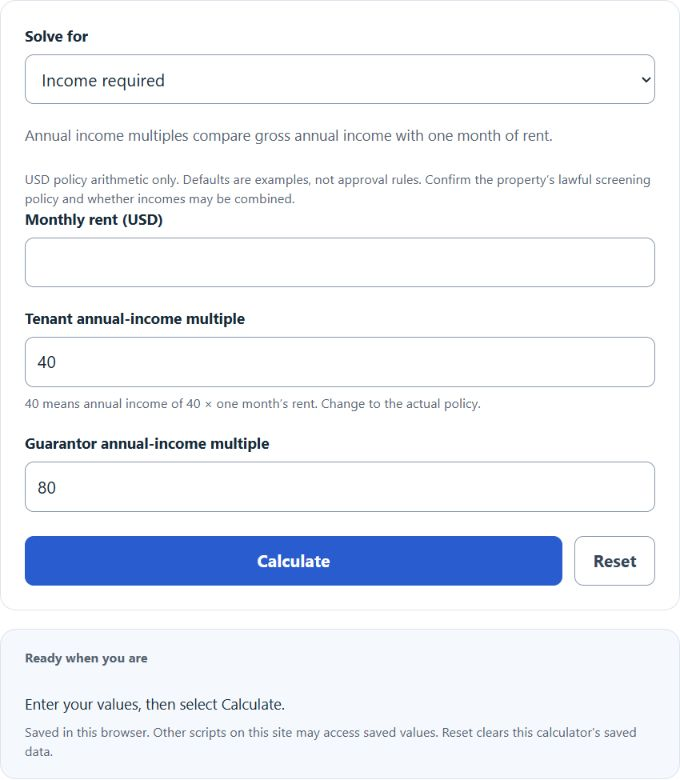
Use this calculator to estimate tenant and guarantor income thresholds, compare entered incomes or find a rent limit under a specified income multiple. The 40× and 80× defaults are examples of annual income compared with one month’s rent, not universal qualification rules.
Guarantor Income Formula
A property may describe an income screen as a multiple of one month’s rent. For the following examples, use annual gross-income multiples of 40 for a tenant and 80 for a guarantor; enter the property’s actual applicable multiples in the calculator.
Required Tenant Income = Monthly Rent * 40
 Required Guarantor Income = Monthly Rent * 80
Variables:
- Monthly Rent is the rent for the unit
- 40 is the tenant income multiple, meaning annual income of forty times one month’s rent (the same as rent being 30% of gross income)
- 80 is the guarantor income multiple, set higher because the guarantor also supports their own housing costs
A guarantor or co-signer may promise to cover obligations if the tenant does not, subject to the actual agreement. The calculator compares guarantor income with the full entered guarantor threshold; it does not add only the tenant’s income shortfall. It does not determine approval or interpret a lease.
Common Income Multiples
The following arithmetic examples use $2,500 monthly rent. The labels describe example multiples rather than typical, lenient or strict policies; confirm the actual policy and applicable screening protections.
| Applicant | Typical rule | Income on $2,500 rent |
|---|---|---|
| Tenant example | 40x monthly rent | $100,000 |
| Tenant alternative | 36x (3x monthly income) | $90,000 |
| Guarantor example | 80x monthly rent | $200,000 |
| Guarantor alternative | 90x monthly rent | $225,000 |
Only combine roommate or co-signer incomes when the property permits it. Some policies apply individual minimums or require each guarantor to meet a full threshold; the equal-share tool is hypothetical arithmetic.
Example Problems
Example 1: Income needed to rent an apartment.
The rent is $2,500 a month. Using the standard rules, the tenant needs 2,500 * 40 = $100,000 a year, and a guarantor would need 2,500 * 80 = $200,000 a year.
Example 2: Deciding whether a guarantor is needed.
You earn $85,000 and want the same $2,500 apartment. The requirement is $100,000, so you are $15,000 short and will likely need a guarantor. That guarantor would need to show the full $200,000 in annual income to satisfy the landlord.
Frequently Asked Questions
How much does a guarantor need to make?
Under an example 80× annual-income multiple, $2,000 monthly rent implies $160,000 annual income. Actual guarantor requirements and acceptance vary; the 80× value is not a universal rule.
What income do I need to rent without a guarantor?
Under the example 40× annual-income rule, monthly rent is 30% of gross monthly income at the threshold. Meeting that arithmetic test does not guarantee approval or affordability. Confirm which requirements apply; voucher and other lawful-source-of-income protections may prohibit blanket income screens in some circumstances.
Can I use a guarantor if my income is a little low?
A property may accept a guarantor when the applicant does not meet its applicable income screen. Confirm whether one is accepted and the actual terms. This calculator does not determine legal responsibilities or replace advice about an agreement.