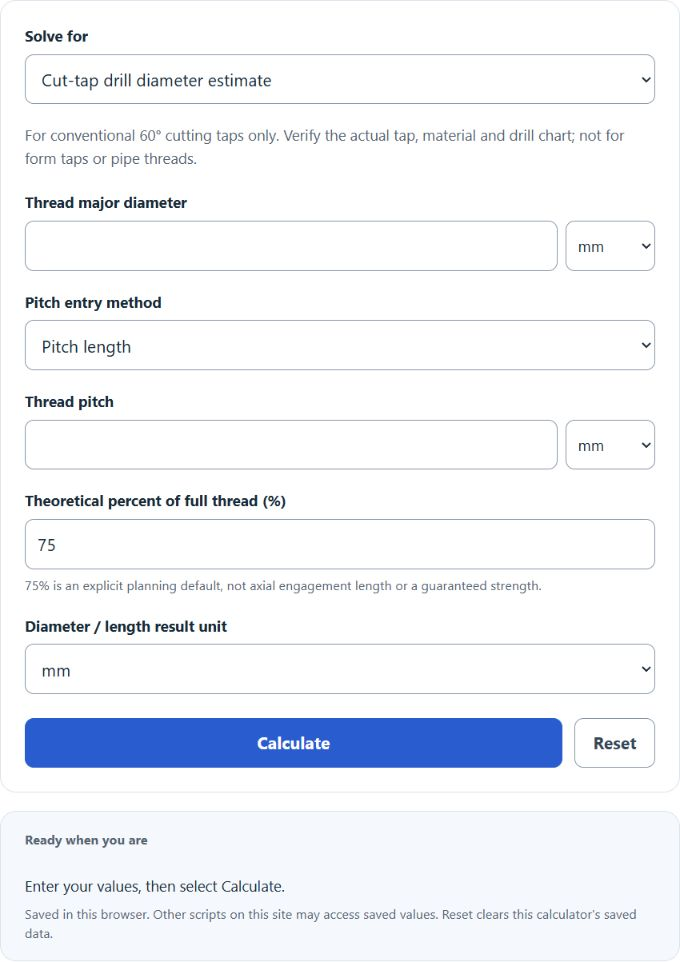
Calculate a conventional 60° cutting-tap drill estimate, circular diameter from area, finished-hole tolerance limits, or cylindrical hole volume. For cutting taps, d ≈ D − 0.01299 × E × P uses percent E (75, not 0.75) and matching-unit pitch P; TPI converts to pitch first. This follows Tapmatic’s inch cutting-tap convention, approximately equivalent to its rounded metric 76.98 divisor. Forming and pipe taps need different guidance. Nearest 1/64-inch grid values are comparisons, not drill recommendations.
Hole Size Formula
The following formula and example apply to the cylindrical-volume mode. For diameter from area, d = 2√(A/π). Finished-hole limits equal nominal plus the lower and upper signed deviations.
Variables:
- HS is ideal cylindrical hole volume (ft³), not diameter or tap-drill size
- hr is the hole radius (ft)
- hd is the hole depth (ft)
How to Calculate Hole Size?
The following steps outline how to calculate the Hole Size.
- First, determine the hole radius (ft).
- Next, determine the hole depth (ft).
- Next, gather the formula from above = HS = pi*hr^2*hd.
- Finally, calculate the Hole Size.
- After inserting the variables and calculating the result, check your answer with the calculator above.
Example Problem :
Use the following variables as an example problem to test your knowledge.
hole radius (ft) = 3
hole depth (ft) = 10
HS = π × 3² × 10 ≈ 282.743339 ft³. The model excludes drill-tip cones, chamfers and irregular walls.