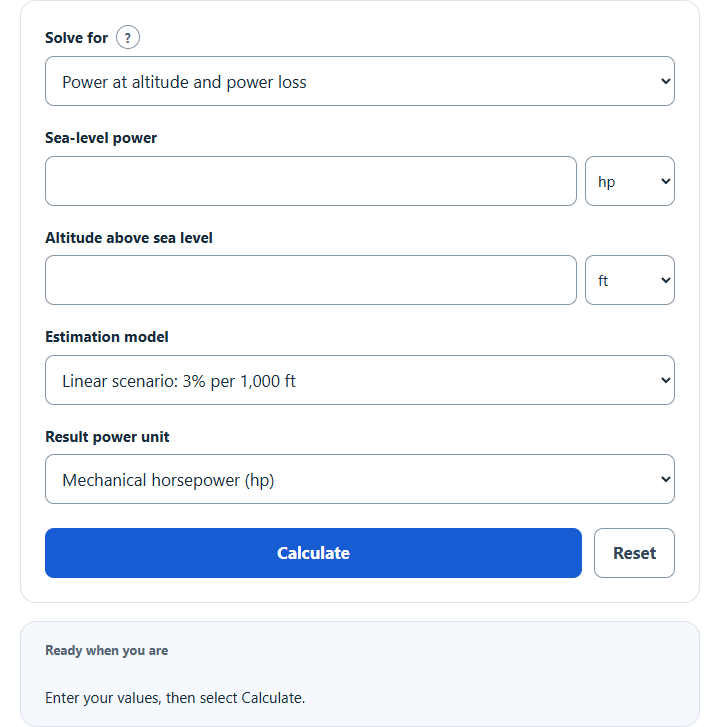
Calculate horsepower loss at altitude and the engine power left, using the 3% per 1,000 ft rule or the standard atmosphere, in hp or kW and ft or m.
Calculator Functions
| Function | What it does | What it requires |
|---|---|---|
| Power at altitude and power loss | Estimates the power an engine makes at an altitude and the power lost against its sea-level figure | Requires the sea-level power, the altitude above sea level and an estimation model |
| Sea-level reference power | Works back from power measured at altitude to the equivalent sea-level power | Requires the measured power at altitude, the altitude above sea level and an estimation model |
| Altitude from a known power loss | Finds the altitude at which the chosen model gives a stated power loss | Requires the sea-level power, the power loss and an estimation model |
Power goes in as hp or kW and altitude as ft or m, with 1 hp taken as 0.7457 kW and 1 ft as 0.3048 m [3]. The Estimation model is one of three: Linear scenario: 3% per 1,000 ft, ISA dry-air density proxy (0–11,000 m), or Custom linear loss rate, which adds a field for the loss in % per 1,000 ft. Every result lists the sea-level reference, the power at altitude, the power loss in hp or kW and as a percentage, and the altitude.
HP Loss at Altitude Formulas
| Palt | Power at altitude (hp or kW) |
| Psea | Sea-level power (hp or kW) |
| R | Share of sea-level power kept at altitude, from the estimation model |
The power loss is Psea − Palt. The two linear models and the ISA model differ only in how they set R.
Linear loss rate
(h ÷ 1,000) [1]
h is the altitude in feet and r is the loss in percent per 1,000 ft: 3 for the linear scenario, or the custom rate. A naturally aspirated engine is commonly taken to lose 3% of its power per 1,000 ft [1]. A 300 hp engine at 5,000 ft keeps R = 1 − 0.03 × 5 = 0.85, so it makes 255 hp and loses 45 hp.
ISA dry-air density proxy
288.15)4.2559 [2]
h is the altitude in meters. R here is the ratio of standard-atmosphere air density at altitude to its sea-level value, on the assumption that engine power follows air density. The standard atmosphere cools by 6.5 °C per 1,000 m from 288.15 K at sea level, and density falls with the temperature ratio to roughly the 4.256 power up to 11,000 m [2]. At 5,000 ft (1,524 m) R = 0.8617, so 300 hp becomes 258.5 hp, a loss of 41.5 hp.
Power at altitude and power loss
The main formula applies directly with R from the selected model. An altitude at which the linear model reaches a 100% loss is rejected, as is an ISA altitude above 11,000 m.
Sea-level reference power
A dyno reading of 255 hp at 5,000 ft with the 3% model gives 255 ÷ 0.85 = 300 hp at sea level.
Altitude from a known power loss
× 1,000
This is the linear model solved for altitude in feet: a 45 hp loss on 300 hp at 3% per 1,000 ft is 5,000 ft. With the ISA model the calculator inverts the density formula instead, h = [1 − R1 ÷ 4.2559] × 288.15 ÷ 0.0065 in meters, and the same loss gives 5,449 ft. The answer is the altitude the model implies, not a measured elevation.
Limits of This Estimate
- The 3% figure is a general rule for naturally aspirated engines, not a rating for any one engine. A turbocharged or supercharged engine can make up for thinner air and lose far less [1].
- The ISA model describes an average day. Real air density changes with weather, temperature and humidity [2], and the model treats elevation as standard-atmosphere altitude.
- Power is assumed to follow air density exactly. Fuel mapping, intake temperature and engine condition are not modeled.
- These estimates are based on the best available data and estimations.
Sources
- Garrett Motion, Turbocharging At Elevation: 3% power loss per 1,000 ft for a naturally aspirated engine, and why a turbocharged engine differs
- NASA Glenn Research Center, Earth Atmosphere Equation (Metric): standard atmosphere temperature, pressure and density up to 11,000 m
- NIST, Guide for the Use of the International System of Units (SP 811), Appendix B.8: horsepower to watts and feet to meters