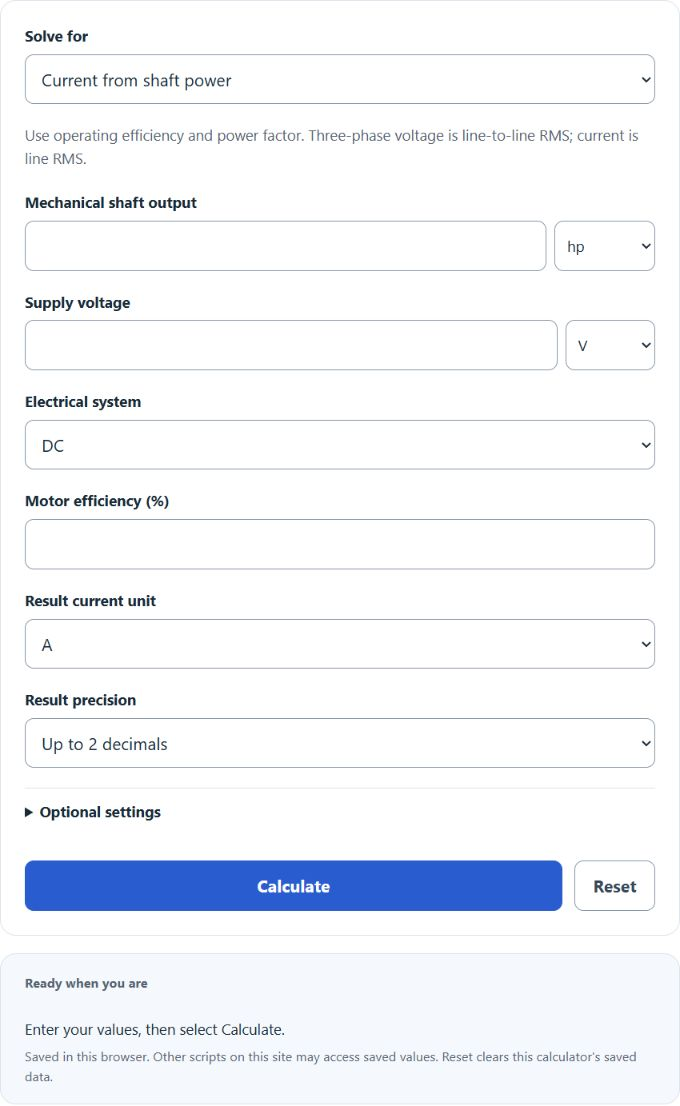
Calculate motor current from horsepower for DC, single-phase, or three-phase power, or reverse horsepower or voltage with efficiency, power factor, and loss details.
- All Physics Calculators
- Motor Current Calculator
- Watts to Amps Calculator
- Volts to Horsepower Calculator
- Single Phase Power Calculator
- Three Phase Power Calculator
- Current Per Phase Calculator
Current From HP Formula
The following formulas estimate current at an operating point. Pshaft is mechanical output in watts: mechanical hp × 745.6998715822702 or metric hp × 735.49875. Efficiencies are fractions in the formulas and percentages in the calculator.
Single-phase AC: I = Pshaft / (V × PF × η)
Balanced three-phase AC: I = Pshaft / (√3 × V × PF × η)
DC: I = Pshaft / (V × η)
- Where I is the current (amps)
- HP is the mechanical power output in horsepower (hp)
- V is supply voltage in volts; AC uses RMS, and balanced three-phase uses line-to-line RMS voltage and line RMS current
- PF is true AC power factor, greater than zero and no more than 1; omit it for DC
- η is motor efficiency, greater than zero and no more than 1; enter its percentage in the calculator
To calculate current from horsepower, convert horsepower to watts (mechanical HP × 745.6998715822702) and divide by the product of voltage, power factor, and efficiency (and also divide by √3 for three-phase systems).
| Horsepower (HP) | Current at 120 V (A) | Current at 240 V (A) | Current at 480 V (A) |
|---|---|---|---|
| ¼ | 2.03 | 1.02 | 0.51 |
| ⅓ | 2.71 | 1.35 | 0.68 |
| ½ | 4.06 | 2.03 | 1.02 |
| ¾ | 6.09 | 3.05 | 1.52 |
| 1 | 8.12 | 4.06 | 2.03 |
| 1½ | 12.18 | 6.09 | 3.05 |
| 2 | 16.25 | 8.12 | 4.06 |
| 3 | 24.37 | 12.18 | 6.09 |
| 5 | 40.62 | 20.31 | 10.15 |
| 7½ | 60.92 | 30.46 | 15.23 |
| 10 | 81.23 | 40.62 | 20.31 |
| 15 | 121.85 | 60.92 | 30.46 |
| 20 | 162.46 | 81.23 | 40.62 |
| 25 | 203.08 | 101.54 | 50.77 |
| 30 | 243.69 | 121.85 | 60.92 |
| 40 | 324.92 | 162.46 | 81.23 |
| 50 | 406.15 | 203.08 | 101.54 |
| 60 | 487.39 | 243.69 | 121.85 |
| 75 | 609.23 | 304.62 | 152.31 |
| 100 | 812.31 | 406.15 | 203.08 |
| Single-phase formula: I (A) = (mechanical HP × 745.6998715822702) / (V × PF × η). Assumes PF = 0.90 and efficiency η = 0.85. For three-phase (using line-to-line voltage), I = (mechanical HP × 745.6998715822702) / (√3 × V × PF × η). | |||
How to Calculate Current From HP?
The following example problem outlines how to calculate Current From HP.
Example Problem #1
- First, determine the total horsepower (hp). In this example, the total horsepower (hp) is 10 hp.
- Next, determine the voltage (volts). For this problem, the voltage is 240 V.
- Next, determine the power factor. In this case, the power factor is 0.85.
- Next, determine the efficiency. For this problem, the efficiency is 0.90.
- Finally, calculate the Current From HP using the formula above (single-phase):
I = (mechanical HP × 745.6998715822702) / (V × PF × η)
Inserting the values from above and solving yields:
I = (10 × 745.6998715822702) / (240 × 0.85 × 0.90) ≈ 40.62 A
FAQ
What is horsepower (HP) and how is it related to electrical current?
Horsepower (HP) is a unit of power commonly used to describe mechanical output power from motors and engines. When a motor is powered electrically, you can estimate the electrical current it draws from its mechanical horsepower, voltage, power factor, and efficiency. For single-phase systems, a common estimate is: I = (mechanical HP × 745.6998715822702) / (V × PF × η). For three-phase systems (using line-to-line voltage), use: I = (mechanical HP × 745.6998715822702) / (√3 × V × PF × η).
Why is the power factor (PF) important in calculating current from HP?
Power factor (PF) is the ratio of real power (kW) to apparent power (kVA) in an AC circuit. A lower power factor means more current is required to deliver the same real power, which increases the electrical load on conductors and equipment. That’s why PF appears in the denominator of the HP-to-current formulas.
How does efficiency (η) impact the calculation of current from HP?
Efficiency (η) is the ratio of mechanical power output to electrical power input (expressed as a decimal from 0 to 1). Lower efficiency means more electrical input power (and therefore more current) is required to produce the same mechanical horsepower, so η also appears in the denominator of the current calculation.