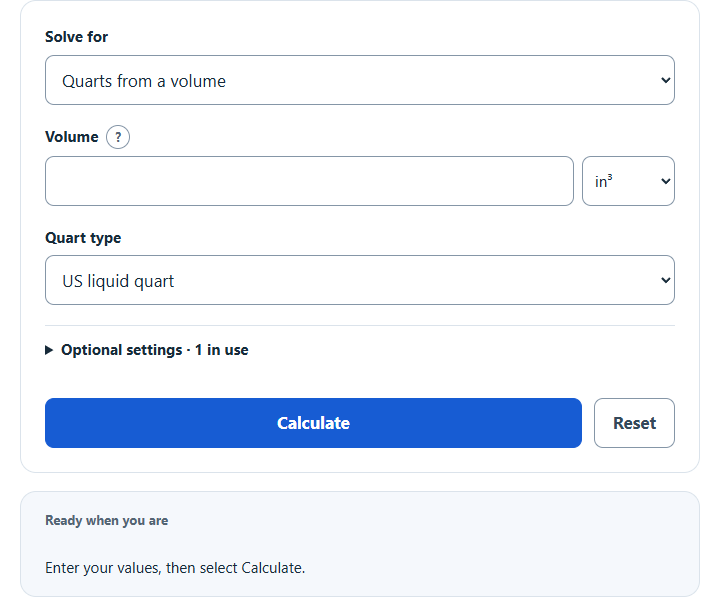
Convert cubic inches to quarts or quarts to cubic inches, or find how many quarts a box, cylinder or other container holds from its inside dimensions.
- All Unit Converters
- Pounds To Quarts Calculator
- In3 To Fluid Ounces Conversion Calculator
- Quart Volume Calculator
- Liquid Volume Calculator
- Box Volume Calculator
Calculator Functions
| Function | What it does | What it requires |
|---|---|---|
| Quarts from a volume | Converts a volume in cubic inches, or another volume unit, to quarts | Requires the volume and the quart type |
| Cubic inches from quarts | Converts quarts to cubic inches | Requires the number of quarts and the quart type |
| Container capacity | Finds how many quarts a box, cube, cylinder, sphere or cone holds | Requires the container shape, its inside dimensions and the quart type |
| Fill volume or depth | Finds the quarts held at a given depth in a straight-sided container, or the depth a number of quarts reaches | Requires the base shape, its length and width or diameter, the fill depth or the target quarts, and the quart type |
The quart type is US liquid, US dry or Imperial. Volumes can be entered in in³, ft³, cm³, mL, L, US fl oz, US cups, US pints or US gallons, and lengths in in, ft, cm or mm. Every result includes a table of the same volume in cubic inches, all three quarts, US gallons, pints, fluid ounces and cups, liters and cubic feet. An optional setting changes the number of decimal places.
Inches to Quarts Formulas
| Q | Volume in US liquid quarts (qt) |
| V | Volume in cubic inches (in³) |
| 57.75 | Cubic inches in one US liquid quart, an exact figure [1] |
A quart is a volume and an inch is a length, so inches alone cannot be turned into quarts. The conversion works on cubic inches, or on the inside dimensions of a container. Square inches are an area and cannot be converted either, unless a depth is known. The three quarts in use are different sizes:
| Quart type | Cubic inches in 1 quart | Liters in 1 quart |
|---|---|---|
| US liquid quart | 57.75 (exact) | 0.946353 |
| US dry quart | 67.200625 (exact) | 1.101221 |
| Imperial quart | 69.3549 | 1.1365225 (exact) |
The US figures come from the gallon of 231 cubic inches and the dry quart of 67.200625 cubic inches [1]. The Imperial quart is a quarter of the Imperial gallon of 4.54609 liters [2], converted at 16.387064 cm³ per cubic inch.
Quarts from a volume
The volume is converted to cubic inches and divided by the factor for the chosen quart. 100 cubic inches is 100 ÷ 57.75 = 1.732 US liquid quarts, 1.488 US dry quarts or 1.442 Imperial quarts.
Cubic inches from quarts
For US dry quarts the factor is 67.200625, and for Imperial quarts it is 69.3549. Six US liquid quarts are 6 × 57.75 = 346.5 cubic inches.
| Quarts | US liquid (in³) | US dry (in³) | Imperial (in³) |
|---|---|---|---|
| 1 | 57.75 | 67.20 | 69.35 |
| 2 | 115.5 | 134.40 | 138.71 |
| 3 | 173.25 | 201.60 | 208.06 |
| 4 | 231 | 268.80 | 277.42 |
| 5 | 288.75 | 336.00 | 346.77 |
| 6 | 346.5 | 403.20 | 416.13 |
| 8 | 462 | 537.61 | 554.84 |
| 10 | 577.5 | 672.01 | 693.55 |
Container capacity
The inside volume is worked out in cubic inches from the shape, then divided by the quart factor.
| Shape | Inside volume |
|---|---|
| Rectangular box | length × width × height |
| Cube | side³ |
| Cylinder | π × r² × height |
| Sphere | 4 × π × r³ ÷ 3 |
| Cone | π × r² × height ÷ 3 |
r is the radius, or half the diameter. A box 10 by 8 by 6 inches is 480 cubic inches, or 8.312 US liquid quarts. A cylinder 6 inches across and 10 inches high is π × 3² × 10 = 282.74 cubic inches, or 4.896 quarts. For a box, cube or cylinder the result also gives the quarts held by each inch of depth.
Fill volume or depth
A is the area of the base in square inches, length × width for a rectangle or π × (diameter ÷ 2)² for a circle, and d is the depth of the contents in inches. A pan 12 by 8 inches filled 3 inches deep holds 288 cubic inches, or 4.987 US liquid quarts. Set to Depth for target quarts, the calculator works the other way, d = Q × 57.75 ÷ A: four quarts in a round pot 8 inches across reach 231 ÷ 50.265 = 4.596 inches. With the optional total inside height entered, the result adds the capacity, the percentage full and the room left, and a fill deeper than the container is rejected.
Limits of This Estimate
- Dimensions are inside measurements. Outside measurements include the wall and base thickness and overstate the capacity.
- Fill volume or depth assumes a level, upright container with straight vertical sides. Tapered pots, bowls and buckets hold less near the bottom than this gives.
- US recipes, motor oil and paint use the US liquid quart. The US dry quart is for dry goods such as berries and grain, and the Imperial quart is the British unit, about 20% larger than the US liquid quart.
Sources
- NIST, Handbook 44 (2026), Appendix C, General Tables of Units of Measurement: cubic inches in the US liquid quart, US dry quart and US gallon
- NIST, Guide for the Use of the International System of Units (SP 811), Appendix B.8: liters in the Imperial gallon and in the US quarts