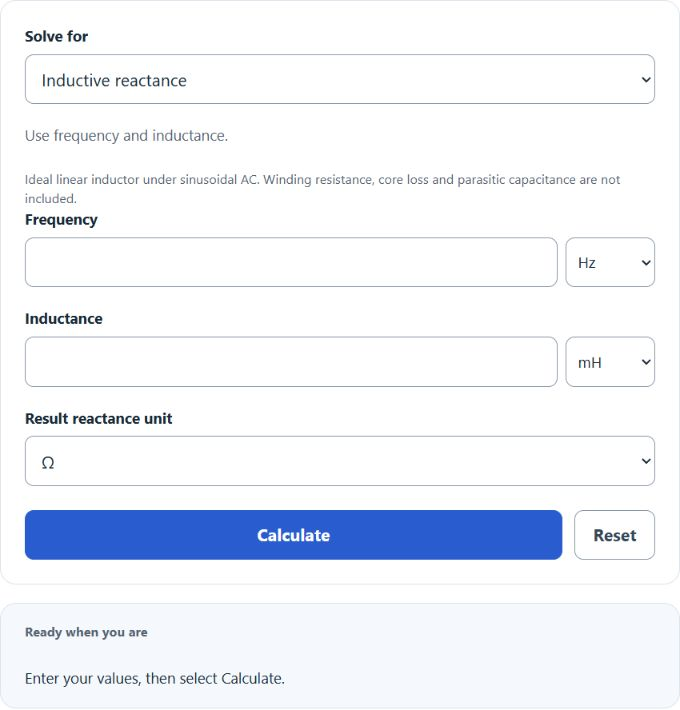
Calculate inductive reactance or inductance from frequency and coil values, with results in ohms, henries, millihenries, and microhenries.
Related Calculators
- Inductance To Ohms Calculator
- Transformer Impedance Calculator
- Current Imbalance Calculator
- Peak Current Calculator
- All Physics Calculators
Inductive Load Formula
The following equation gives the inductive reactance of an ideal linear inductor under sinusoidal AC when frequency and inductance are known. It excludes winding resistance, core loss and parasitic capacitance.
- Where X_L is the inductive reactance (Ω)
- f is the frequency (Hz)
- L is the inductance (H)
Select Inductive reactance or Inductance under Solve for, enter the two known quantities and their units, then select Calculate.
What is an Inductive Load?
Definition:
An inductive load refers to a component in an AC circuit—such as an inductor—that resists changes in current by generating inductive reactance. This calculator determines inductive reactance or inductance from the two known quantities using X_L = 2π f L. It does not solve for frequency.
How to Calculate Inductive Load?
Example Problem:
The following example outlines the steps and information needed to calculate the inductive reactance.
First, determine the known values. In this example, the Frequency is 60 Hz and the Inductance is 0.2 H.
Next, calculate the inductive reactance using the formula above:
X_L = 2π f L
X_L = 2π * 60 * 0.2
X_L ≈ 75.40 Ω
FAQ
What is inductive reactance?
Inductive reactance is the opposition an inductor offers to AC current flow, and it increases with both frequency and inductance.
How do I use the calculator?
Choose the value to solve for, enter the two known quantities with their units, then select Calculate. Calculation details show the formula and unit conversions.
Why is understanding inductive load important in circuit design?
Knowing the inductive load helps in predicting the behavior of AC circuits, ensuring proper design and safe operation by accounting for the opposition an inductor provides against changes in current.