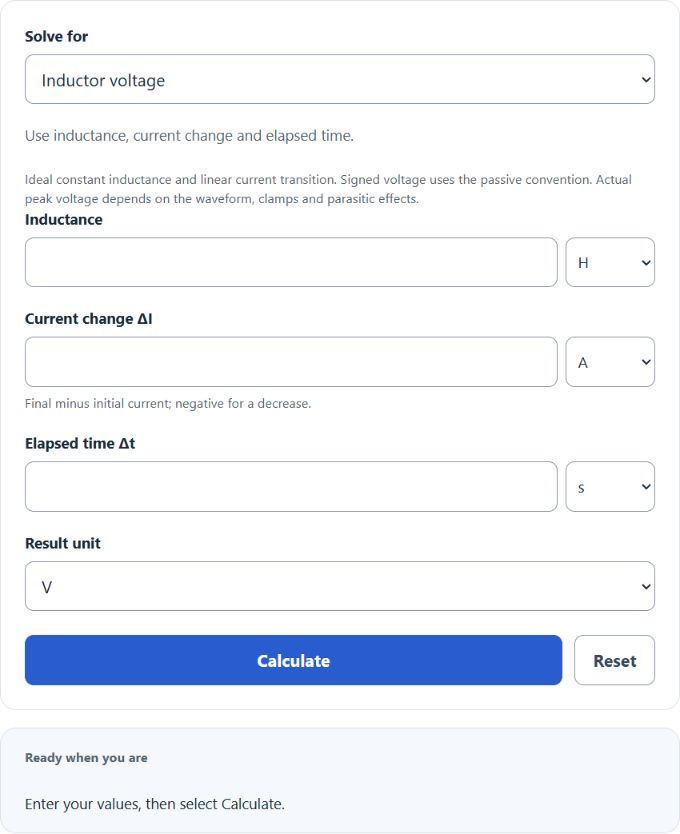
Calculate inductor voltage spike, inductance, current change, or time from three known values using L, ΔI, and Δt with unit support.
Related Calculators
- Diode Selection Calculator
- Transistor Base Current Calculator
- Motor Startup Current Calculator
- Norton Current Calculator
- All Physics Calculators
Inductor Voltage Spike Formula
The calculator uses V = L ΔI/Δt for constant ideal inductance. This gives signed average voltage over the interval and constant voltage for a linear current transition. Actual peak voltage also depends on the current waveform, protection clamps and parasitic effects.
- V = inductor voltage spike, in volts (V)
- L = inductance, in henrys (H)
- ΔI = change in current, in amperes (A)
- Δt = change in time, in seconds (s)
Select Inductor voltage to solve from inductance, current change and elapsed time:
Select Inductance to rearrange the same formula:
Select Current change to solve for current change:
Select Elapsed time to solve for switching or transition time:
The calculator converts all entries to base units before calculating: volts, henrys, amperes, and seconds. It then converts the result to the selected Result unit. Enter the displayed known quantities and select Calculate.
Common Unit Conversions for Inductor Spike Calculations
Use these conversions to check whether your inputs are in the expected scale.
| Quantity | Unit | Base unit conversion |
|---|---|---|
| Voltage | 1 kV | 1000 V |
| Inductance | 1 mH | 0.001 H |
| Inductance | 1 kH | 1000 H |
| Current | 1 mA | 0.001 A |
| Current | 1 kA | 1000 A |
| Time | 1 ms | 0.001 s |
| Time | 1 min | 60 s |
How Transition Time Affects Voltage Spike
For the same inductance and current change, a shorter transition time creates a higher voltage spike.
| Inductance | Change in Current | Change in Time | Voltage Spike |
|---|---|---|---|
| 10 mH | 2 A | 100 ms | 0.2 V |
| 10 mH | 2 A | 10 ms | 2 V |
| 10 mH | 2 A | 1 ms | 20 V |
| 10 mH | 2 A | 0.1 ms | 200 V |
Example Problems
Example 1: Calculate the voltage spike
You have an inductance of 50 mH, a current change of 3 A, and a time change of 2 ms.
Convert units first:
- 50 mH = 0.05 H
- 2 ms = 0.002 s
The inductor voltage spike is 75 V.
Example 2: Calculate the change in time
You have a voltage spike of 120 V, an inductance of 20 mH, and a current change of 6 A.
Convert inductance first:
- 20 mH = 0.02 H
The change in time is 0.001 s, or 1 ms.
FAQ
Why does an inductor create a voltage spike?
An inductor resists changes in current. When current through the inductor changes quickly, the inductor generates voltage in response. The faster the current changes, the larger the voltage can be. This is why switching off a coil, relay, solenoid, or motor winding can produce a sharp voltage spike.
Does the formula include polarity?
The calculator gives signed average voltage using V = L × ΔI / Δt under the passive convention: positive current enters the positive-voltage terminal. Enter ΔI as final minus initial current. The magnitude is the absolute value of this result. Induced emf around the current loop has the opposite sign. This average-voltage estimate alone is not a guaranteed peak or protection-component rating.
Why does a smaller time value produce a much larger spike?
The voltage is proportional to the rate of current change. If the same current change happens in one tenth of the time, the voltage spike becomes ten times larger. This is why very fast switching events can create high transient voltages even with relatively small inductors.