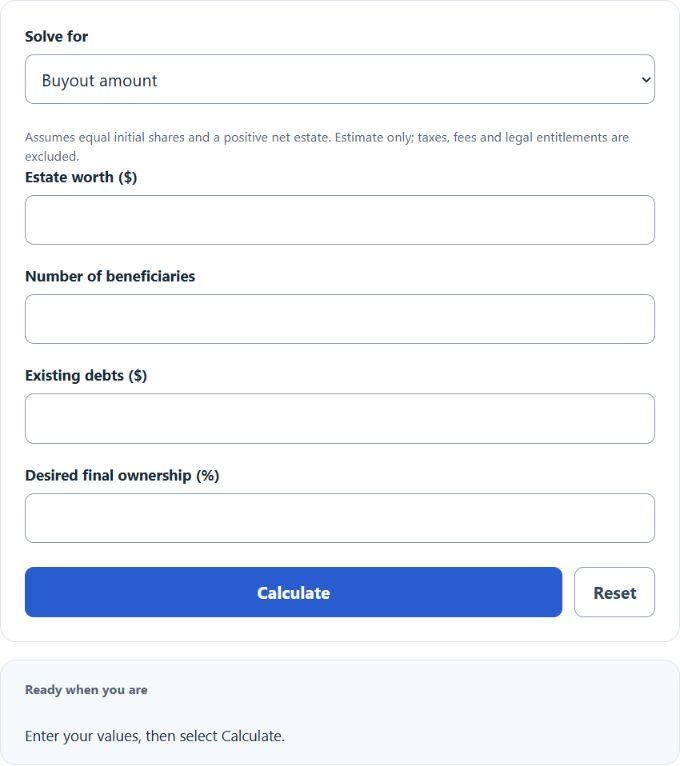
Calculate inheritance buyout amounts, estate worth, beneficiary count, debts, or ownership share from a net estate and desired share.
Related Calculators
- Asset Based Mortgage Calculator
- Origination Fee Calculator
- Imputed Interest Calculator
- Appreciation Rate Calculator
- All Personal Finance Calculators
Inheritance Buyout Formula
The following equation is used to calculate the Inheritance Buyout.
- Where IB is the inheritance buyout ($)
- EW is the estate worth ($)
- D is any existing debts ($)
- B is the additional fraction purchased: desired final ownership fraction minus 1 divided by the number of equally entitled beneficiaries
To calculate the inheritance buyout, subtract any debts from the total estate value, then multiply by the portion of the estate one heir (or party) wishes to buy out.
What is an Inheritance Buyout?
Definition:
An inheritance buyout is the process by which one or more beneficiaries purchase the ownership interest of the remaining beneficiaries in an estate, effectively consolidating ownership to a single party or fewer parties and compensating all heirs fairly.
How to Calculate Inheritance Buyout?
Example Problem:
The following example outlines the steps and information needed to calculate the Inheritance Buyout.
First, determine the estate worth. In this case, the total value of the estate is $500,000.
Next, identify any outstanding debts. Suppose there is $100,000 in debts on the estate.
Also, determine the additional ownership interest being purchased. With four equally entitled beneficiaries, each starts with 25%. A desired final share of 75% means purchasing an additional 50% of the estate.
Finally, calculate the inheritance buyout using the formula above:
IB = ( EW - D ) * B
IB = ( $500,000 - $100,000 ) * 0.50
IB = $200,000
FAQ
How does an inheritance buyout calculator work?
This calculator subtracts debts from estate value and prices the additional share acquired, assuming equal initial shares. It can solve for the buyout, estate worth, beneficiary count, debts, or desired final share. It excludes taxes, transaction costs, and differing legal entitlements; actual terms require an agreed valuation and professional advice.
Why might someone want to perform an inheritance buyout?
An inheritance buyout allows one heir to take full or increased control of an asset (such as a home or property) without forcing a sale or ongoing co-ownership. This can reduce conflicts among heirs and ensure that each party receives fair compensation for their share.
Are there tax implications to consider with an inheritance buyout?
Yes, potential tax obligations may include capital gains, estate taxes, or gift taxes depending on your location and the specifics of the transaction. Always consult with a financial or legal professional to understand how taxes may apply to your situation.