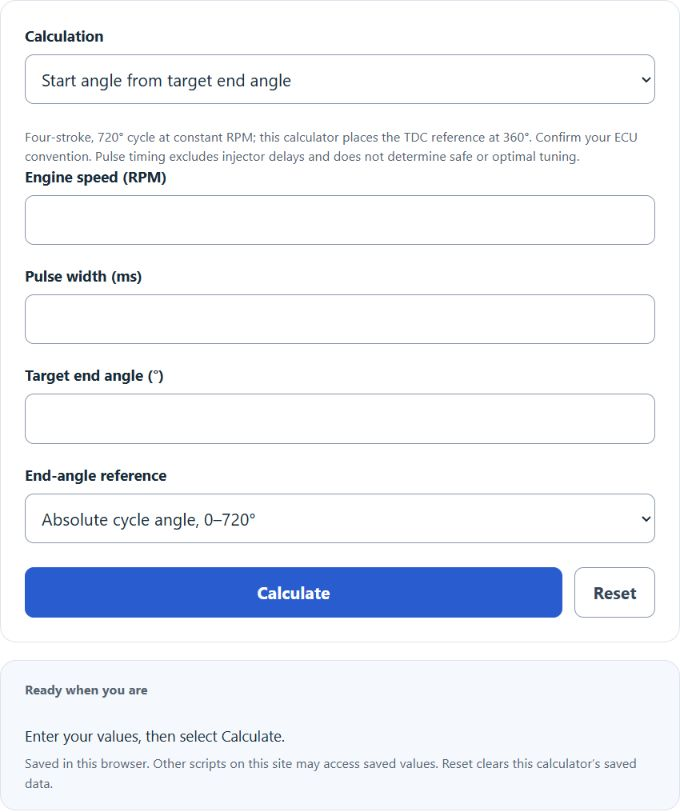
Calculate injector start timing from engine RPM, pulse width, and desired end-of-injection angle, with crank degrees and cycle usage.
Related Calculators
- Boost ↔️ HP Calculator
- Cranking Pressure Calculator
- Head Gasket Volume Calculator
- Compression Height Calculator
- All Automotive Calculators
Injector Timing / End of Injection Formula
For a four-stroke engine at constant RPM, the calculator converts pulse width into crankshaft degrees and subtracts that duration from the selected end angle. It uses a 720° cycle and places the TDC reference at 360°. Confirm the ECU convention; injector delays and physical fuel delivery are outside this pulse-timing model.
- DurationDeg is the injector pulse width expressed in crankshaft degrees.
- PW_ms is injector pulse width in milliseconds.
- RPM is engine speed in revolutions per minute.
- EOI_input is the end of injection value entered as an absolute 0 to 720 degree cycle angle.
- EOI_BTDC is the end of injection value entered as degrees before the 360 degree reference point.
- EOI_ATDC is the end of injection value entered as degrees after the 360 degree reference point.
- EOI_abs is the end of injection angle converted to an absolute cycle angle.
- SOI is start of injection.
- CycleUsed is the percent of the 720 degree engine cycle occupied by the injector pulse.
- WindowLeft is the remaining crank angle in the 720 degree cycle after the pulse duration is accounted for.
In the end of injection mode, you enter RPM, pulse width, and a target end angle. The calculator converts the pulse width to crank degrees, converts the end angle reference if needed, and subtracts the pulse duration from the end angle to calculate start of injection.
In the timing sweep mode, the same formulas are repeated for each end angle in your sweep range. RPM and pulse width stay fixed, while the target end of injection angle changes by the step size you enter.
Injector Timing Reference Tables
Use these tables to put the result in context. Actual usable timing depends on the engine, injector location, fuel, air speed, wall wetting, and ECU strategy.
| Cycle used | Mathematical interpretation |
|---|---|
| Below 100% | Some cycle angle remains outside this single pulse. Usable valve timing is not determined by this percentage. |
| 100% | The pulse occupies the full 720° cycle, with no off-time. |
| Above 100% | A pulse repeated once per cycle would overlap; a distinct event cannot fit within one cycle. |
| Input Reference | Conversion | Example |
|---|---|---|
| Absolute cycle angle | Use the entered value directly | 380 degrees stays 380 degrees |
| BTDC from 360 degrees | 360 minus BTDC value | 20 degrees BTDC becomes 340 degrees absolute |
| ATDC from 360 degrees | 360 plus ATDC value | 20 degrees ATDC becomes 380 degrees absolute |
Injector Timing Examples
Example 1: Find start of injection from an absolute end angle
You have 6500 RPM, an 8.5 ms pulse width, and a desired end of injection of 380 degrees absolute.
First, convert pulse width to crank degrees:
Then subtract that from the end angle:
The start of injection is 48.5 degrees absolute. The injector event uses 46.04% of the 720 degree cycle.
Example 2: Use an ATDC end angle
You have 3000 RPM, a 5.0 ms pulse width, and a desired end of injection of 20 degrees ATDC from the 360 degree reference.
Convert the end angle to absolute:
Convert pulse width to crank degrees:
Find start of injection:
The start of injection is 290 degrees absolute, which is 70 degrees BTDC relative to the 360 degree reference.
Injector Timing FAQ
What does end of injection mean?
End of injection is the crank angle where the injector pulse finishes. If the end of injection is set to 380 degrees absolute, the modeled pulse ends at 380 degrees in the 720 degree engine cycle. The calculator works backward from that pulse end to find the corresponding pulse start. Physical opening and closing can differ because injector delays are not modeled.
Why does RPM change the start of injection?
Injector pulse width is entered in milliseconds, but engine position is measured in crank degrees. At higher RPM, the crankshaft travels through more degrees during the same number of milliseconds. Because of that, the same 8 ms pulse takes more crank degrees at high RPM than it does at low RPM.
What happens if the calculated start angle is negative?
A negative raw start angle means the event begins before 0 degrees in the current 720 degree view. The calculator wraps that value back into the 0 to 720 degree cycle. For example, a raw start angle of -30 degrees displays as 690 degrees.