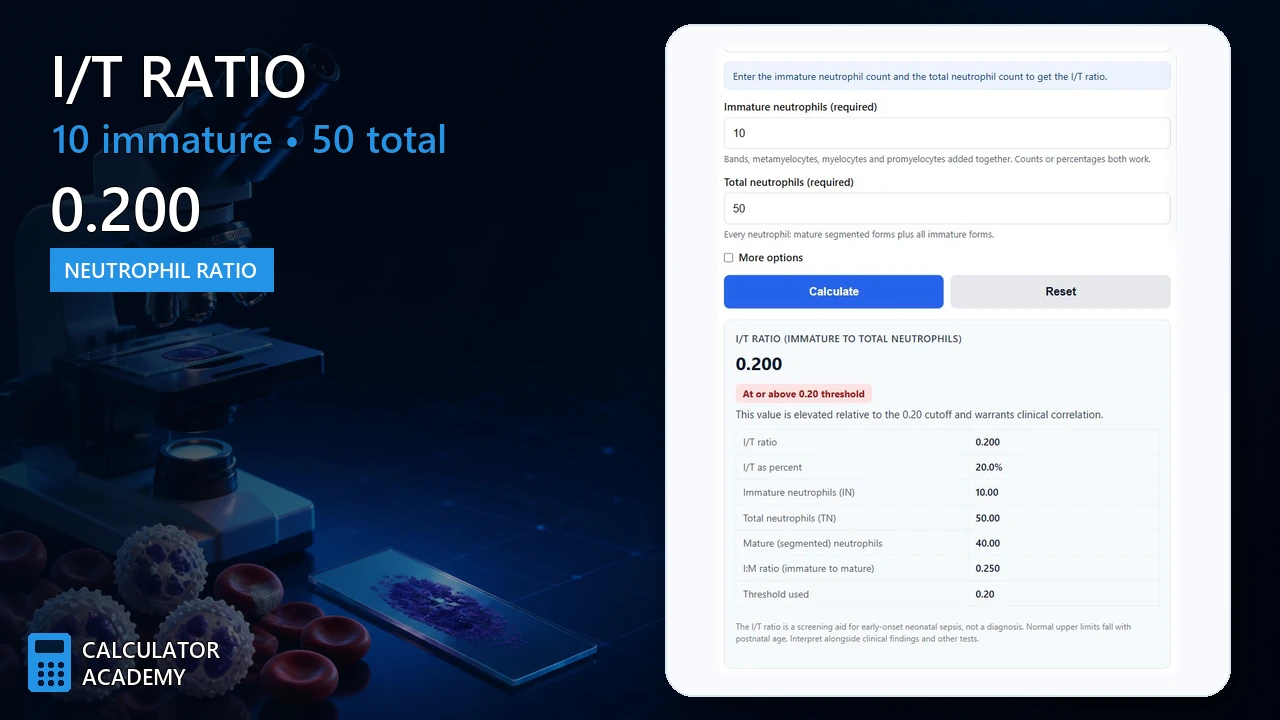
Enter the total immature neutrophils and total neutrophils into the calculator to determine the I/T Ratio. You can also calculate it use differential or ANC.
Related Calculators
- Neutrophil-Lymphocyte Ratio Calculator
- Platelet-Lymphocyte Ratio Calculator
- WBC Calculator
- Absolute Lymphocyte Count Calculator
- BUN Creatinine Ratio Calculator
- International Normalized Ratio Calculator
- All Math and Numbers Calculators
IT Ratio Formula
Formula source: Texas Children’s Hospital – Recognition of Neonatal Sepsis Workshop Slides (2024)
Where ITR is the I/T ratio (fraction 0 to 1, or percent), IN is the total immature neutrophil count, and TN is the total neutrophil count including both mature segmented forms and all immature precursors.
What counts as immature (IN): bands (stabs), metamyelocytes, myelocytes, and promyelocytes. Segmented neutrophils (segs) are mature and contribute only to TN, not IN. Automated analyzers report an immature granulocyte percentage (IG%) that approximates manual band counting; manual differentials remain the reference standard for clinical I/T ratio calculation.
I/T Ratio Reference Ranges
The upper limit of normal is age-dependent in neonates. Physiologic neutrophilia peaks immediately after birth and declines progressively over the first 72 hours of life.
| Postnatal Age | Upper Limit of Normal | Sepsis Threshold |
|---|---|---|
| 0 to 24 hours | 0.16 | >0.20 |
| 24 to 60 hours | 0.14 | >0.20 |
| After 60 hours | 0.12 | >0.20 |
An I/T ratio above 0.25 carries a likelihood ratio of 33.8 (95% CI: 8.6 to 132.4) for predicting neonatal sepsis, with 96.4% sensitivity reported in prospective study. A ratio at or below the age-specific upper limit substantially reduces the probability of early-onset sepsis (EOS).
Diagnostic Performance
| Threshold | Sensitivity | Specificity | PPV | NPV |
|---|---|---|---|---|
| I/T >0.20 | 82.4% | 81.3% | 92.5% | 62.2% |
| I/T >0.20 (pooled) | 76.5% | 83.8% | 54.2% | 93.4% |
| I/T >0.25 | 96.4% | Varies by population | Not pooled | Not pooled |
The high NPV (above 93%) makes a normal I/T ratio most useful for ruling out sepsis rather than confirming it. Approximately 25 to 50 percent of culture-negative neonates may have an I/T ratio above 0.20 from non-infectious causes, limiting the PPV in low-prevalence populations.
Non-Infectious Causes of Elevated I/T Ratio
Any condition that accelerates bone marrow release of immature neutrophils can raise the I/T ratio without infection: perinatal asphyxia, meconium aspiration syndrome, respiratory distress syndrome, maternal hypertension or pre-eclampsia, intracranial hemorrhage, hemolytic disease of the newborn, and administration of corticosteroids or parenteral nutrition. CBCs collected before 4 hours of age may reflect the physiologic stress of delivery rather than infection.
I/T Ratio vs. Other Neonatal Sepsis Markers
| Marker | Earliest Rise | Sensitivity | Specificity | Key Limitation |
|---|---|---|---|---|
| I/T ratio | At birth | 60 to 90% | 50 to 75% | High false-positive rate from non-infectious stress |
| ANC | At birth | Moderate | 63% | Requires age-adjusted normal range |
| CRP | 6 to 12 hours after onset | High (after 12h) | High | Not useful in first 6 hours of infection |
| Procalcitonin (PCT) | 4 to 6 hours after onset | High | Moderate | Physiologically elevated in first 24h of life |
| I/T2 (I / T squared) | At birth | 68% | 78% | Not yet in routine use; requires further validation |
A normal I/T ratio combined with a negative CRP is the strongest standard-CBC combination for ruling out EOS. In adults, mean neutrophil volume (MNV) significantly outperforms the I/T ratio for sepsis detection (AUC 0.85 vs. 0.70 for bacterial infection).
I/T2 Ratio
The I/T2 ratio (Immature / Total squared) was proposed to capture the combined predictive power of both the I/T ratio and the ANC in a single value. At a fixed 68% sensitivity, I/T2 achieved 78% specificity, outperforming both the I/T ratio (73%) and the ANC (63%) separately. The formula penalizes high total neutrophil counts more heavily than the standard I/T ratio, making it better at distinguishing infection-driven left shift from physiologic neonatal neutrophilia. It is not yet standard practice and awaits broader clinical validation.
CBC Timing and Serial Monitoring
Diagnostic accuracy improves substantially when the CBC is drawn at 4 hours of age or later rather than immediately at birth. Serial CBCs at 6 to 12 hour intervals are more informative than a single early result: a persistently elevated or rising I/T ratio supports infection, while normalization over 12 to 24 hours is consistent with physiologic birth stress. For low-risk neonates with an initially normal I/T ratio, a single repeat CBC at 6 to 8 hours is generally sufficient for EOS screening.